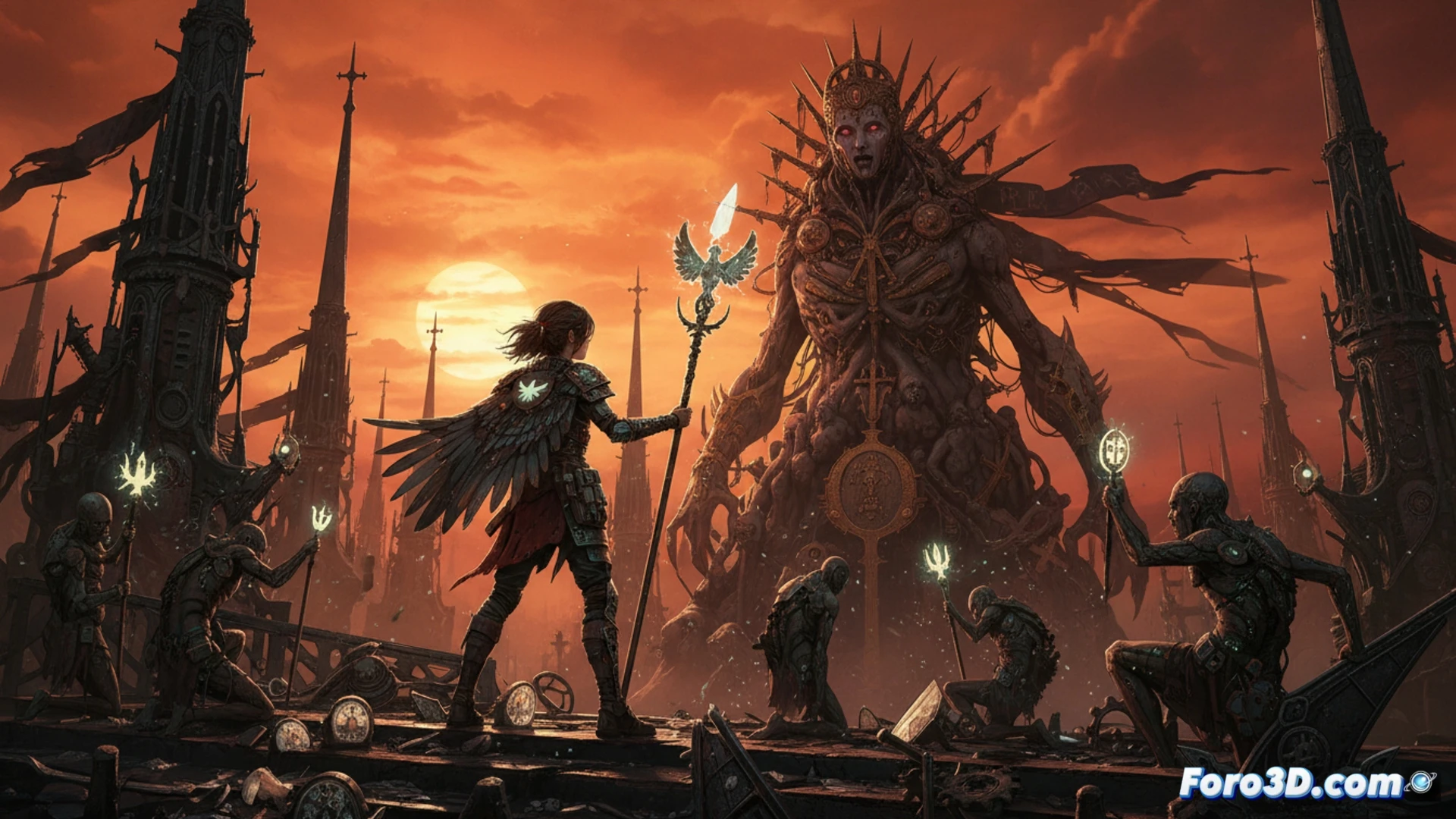
The work Little Bird, signed by Darcy Van Poelgeest and Ian Bertram, immerses us in a dystopian North America where a theocratic regime oppresses the population. Through the eyes of a young warrior, the narrative explores the struggle for freedom in a setting that combines horror and beauty. This analysis focuses on how intricate detail and grotesque forms, enhanced by 3D modeling, build a universe of political resistance.
Organic modeling and digital architecture for denunciation 🎨
Bertram's visual style, evoking Moebius and Frank Quitely, finds in 3D technology a perfect vehicle to capture its complexity. The architecture and organic technology that appear in the work are not mere backdrops; they are an extension of the conflict. Each twisted structure and each grotesque biomechanism function as metaphors for authoritarian control. Three-dimensional modeling allows for layers of detail that would be almost impossible to manage in traditional drawing, offering a visual density that immerses the reader in the regime's oppression and the rawness of the rebellion.
Computer-generated art as a tool for activism 🖥️
In the context of digital activism, Little Bird demonstrates that computer-generated art is not merely an aesthetic exercise, but a powerful tool for denunciation. By depicting resistance against a theocratic system, the work directly connects with contemporary struggles for freedom of expression and human rights. The organic and grotesque aesthetic, far from alienating, humanizes the struggle by showing the deformity that power imposes, inviting the viewer to reflect on current authoritarian regimes through a digital window of high visual complexity.
As a content creator for a blog specialized in art and digital activism, how can the visual aesthetic of Little Bird inspire 3D artists to develop narratives of resistance against authoritarian regimes in the digital space?
(PS: pixels also have rights... or at least that's what my latest render says)