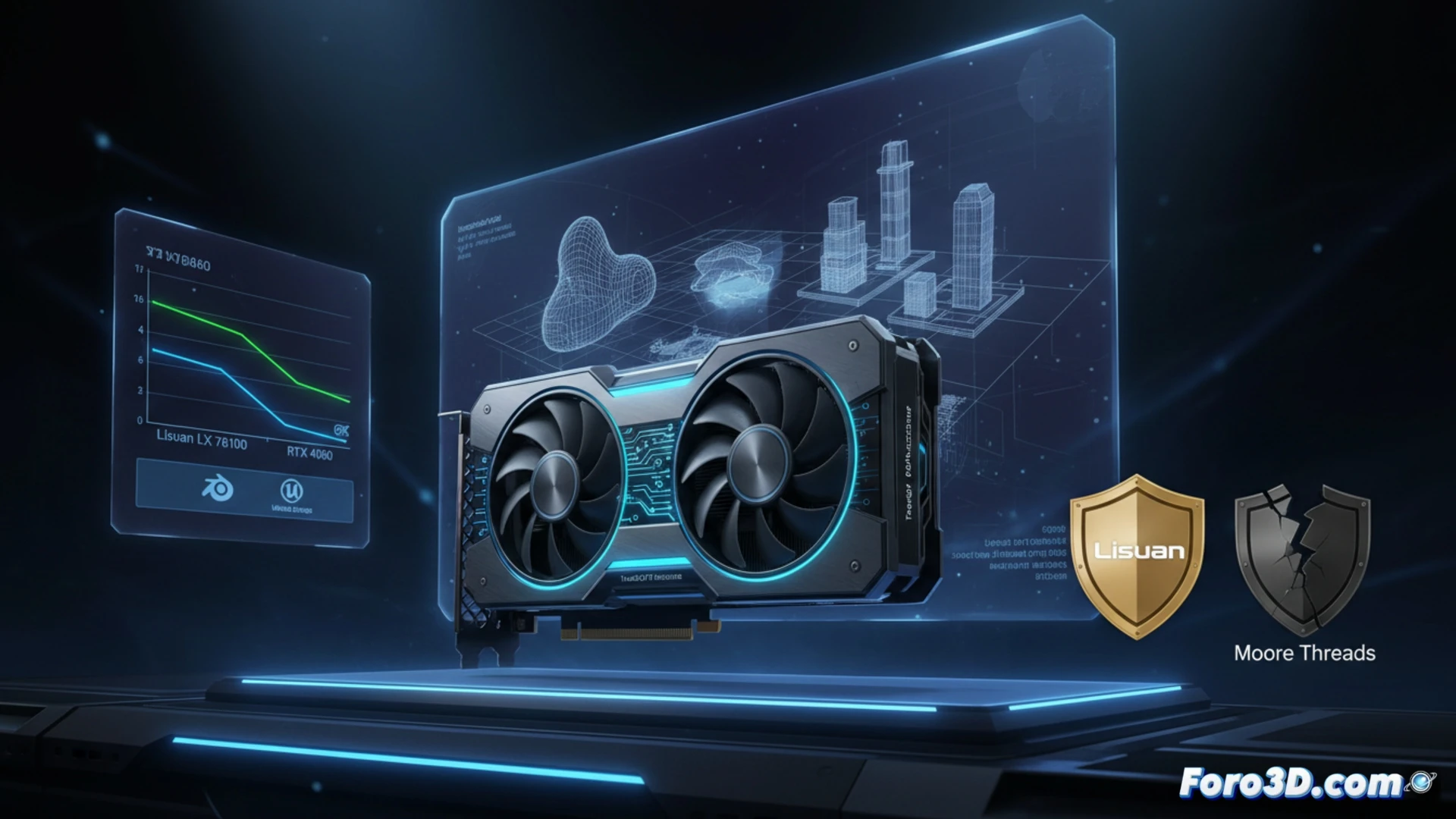
The first independent analyses of the Lisuan LX 7G100, based on the TrueGPU architecture, show that China has managed to produce a graphics card capable of running modern games with native support for DirectX 12. However, for the 3D professional, performance in applications like Blender and Unreal Engine reveals a significant gap compared to the GeForce RTX 4060. The Founder Edition shows inferior performance in rasterization rendering and ray tracing tasks, although it manages to load complex scenes without critical display errors. This advancement positions Lisuan ahead of local competitors like Moore Threads, which required months of driver optimization to achieve similar stability.
Technical Analysis: Performance in Blender, Unreal Engine, and Simulations 🖥️
In rendering tests with Blender 4.0, the LX 7G100 completed the Classroom benchmark in 12 minutes and 45 seconds, compared to 7 minutes and 20 seconds for the RTX 4060. The difference is accentuated in ray tracing tasks: in Unreal Engine 5.4 with Lumen enabled, the frame rate dropped to 18 FPS in an indoor scene, while the RTX 4060 maintained 45 FPS. For 3D modeling in Autodesk Maya, the Chinese GPU showed latencies of up to 200 ms when manipulating meshes of 5 million polygons, indicating that the drivers still lack optimization for professional workflows. In physical simulations with NVIDIA PhysX (via a compatibility layer), the card presented visual artifacts in particles, although without system crashes. Support for DirectX 12 Ultimate is complete, but the implementation of Shader Model 6.7 is partial, which limits the use of advanced techniques like variable rate shading.
Professional Viability: Price, Drivers, and Future in the 3D Market 🛠️
The main obstacle to adopting the LX 7G100 in a production studio is its price-to-performance ratio. With a cost close to 400 euros, it exceeds the RTX 4060 in price but offers between 40% and 50% less performance in 3D workloads. While game compatibility is broad, drivers for professional software like Cinema 4D or Substance 3D Painter are still in beta, with reports of texture flickering and lack of hardware acceleration for certain filters. For it to be a viable option, Lisuan needs to release an ISV-certified driver update and reduce the price to around 250 euros. Until then, the card is only recommended for independent developers looking to test alternative architectures or for educational environments where performance is not critical.
According to the first independent analyses, what key architectural and driver differences of the Lisuan LX 7G100 explain its performance in 3D rendering compared to the RTX 4060, and what software limitations could hinder its adoption in professional workflows?
(PS: Your CPU runs hotter than the Blender vs. Maya debate)