LightWave Digital has released LightWave 2026, an update that targets VFX and motion graphics workflows directly. The version introduces Advanced Placement, a system that places objects in a scene with real-time physics simulation, allowing them to stack or fall naturally under gravity, with the option to break upon collision. Also arriving are MotoRig for vehicle rigs and Fracture for controlled destruction.
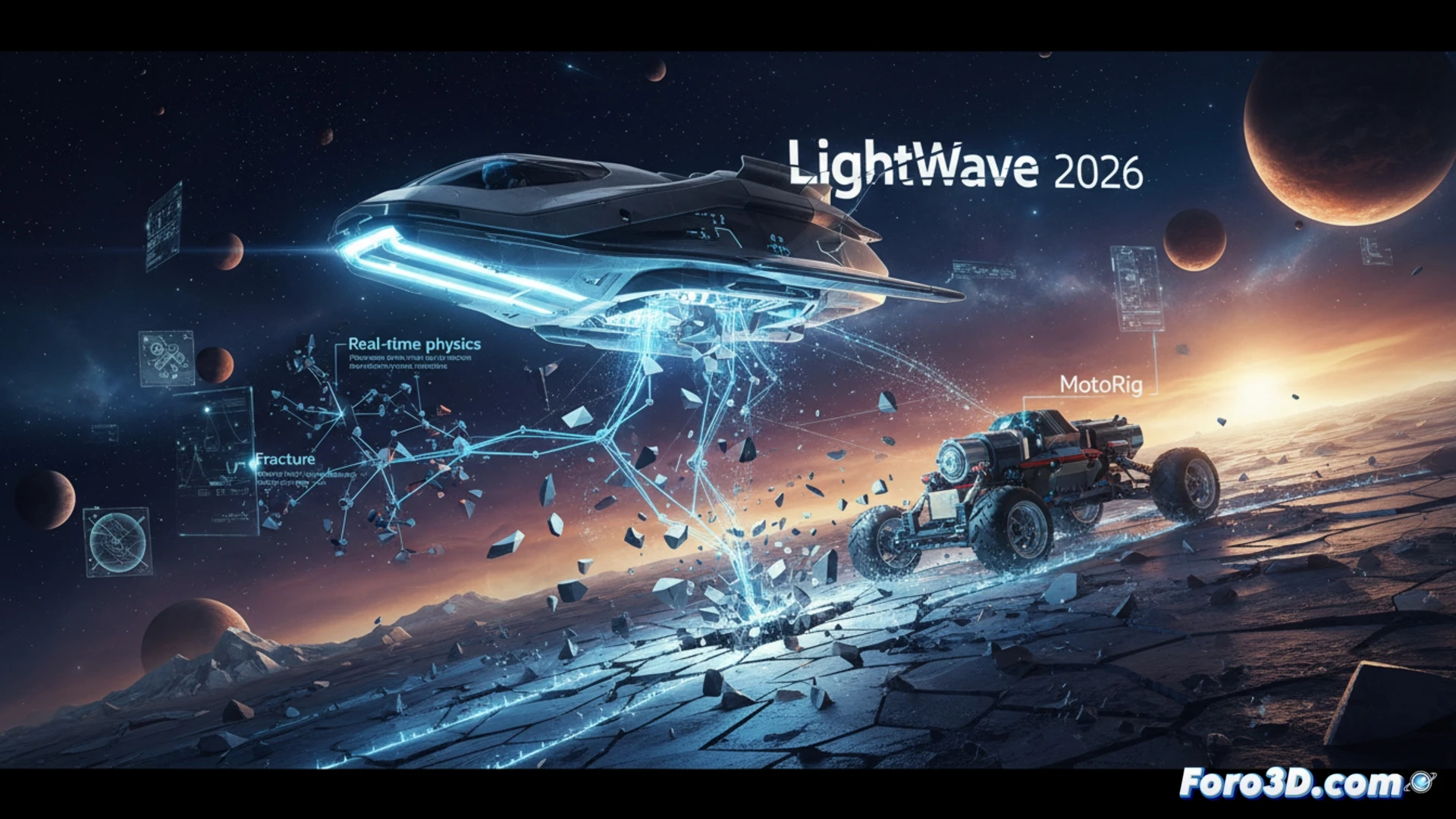
MotoRig and Fracture: automation for complex simulations 🚗
MotoRig allows you to assemble vehicles with four, six, or eight wheels, controlling mass, weight distribution, and suspension, all semi-automatically. On the other hand, Fracture pre-fragments geometry for destruction simulations, preserving materials and UVs, and works in real-time on simple meshes. Both tools aim to reduce manual work in repetitive rigging and effects tasks, giving the artist more time to fine-tune details.
When your virtual car needs alignment, not a workshop 🔧
Advanced Placement physics is perfect for those moments when you want a box to fall on another and not look like a bad joke. Of course, if your model fragments upon falling, remember it's not the software's fault, but your low-poly modeling. And with MotoRig, at least you'll know the virtual car has better suspension than your real one after years of potholes.