Last January, a critical section of the Permafrost Pipeline in Alaska suffered massive structural deformation. The failure, located at the Thermal Settlement, caused a controlled leak that forced the line to shut down. Immediately, an engineering team deployed aerial LiDAR scanning and buried geotechnical sensors to reconstruct the disaster's kinematics in 3D, diagnosing an asymmetric subsidence of 1.8 meters in less than 72 hours.
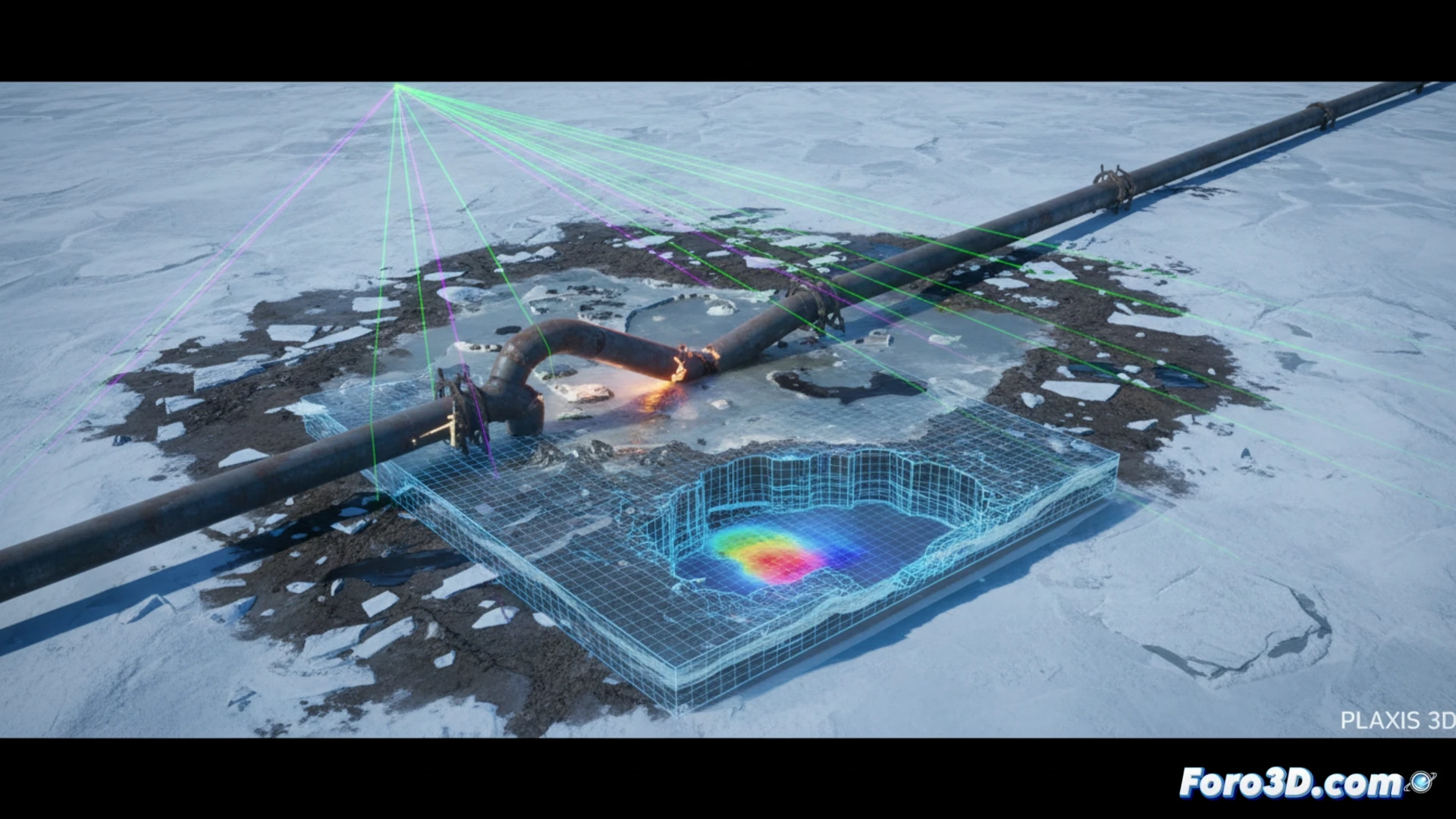
Geotechnical diagnosis with Civil 3D and PLAXIS 3D 🛠️
The LiDAR point cloud data was integrated into Global Mapper to generate a high-resolution elevation model. Subsequently, it was exported to Civil 3D to model the deformed geometry of the pipeline. The surprise came when running the thermo-mechanical simulation in PLAXIS 3D: the residual heat from the crude oil, circulating at 65 degrees Celsius, melted the underlying permafrost unevenly. The analysis showed that the ice layer on the south side of the duct liquefied first, generating a differential settlement that exceeded the rotation capacity of the expansion joint, breaking it by pure shear.
Lessons for Arctic infrastructure ❄️
This event replicates patterns seen in the 2006 Prudhoe Bay disaster, but with a key difference: 3D modeling allowed predicting the failure hours before the total rupture. The lesson is clear: current expansion joints are not designed for asymmetric subsidence accelerated by climate change. To prevent future catastrophes, it is recommended to install active permafrost cooling systems and redesign the joints with multidirectional compensation capacity, validated through thermal simulations in PLAXIS 3D.
The article mentions that LiDAR and PLAXIS 3D were key to analyzing the thermal collapse, but how could this data be integrated in real-time with IoT sensors to predict and prevent similar failures in other sections of the pipeline before they occur.
(PS: Simulating catastrophes is fun until the computer crashes and you are the catastrophe.)