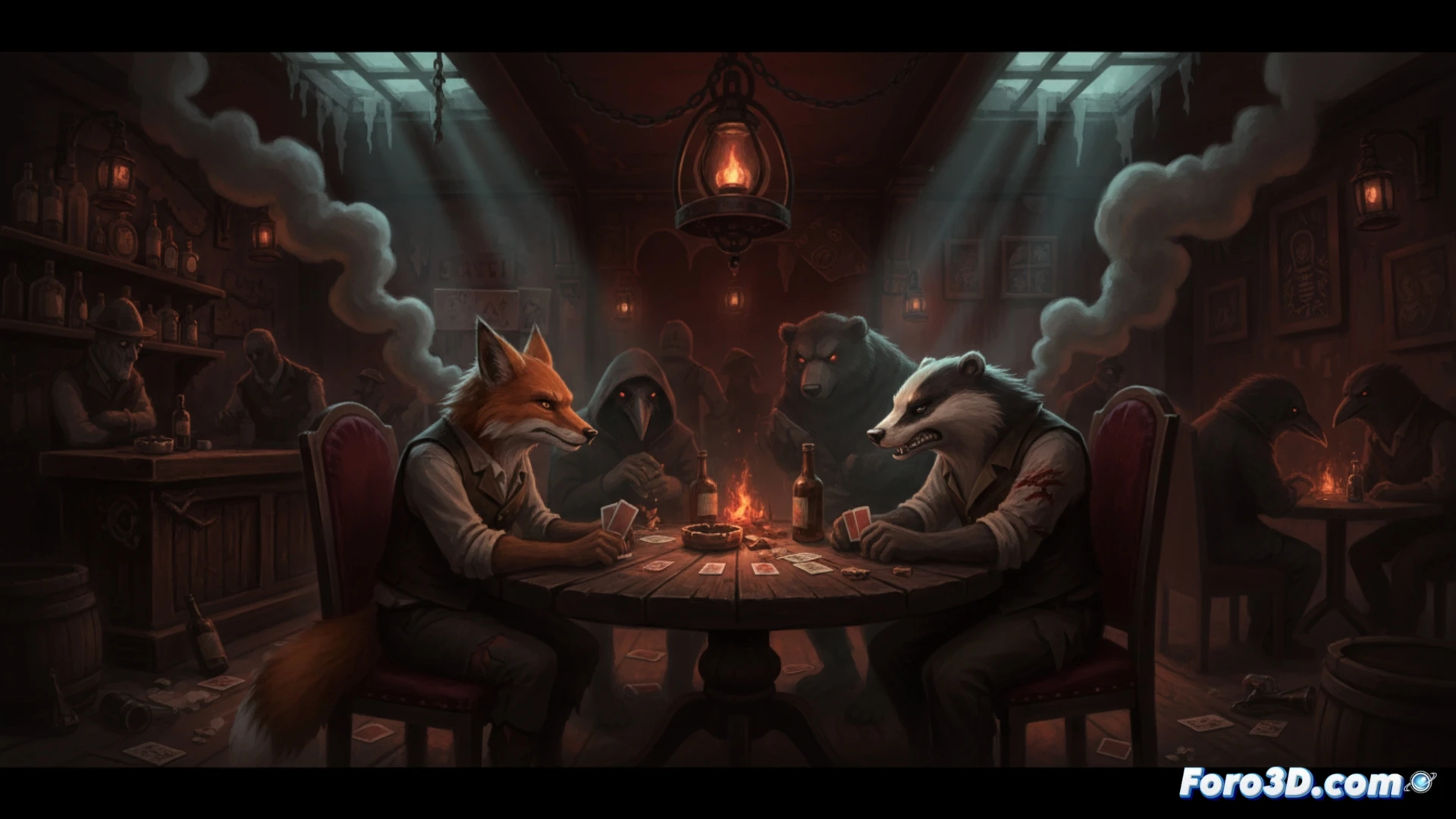
The independent study behind Liar's Bar demonstrates that atmosphere is everything. The game, built in Unity, immerses us in a clandestine den where lying is the currency of the realm. The key to its visual success lies in the fusion of two tools: ZBrush for sculpting anthropomorphic characters and the Unity graphics engine for managing projected shadows and volumetric smoke. This combination not only beautifies but defines the gameplay, creating an oppressive space where every bluff feels like a sentence.
Technical Construction: Optimization of Shadows and Real-Time Volumetrics 🎲
The biggest technical challenge of Liar's Bar is maintaining dynamic lighting and volumetric smoke without sacrificing performance. The characters, sculpted with high detail in ZBrush, are retopologized in Unity to maintain a manageable polygon count. Lighting relies on real-time projected shadows from point sources (such as table lamps), which are combined with a particle-based smoke system. To avoid excessive cost, an occlusion system is used that attenuates smoke in areas not visible to the camera. The character textures, with a marked digital painting style, receive a normal map layer that enhances chiaroscuro, making the players' lies seem sculpted in the shadows.
The Visual Language of Deception 🃏
Beyond the technique, Liar's Bar uses lighting as a silent narrator. The hard shadows not only hide the cards but amplify the tension of each round. The volumetric smoke, rather than being a mere aesthetic effect, acts as a veil that separates the table from the rest of the world, isolating players in their own drama. This design demonstrates that in indie development, art direction and technical optimization are not enemies; they are two sides of the same coin, necessary to sell a fantasy as dirty and dangerous as a con in a dead-end alley.
Considering that Liar's Bar uses Unity as its engine and ZBrush for modeling, what do you think was the biggest technical challenge in integrating high-polygon assets from ZBrush into the Unity pipeline without compromising performance, while maintaining that dense and detailed hellish atmosphere?
(PS: game jams are like weddings: everyone is happy, nobody sleeps, and you end up crying)