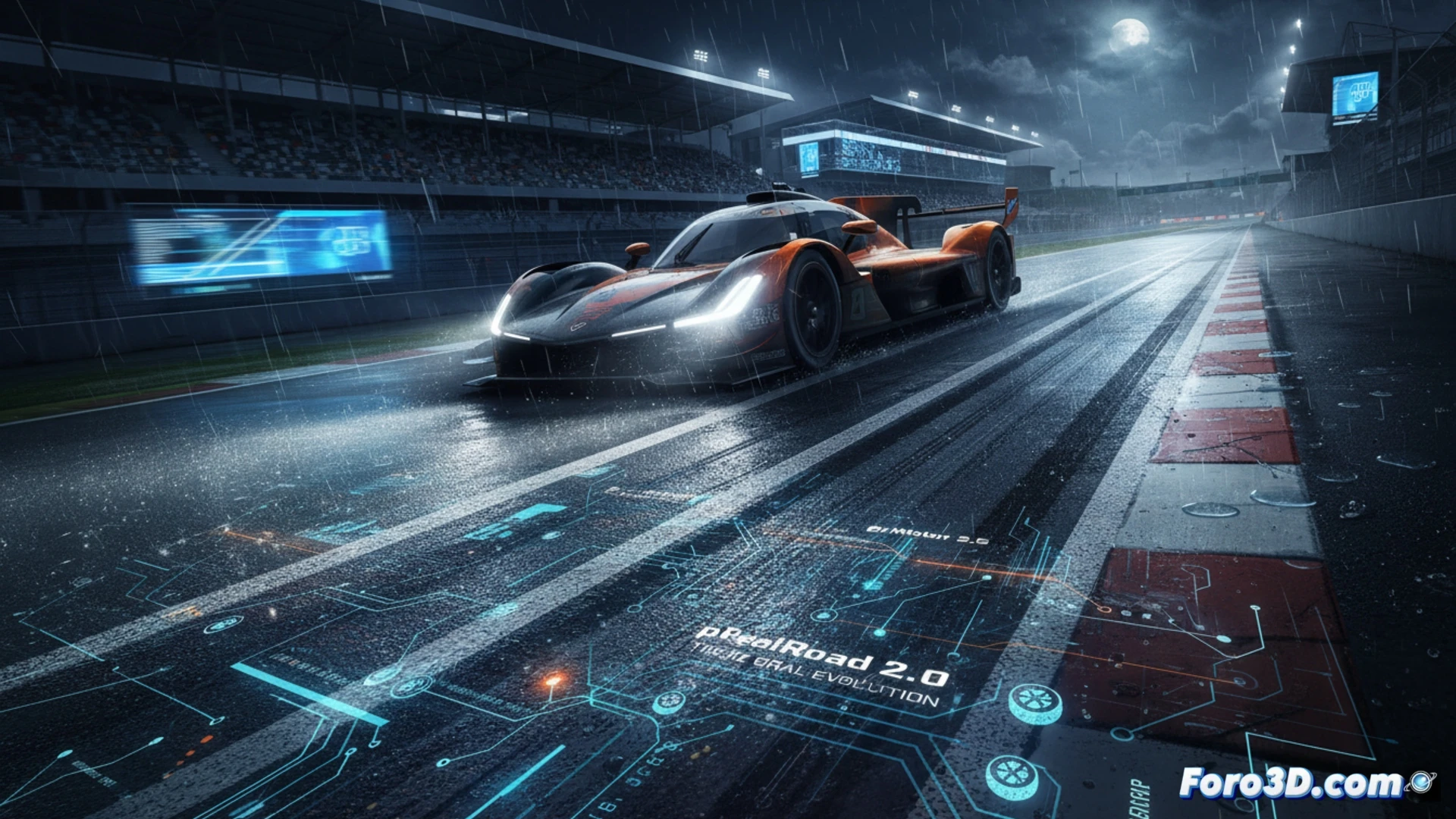
Le Mans Ultimate, developed on the pMotor 2.5 engine (derived from rFactor 2), represents a milestone in racing simulation thanks to the implementation of the RealRoad 2.0 system. This engine allows for a physical evolution of the asphalt in real time, managing variables such as track rubbering and the dynamic accumulation of water during rain. The result is a surface that changes its coefficient of friction lap by lap, requiring constant recalibration of the tire model to maintain grip.
Technical workflow: 3ds Max and Substance Designer for Hypercars 🏎️
The creation of materials for the Hypercars in Le Mans Ultimate follows a pipeline optimized for real time. In 3ds Max, high-detail geometry (High Poly) is modeled, and the low-resolution shell (Low Poly) is generated with baked normal maps. Subsequently, Substance Designer handles the procedural creation of complex materials: multi-layer paint with flake effect, carbon fiber with variable weave orientation, and diffusers with wear from use. The key lies in texture compression (BC7) and the use of occlusion maps to maintain visual fidelity without sacrificing the stable 60 FPS required by competition.
The simulation paradox: realism vs. playability ⚖️
While the RealRoad 2.0 system offers impeccable physical precision by replicating asphalt rubbering or aquaplaning in flooded areas, a reflection on experience design arises. A simulator must balance raw physics with playability; an excess of realism in track evolution can become frustrating for the casual player. The challenge for Le Mans Ultimate developers is to calibrate these parameters so that the change in grip is noticeable and rewarding, without becoming an obstacle that breaks immersion.
How does the RealRoad 2.0 system in Le Mans Ultimate manage to replicate the micro-variations of asphalt and track degradation to affect the dynamic behavior of the vehicle in real time, and what key technical differences does it present compared to the implementation of dynamic surfaces in other racing simulators?
(PS: optimizing for mobile is like trying to fit an elephant into a Mini Cooper)