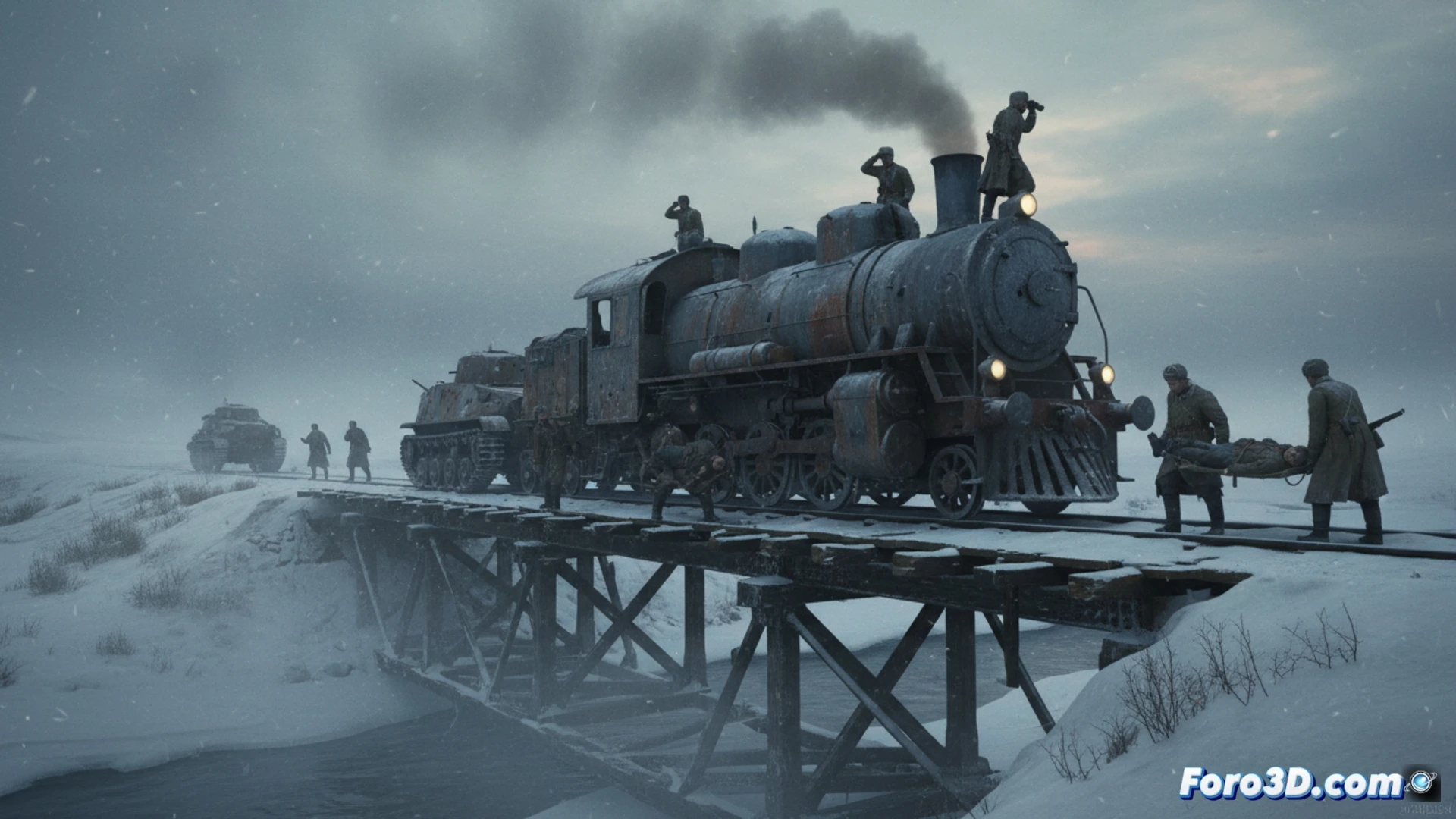
Ashborne Games studio has released Last Train Home, a real-time strategy title that stands out for its realistic and desaturated graphical approach. Set in the harshness of the Russian Civil War, the game uses Unreal Engine 4 as its technical backbone. Far from vibrant colors, the engine manages a cold and dusty palette that reinforces the survival narrative. We analyze the workflow behind its armored vehicles and ragged characters. 🚂
Workflow: From ZBrush to Unreal Engine 4 🎨
To achieve the detail in the soldiers' faces and the rusted sheet metal of the armored trains, the team combined Autodesk Maya for base retopology with ZBrush for high-resolution details, such as wrinkles in uniforms and impact marks on metals. Subsequently, they applied Quixel Megascans textures to add dirt and realistic wear. The technical key was optimization in Unreal Engine 4, using aggressive LODs (levels of detail) and texture atlases to maintain 60 FPS in scenes with dozens of soldiers. The engine's volumetric lighting, combined with dynamic fog, recreates the oppressive atmosphere of the Siberian battlefronts.
The Art of Narrative Desaturation 🎭
The historical realism of Last Train Home relies not only on polygonal fidelity but on a coherent art direction. The decision to desaturate colors is not a simple post-processing filter; it is a design choice that affects material creation. In Unreal Engine 4, the materials for characters and vehicles are configured with high roughness and low reflectance, simulating dirty fabrics and unpolished metals. This demonstrates that, in video game development, the engine is a tool, but the artistic vision is what defines the final immersion.
How would you approach lighting in this level?