Since 1971, the floor of a house in Jaén, Spain, has been the setting of a mystery that defies chemistry and logic: the Faces of Bélmez. These human-shaped pigmentations have withstood decades of conventional analysis. However, digital archaeology offers a new way to approach this controversial heritage, applying three-dimensional scanning techniques and photogrammetry to document, analyze, and digitally preserve these manifestations without relying on traditional explanations.
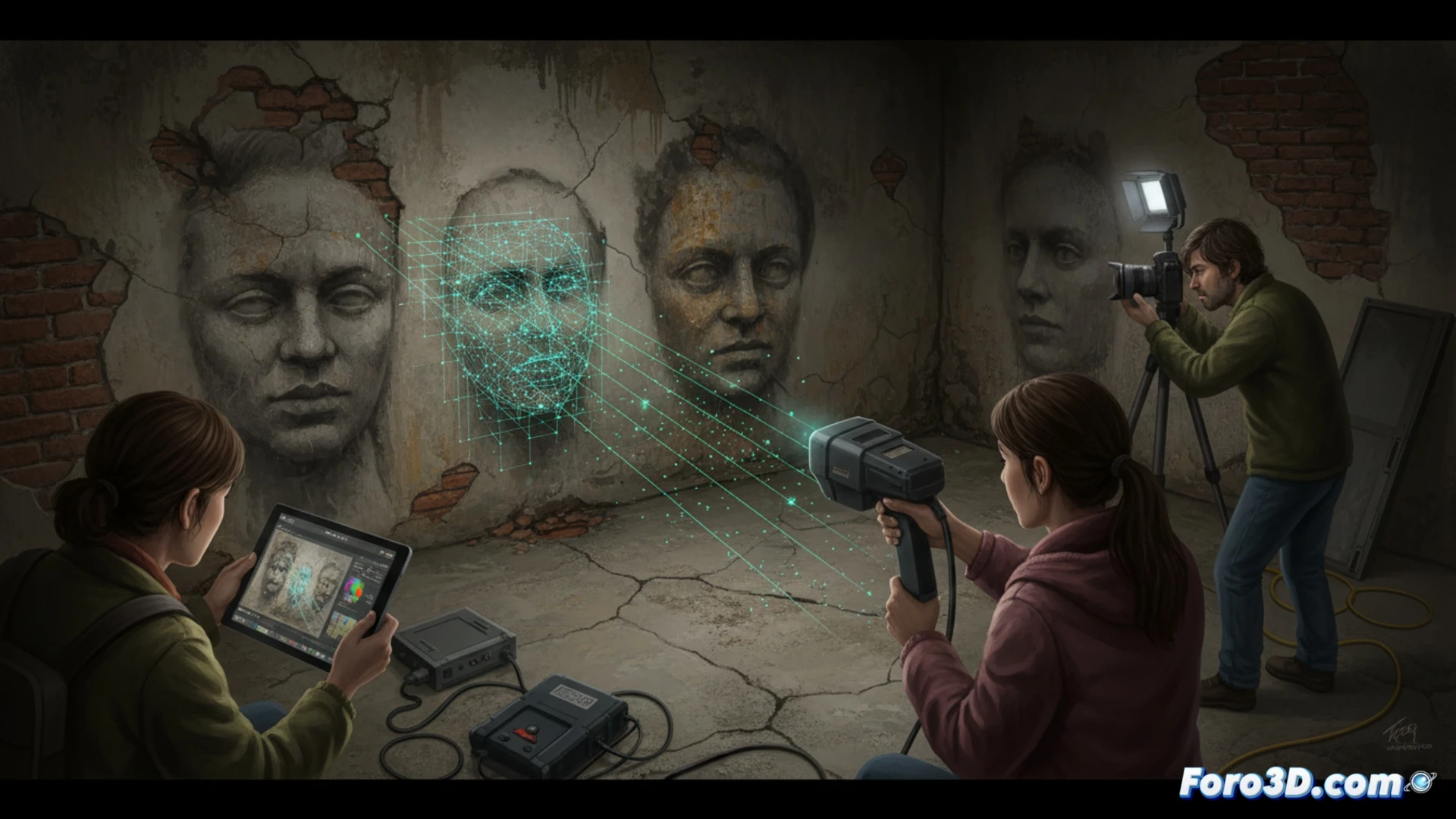
Photogrammetry and 3D Modeling: Forensic Methodology 🕵️
The application of high-resolution photogrammetry allows capturing every micro-variation of the surface where the faces appear. By overlaying digital models obtained on different dates, researchers can quantify the evolution of the stains, detecting changes in pigmentation or millimeter-scale structural alterations. This approach not only rules out possible fraud (such as repainting or external interventions) but also generates a 3D database that enables virtual chemical analysis. Structured light scanning reveals the porosity of the cement and the exact interaction of the pigments with the base material, offering clues about their organic or mineral origin.
Digital Preservation of an Elusive Legacy 💾
Beyond the controversy, the Faces of Bélmez represent a unique cultural heritage that deserves protection from physical degradation. The creation of digital twins allows the global scientific community to study the phenomenon without manipulating the original work. If the mystery is never solved, at least 3D technology will ensure that future generations can access an exact replica of this enigma, preserving both its form and its history for perpetual analysis.
What is the most suitable 3D scanning methodology to document the Faces of Bélmez without altering their surface or interfering with the unexplained phenomenon they have exhibited since 1971?
(PS: and remember: if you can't find a bone, you can always model it yourself)