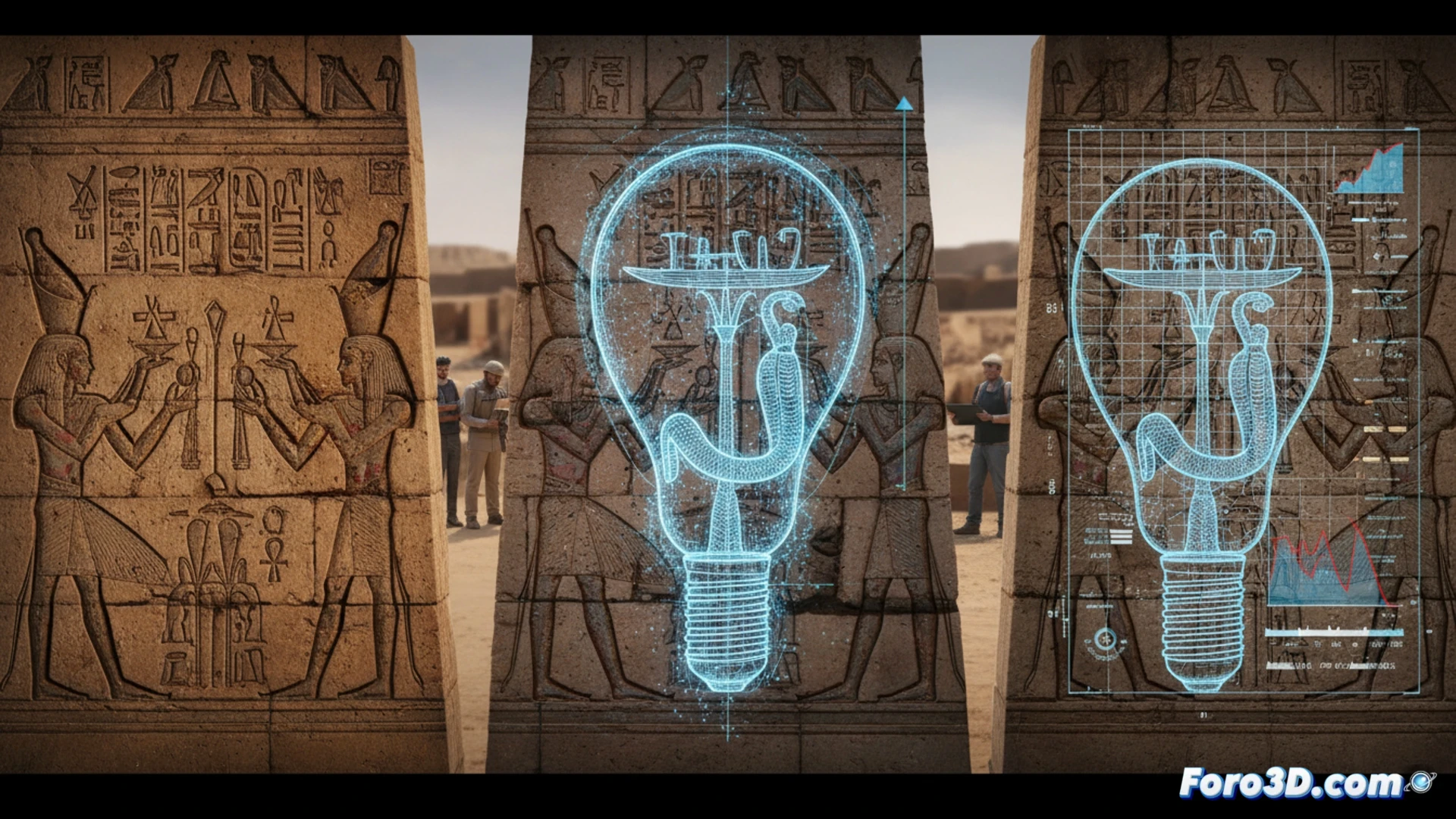
The bas-reliefs of the Temple of Hathor in Dendera have fueled theories about supposed electrical technology in Ancient Egypt for decades. The figures resembling bulbs, filaments, and wires have been interpreted as cold light lamps, but digital archaeology today offers tools to dismantle these hypotheses through metric analysis and virtual reconstruction of the original context.
Photogrammetry and 3D modeling for epigraphic study 🏛️
The application of high-resolution photogrammetry on the reliefs of the southeast crypt allows capturing every micro-detail of the carving, from the depth of the chisel to the orientation of the figures. By generating a textured three-dimensional mesh, researchers can rotate the scene, adjust virtual lighting, and eliminate deceptive shadows that distort perception. This workflow reveals that the supposed light bulbs are actually representations of the divine serpent Mehen emerging from a lotus flower, a symbol of solar rebirth. The serpentine cable is not an electrical conductor, but the plant stem, and the filament corresponds to the body of the deity.
Symbolic reconstruction versus pseudoscience 🔍
3D modeling serves not only for measurement but also to return the image to its architectural and mythological context. By placing the reliefs in a virtual recreation of the crypt, it becomes clear that the scene is part of a cycle about the creation of the world, not a technical manual. Digital archaeology thus acts as a critical filter: it allows us to admire Egyptian symbolic sophistication without falling into anachronisms, demonstrating that sometimes the most advanced technology is the one that helps us read the past correctly.
How can digital analysis of the Dendera reliefs using 3D photogrammetry and spectral filters dismantle the pseudoscientific interpretation of the lamps as electrical technology, revealing instead their true religious and astronomical symbolism?
(PS: If you dig at a site and find a USB, don't plug it in: it could be Roman malware.)