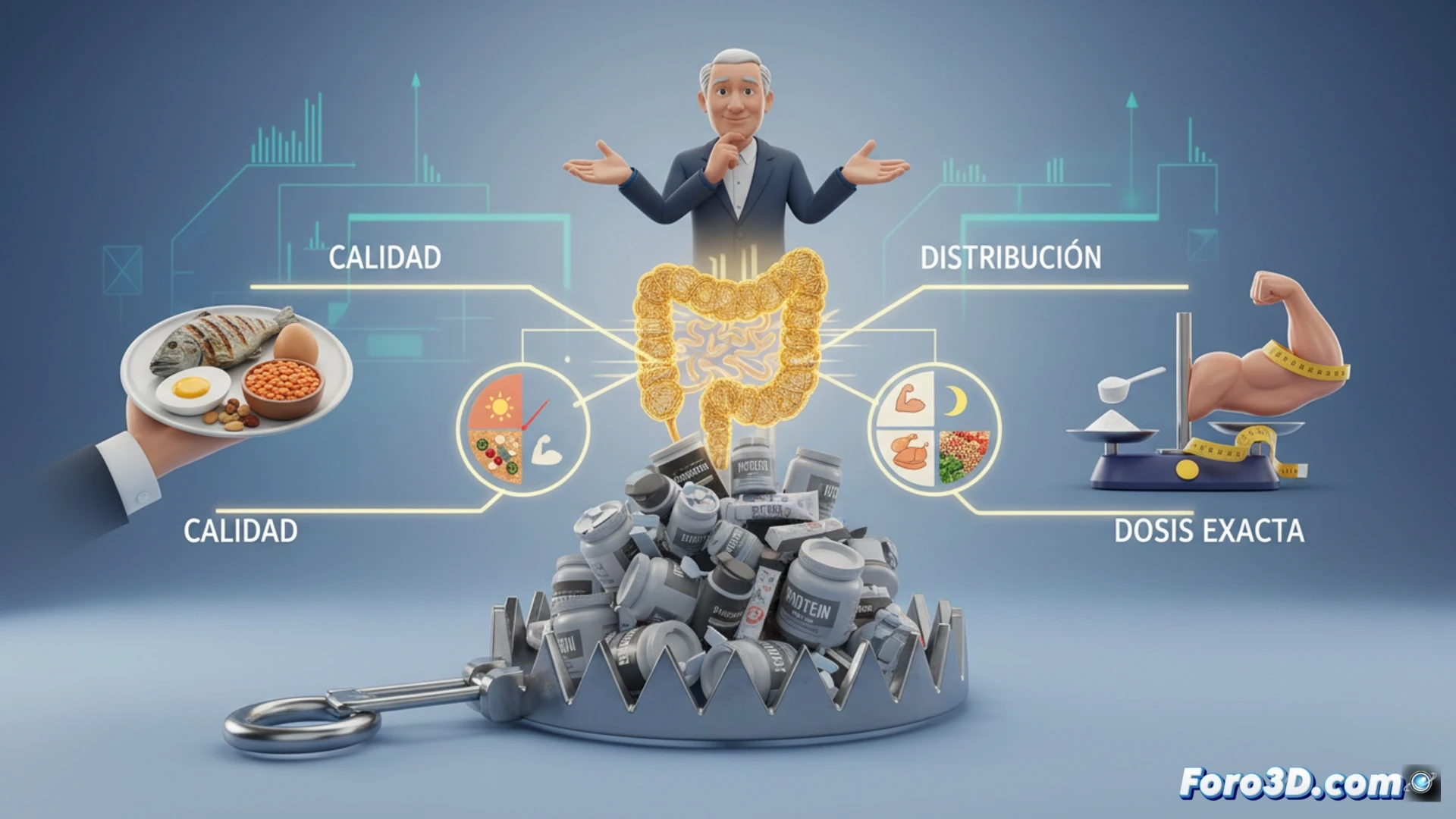
Dr. Donald Layman, a pioneer in protein research, issues a key warning: the obsession with this nutrient has distorted its actual consumption. Many believe that more protein equals more muscle, but science proves otherwise. Layman points out that the focus should be on quality, distribution, and precise dosage, not on gorging on processed shakes and bars. This article breaks down the three fundamental pillars for intelligent intake, ideal for integrating into an educational 3D interactive infographic.
Technical parameters: dosage, distribution, and complete sources 🥩
Layman establishes an optimal range of 1.2 to 1.6 grams of protein per kilogram of body weight per day for those looking to maintain muscle mass or lose weight, surpassing the standard recommendation. The second critical point is timing distribution: it is more effective to spread intake across three main meals of 30 to 40 grams each than to concentrate it in a single massive dose. Finally, the quality of the source is decisive. Complete proteins, such as those from meat, eggs, dairy, and soy, contain the nine essential amino acids that the body cannot synthesize, unlike many incomplete plant proteins or processed isolates. For a 3D infographic, it is recommended to model these foods with a visual breakdown of amino acids and compare their profile against ultra-processed products labeled as high in protein.
The lost balance: why protein is not a superfood ⚖️
Layman warns that excess protein does not generate more muscle; it is simply eliminated or stored as fat. Furthermore, many processed products labeled as high in protein contain additives, sugars, and low-quality fats that make them far from healthy options. Nutrition education should focus on the overall context of the diet, not on fixation with a single nutrient. An interactive 3D infographic in schools or health apps can visually show how a balanced meal with natural protein, complex carbohydrates, and healthy fats outperforms any isolated supplement.
How we can apply Layman's principles of optimal protein intake to design 3D models of personalized plates that visualize the ideal macronutrient distribution and avoid protein excess in digital nutrition education
(PS: modeling an apple in 3D is easy; the hard part is making it not look like a sphere with red texture)