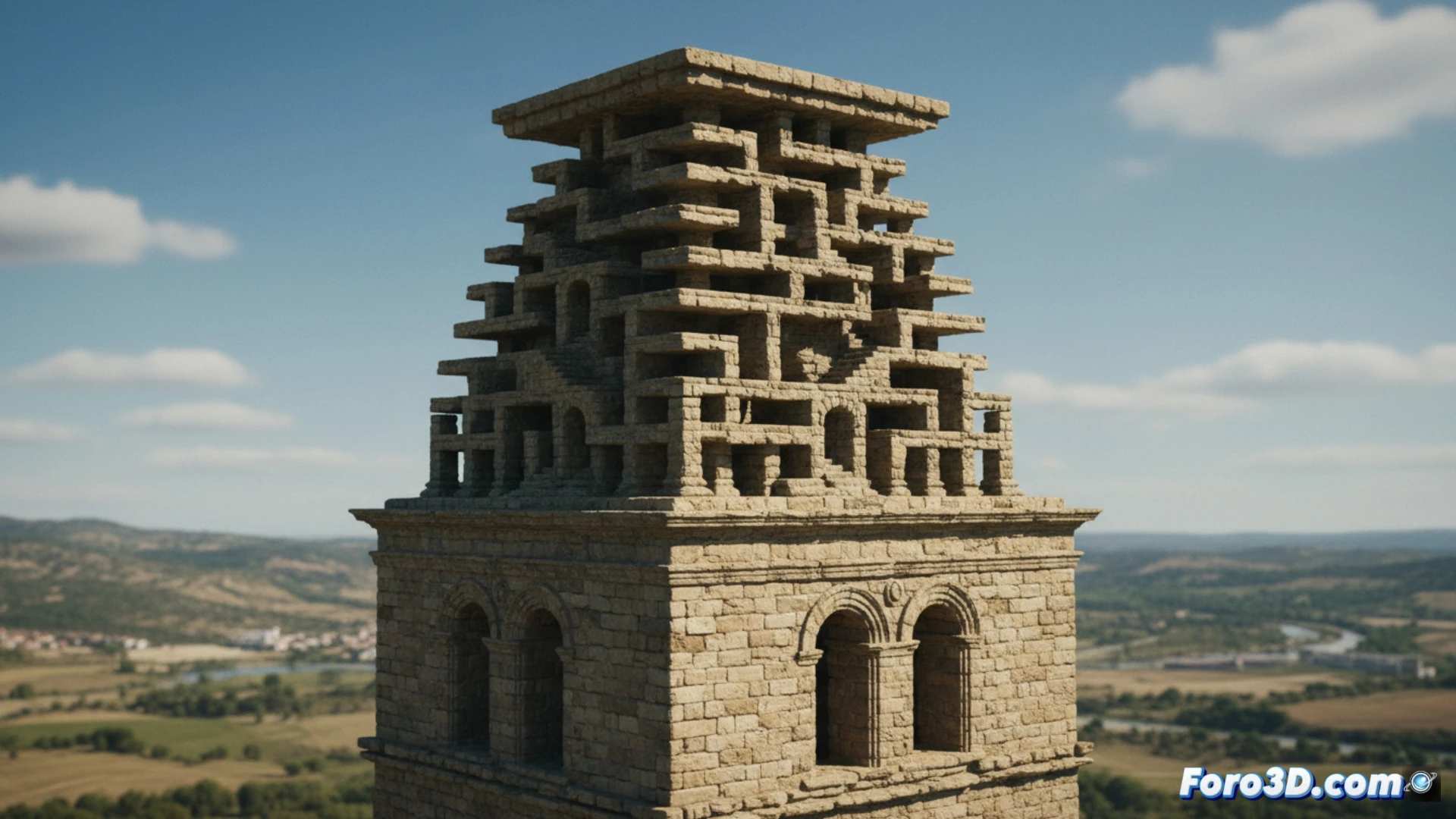
At mid-height, the tower of the Basilica of the Assumption in Cieza (Murcia) is interrupted by a flat top, a testament to an ambitious 18th-century project that was never completed. This block of stone, known as the Stone Labyrinth, is a construction enigma that digital archaeology can unravel. Drone photogrammetry and 3D modeling make it possible to document every crack and ashlar, offering a new tool to understand its history.
Documentation and virtual reconstruction through aerial photogrammetry 🏛️
The first step to unraveling this labyrinth is the massive capture of data. A drone equipped with a high-resolution camera flies over the tower, taking hundreds of images with an overlap of over 80%. These photographs are processed with Structure from Motion (SfM) software, generating a dense point cloud and a textured mesh model. This digital twin reproduces the current state of the structure with millimeter precision, including quarry marks and putlog holes. From this base, the original 18th-century project can be virtually reconstructed, adding the upper sections that were never erected, thus visualizing the architect's truncated ambition.
What does the stone tell us about the past? 🧱
Beyond simple documentation, the virtual model allows for a stratigraphic analysis of the masonry. We can isolate the different construction phases, identifying where and why the work stopped. Interactive visualization, accessible to any user, turns a static monument into an open book. This case study demonstrates that digital archaeology not only preserves heritage but also reinterprets it, offering an unprecedented perspective on the stone dreams that time left unfinished.
How can 3D modeling of the unfinished tower of the Basilica of the Assumption in Cieza help solve the construction enigmas of its abrupt interruption and reveal hidden phases of its architectural history?
(PS: If you dig at a site and find a USB drive, don't plug it in: it could be malware from the Romans.)