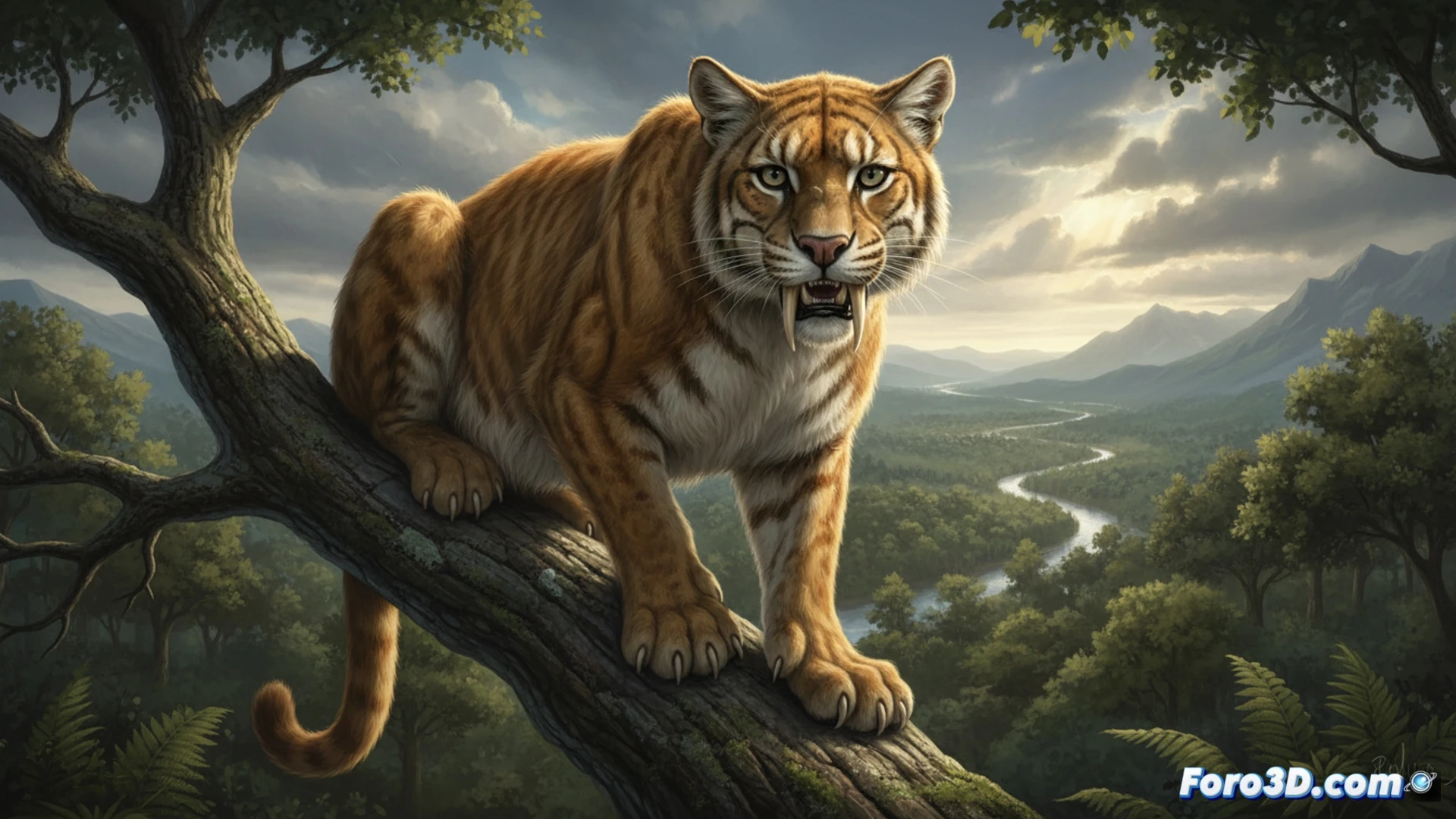
Scientists from the University of Florence have successfully reconstructed the brain of the saber-toothed tiger that inhabited Italy and Europe two million years ago. Using CT scans of fossil skulls, they discovered that this predator combined good vision and climbing skills, similar to modern pumas or jaguars. Although this has no direct impact on citizens' daily lives, the study reveals how science unravels the history of extinct species.
CT scans and fossils: technology at the service of paleontology 🦴
The team used high-resolution computed tomography on well-preserved fossil skulls. By digitizing the internal cavities, they generated 3D models of the brain tissue. The results indicate developed brain areas for stereoscopic vision and fine motor control, typical traits of felines that hunt in forests and climb trees. This non-invasive approach allows studying extinct species without damaging fossils, expanding knowledge about the evolution of big cats.
The tiger that didn't need a gym to climb 🐅
So the saber-tooth wasn't just a biting machine, but a climber with good eyesight. Imagine that prehistoric feline jumping from branch to branch, with half-meter fangs, looking for a prey for breakfast. Meanwhile, we can barely climb the subway stairs without tripping. At least, science confirms that two million years ago, felines already had an advantage over us in coordination.