In the depths of the Bruniquel cave, a 175,000-year-old knee print challenges our view of Neanderthals. This vestige, associated with an enigmatic circle of stalagmites, proves that our extinct cousins planned and executed complex works in total darkness. The discovery, more than a fossil, is an invitation to rethink their cognitive and social abilities, a mystery that modern technology helps us decipher.
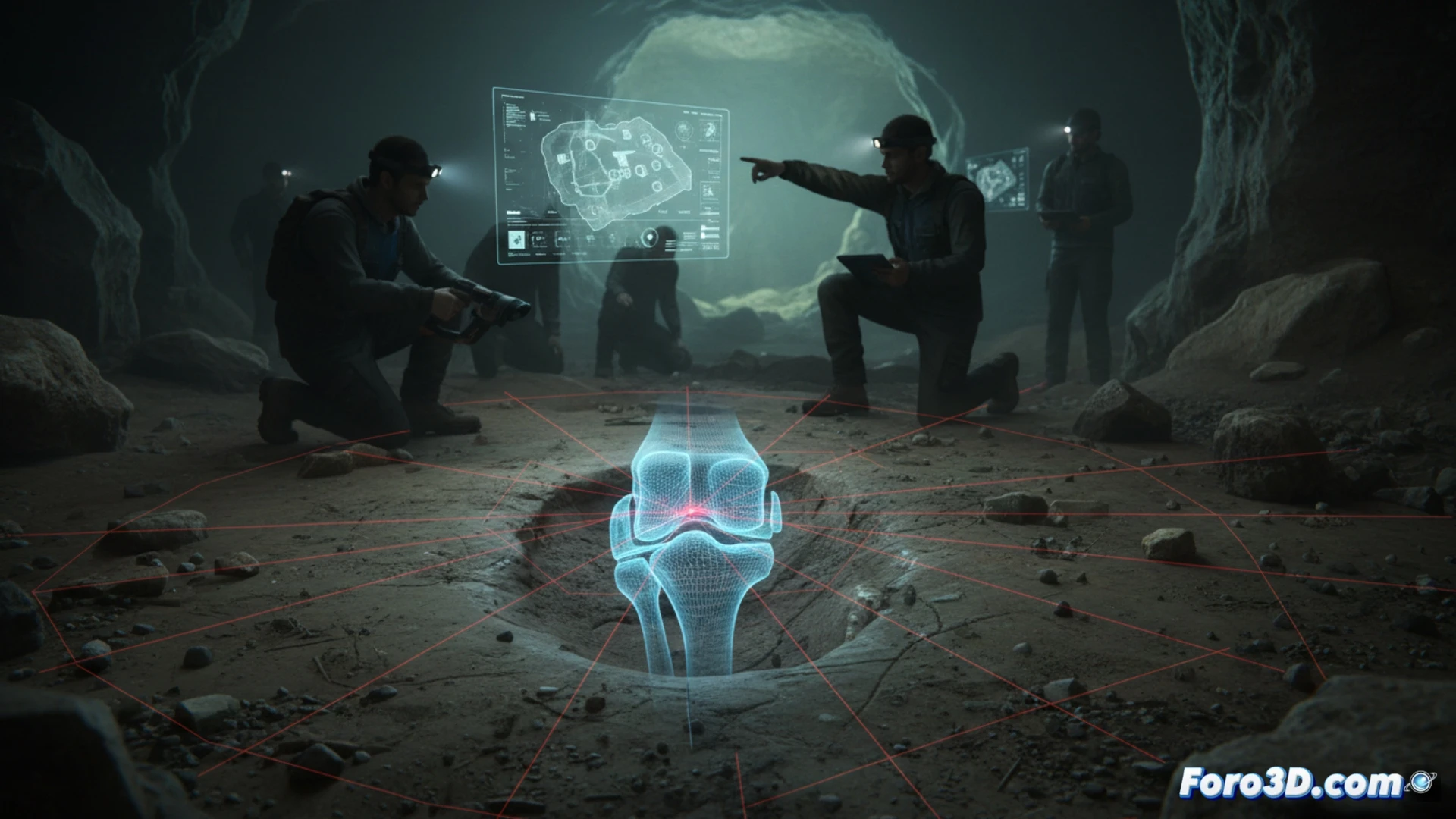
Photogrammetry and 3D scanning: the infallible eye in the cave 🏛️
The fragility of the clay and stalagmites prevents any direct contact. Therefore, archaeologists resort to high-resolution photogrammetry, capturing hundreds of images from millimeter angles to generate a textured 3D model of the print and the circle. This digital twin allows measuring the depth of the mark, the orientation of the fragments, and the wear without risk of damage. Additionally, laser scanning (LiDAR) reconstructs the exact topography of the cave, revealing how light, sound, and space influenced the location of the structure. Similar techniques have been used in caves such as Chauvet or Altamira to preserve rock art, demonstrating that intangible heritage is saved in the point cloud.
Simulating the past to understand the builder 🔍
With the digital model, researchers can perform reverse engineering simulations. By applying virtual forces to the modeled knee and broken stalagmites, it is tested whether the print served as a foothold for breaking rocks or as a ritual gesture. The virtual reconstruction of the assembly process, step by step, reveals Neanderthal logistics: how many individuals were needed, what lighting they used (bonfires or torches), and how they transported the fragments. Digitally preserving these vestiges not only prevents their deterioration but also allows any archaeologist in the world to manipulate the find and formulate new hypotheses about the minds of those who inhabited the darkness.
What 3D scanning and photogrammetry methodologies were used to digitize the Neanderthal knee print from Bruniquel and how has this process influenced the reinterpretation of the symbolic and social capacities of Neanderthals
(PS: and remember: if you can't find a bone, you can always model it yourself)