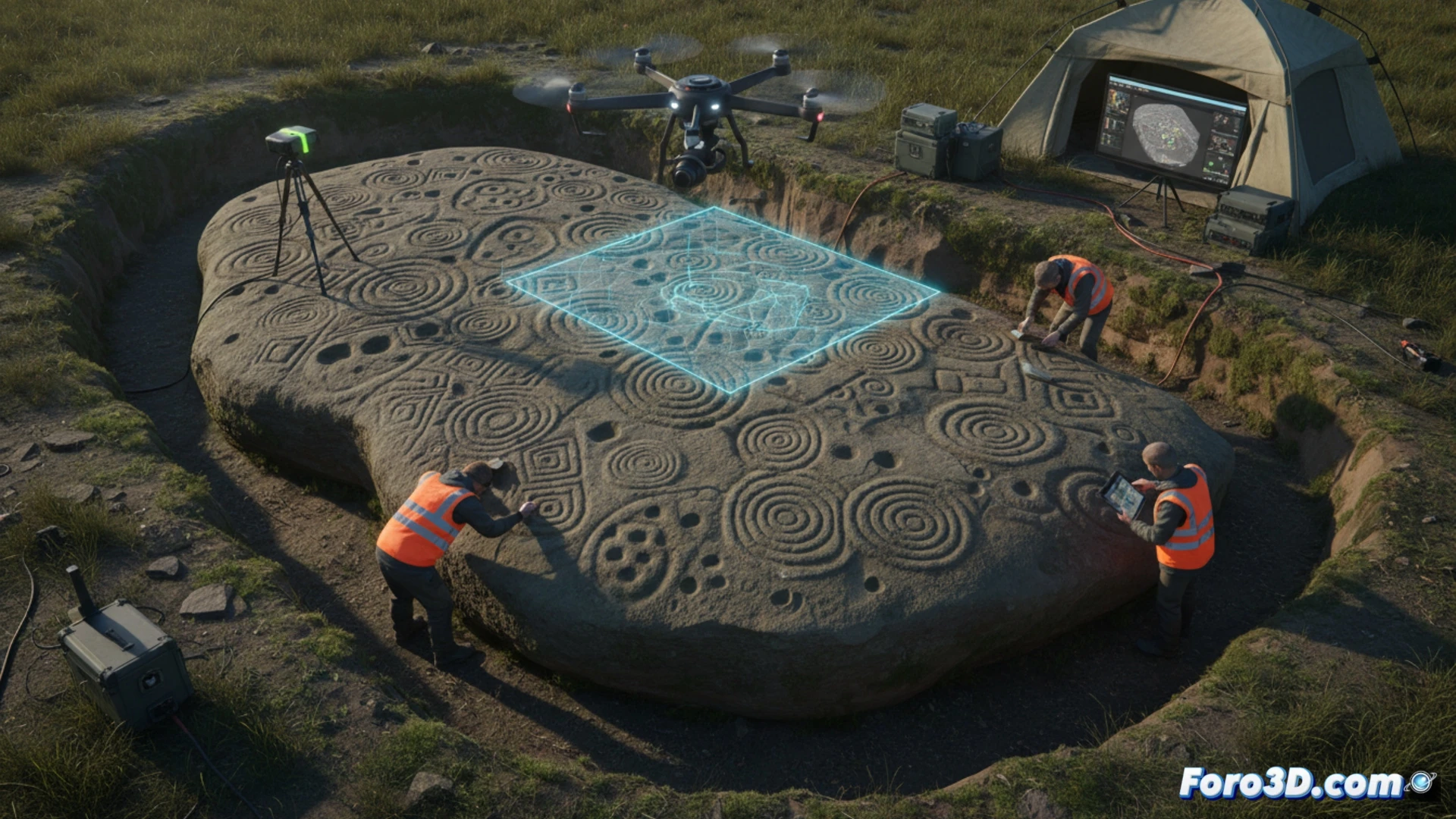
In the depths of Scotland, a 13-meter-long sandstone slab holds one of the greatest Neolithic enigmas. The Cochno Stone, discovered in 1887 and reburied in 1965 to protect it from vandalism, features hundreds of cup and ring mark carvings. Now, a team of archaeologists has unearthed the monument to apply the most advanced digital documentation techniques, seeking answers to its possible astronomical or ritual use without damaging the original surface.
Photogrammetry and Laser Scanning: Creating the Digital Twin 🗿
The capture process began with a careful cleaning of the surface to reveal the petroglyphs hidden under moss and soil. Using a combination of photogrammetry with drones and high-resolution cameras, along with a state-of-the-art terrestrial laser scanner, thousands of images and point clouds were taken. Data processing in specialized software allowed the generation of a 3D model with submillimeter precision. By applying shaded relief filters and false color techniques, researchers were able to highlight the subtle depth differences in the cup and ring carvings, making visible patterns that the human eye barely perceives on the eroded rock.
Beyond Conservation: An Open Virtual Laboratory 🔍
This digital twin not only guarantees the preservation of heritage against erosion or looting but also transforms the way research is conducted. By being able to manipulate the model on a computer, archaeologists can measure exact distances between the carvings, project simulated shadows to study their alignment with the solstice, and share the file with experts worldwide. Interactive dissemination allows anyone to explore the slab from their home, bringing a 5,000-year-old mystery closer to the general public without needing to move or touch the original stone.
What photogrammetry and 3D scanning techniques are being used to document and analyze the petroglyphs of the Cochno Stone without damaging its ancient surface?
(PS: If you dig at a site and find a USB stick, don't plug it in: it could be Roman malware.)