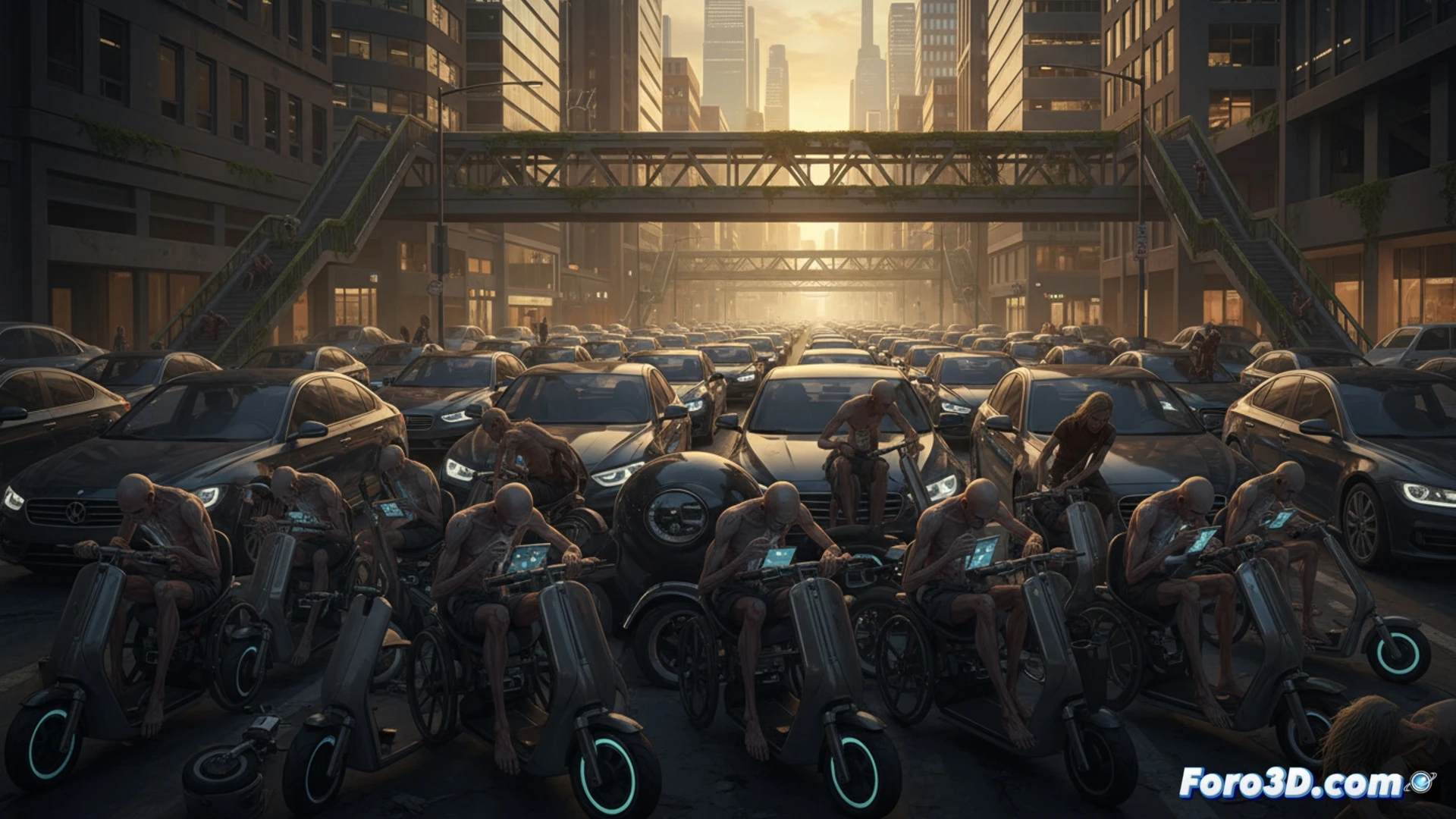
Urban mobility is advancing toward a horizon of scooters and autonomous cars, but at the cost of our own capacity for movement. Bodies are atrophying, sidewalks are becoming saturated with obstacles, and children no longer walk two kilometers without a screen. This contradiction leads us to a wheel-assisted immobility, where the promise of not walking becomes a physical sentence.
The technical cost of motorized efficiency 🛴
Personal electric transportation systems, such as scooters and unicycles, reduce physical effort to zero, but generate muscular and bone dependence. Recent studies indicate that active sedentarism (moving without energy expenditure) accelerates the loss of muscle mass and bone density by 15% annually in frequent users. Cities, designed for these vehicles, multiply blind spots and reduce pedestrian space, creating an ecosystem where the human body is the last link.
When the GPS takes you to the ICU of laziness 😅
Now it turns out that to save five minutes of walking, we sacrifice the ability to climb stairs without panting. Electric scooters not only take you to work, they also prepare you so that one day, when you get up from the couch, your legs ask you: what is this. And while children learn to handle a joystick before pedaling, we wonder if the mobility of the future will not actually be a wheelchair with wifi.