NASA has revealed its plan to return to the Moon and build a permanent base at the South Pole, with Mars as the final destination. The program kicks off in 2026 with three uncrewed missions: Moon Base I using Blue Origin's Blue Moon Mark 1 lander, Moon Base II with the Griffin module and the FLIP rover loaded with 500 kg, and Moon Base III to study geological phenomena. The first crew will set foot on the lunar surface in 2028.
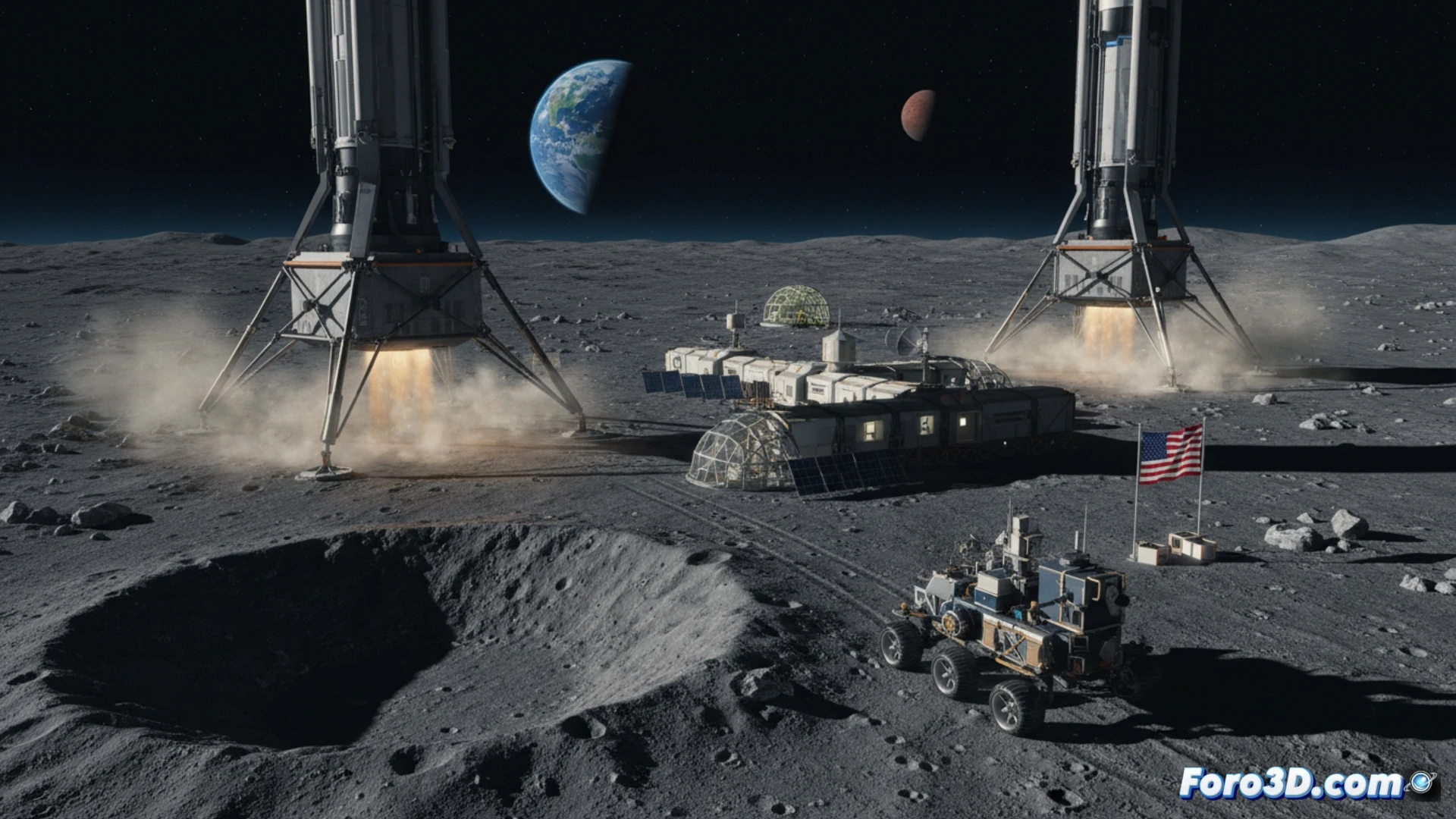
Three robotic missions prepare the ground for the lunar base 🚀
Each uncrewed mission has a specific objective. Moon Base I will test the precision landing system of the Blue Moon Mark 1. Moon Base II will deploy the FLIP rover to move cargo and analyze the soil. Moon Base III will focus on measuring seismic activity and ice deposits at the South Pole. This data will allow selecting the exact location for the base and designing the habitats that astronauts will use in 2028.
The lunar move includes cargo and a rover named after a dolphin 🌙
NASA plans to send 500 kg of cargo on Moon Base II, which sounds like an interplanetary move. The FLIP rover, whose name recalls an acrobatic dolphin, will be in charge of moving the packages. Meanwhile, the agency trusts that the lunar South Pole has no noisy neighbors or parking problems. Hopefully, the first astronauts won't have to assemble furniture with instructions lost in space.