In 1971, Chinese workers discovered a Han tomb in Mawangdui containing an unprecedented archaeological treasure: the body of Xin Zhui, Lady of Dai, who died 2,100 years ago. Its state of preservation defies logic: her joints still bend, her skin retains elasticity, and analyses revealed blood in her veins. Today, digital archaeology allows us to preserve this biological miracle without touching it.
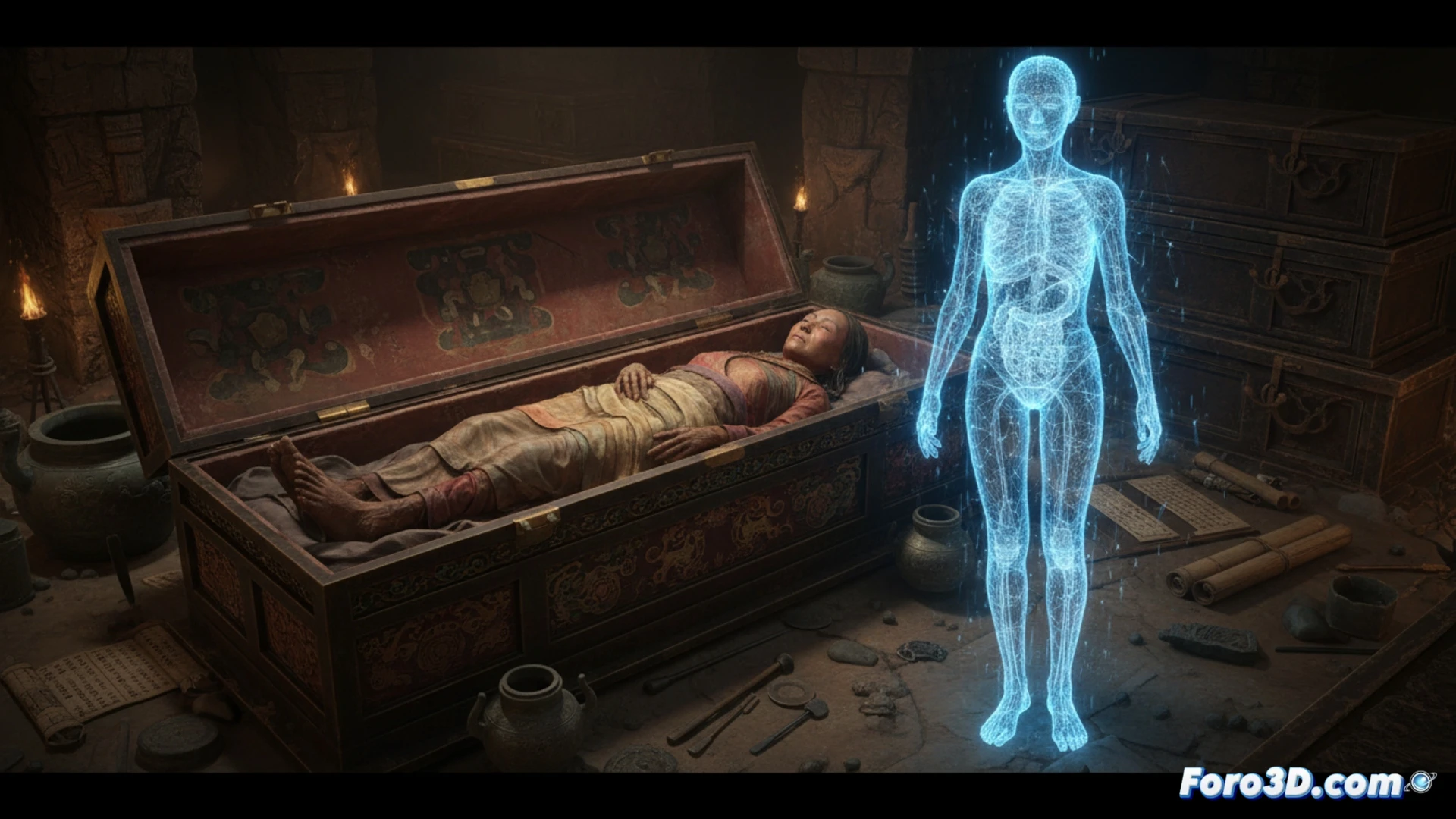
Photogrammetry and tomography: The 3D archive of an aristocrat 🏛️
The team from the Hunan Provincial Museum used structured light scanners and computed tomography to record every layer of Xin Zhui's body. A high-density polygonal model was generated, capturing everything from the texture of her epidermis to the density of her bones. The multi-angle photogrammetry technique, with 400 controlled exposures, allowed mapping of dermal elasticity without mechanical pressure. The result is a digital twin that enables forensic pathologists to simulate virtual incisions and study the preservation of her internal organs, avoiding any risk of degradation to the original specimen.
The intangible legacy of preserved flesh 🧬
The Lady of Dai not only connects us to the Han dynasty; her exceptional preservation raises questions about lost embalming techniques. The 3D model acts as an immortal laboratory, where researchers worldwide can analyze the composition of her bodily fluids and the structure of her blood vessels without traveling to China. This digital archive turns a unique find into a global scientific resource, demonstrating that 3D technology not only documents the past but keeps it alive for future generations of archaeologists.
Which program would you use to virtually reconstruct this site?