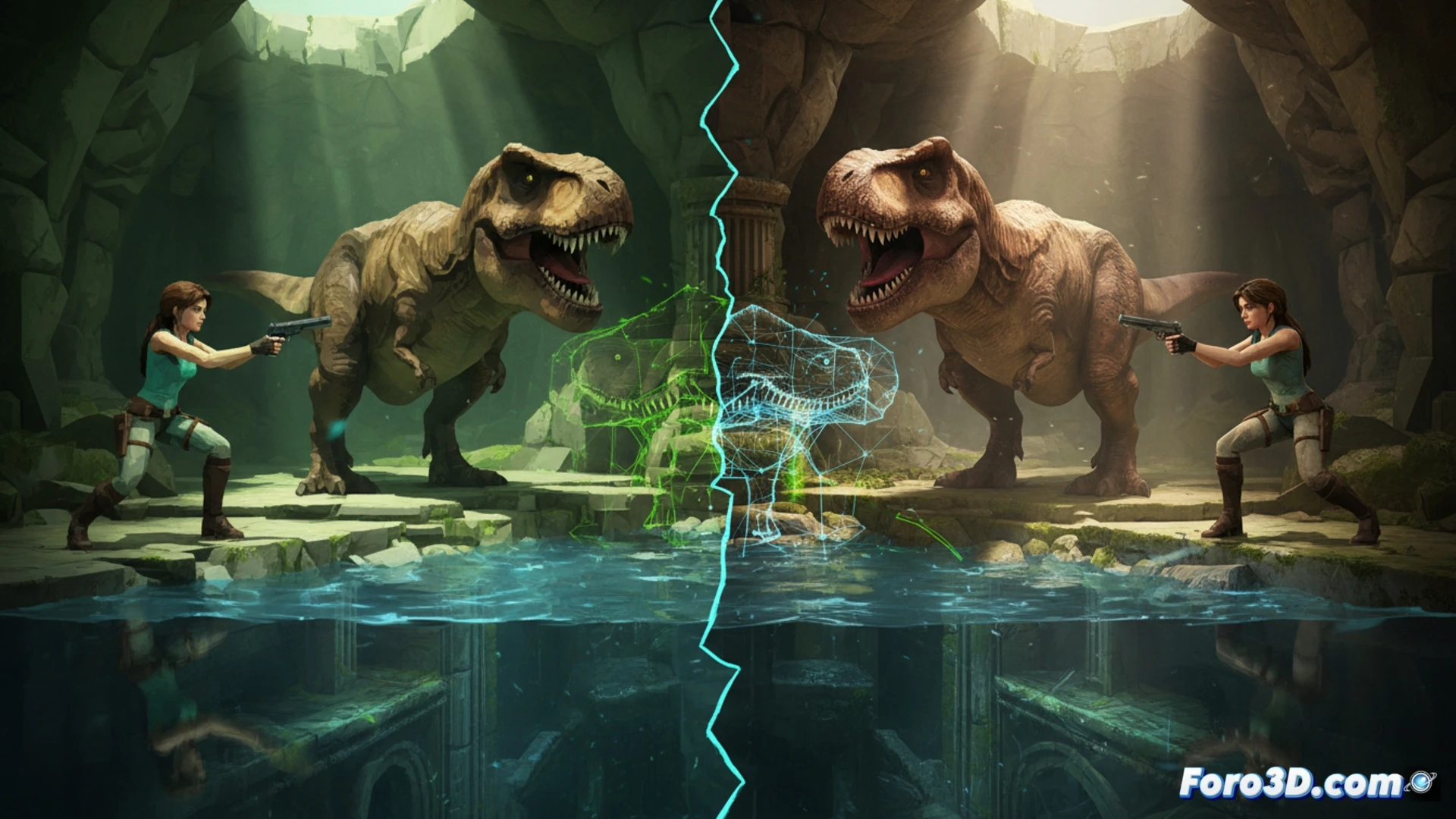
The release of Tomb Raider I-III Remastered represents a fascinating case study in video game development. Aspyr Media did not rebuild the game from scratch; instead, they implemented a modern rendering layer on top of Core Design's original engine. This architecture enables a unique feature: instant switching between the original 1996 polygonal look and a contemporary style with just a button press, without reloads or loading times. 🎮
Technical workflow: modeling, lighting, and real-time texturing 🛠️
The remastering process began with extracting the original assets. Modelers used Autodesk Maya to create new meshes for Lara Croft and the environments, maintaining the original topology as a reference but applying subdivisions and additional geometry to achieve smooth surfaces. The 2D vegetation in the backgrounds was replaced with full 3D models. For textures, Adobe Photoshop allowed increasing the resolution of the original maps, while Aspyr's internal tools managed the integration. The biggest technical challenge was lighting: a real-time lighting system was implemented that replicates the fixed light sources of the classic engine, but with dynamic shadows and bounces calculated by shaders. The instant visual switch is achieved by keeping both data sets (original and modern polygons) in memory and toggling between them at the renderer level.
Lessons for preserving and remastering classic games 📜
This approach demonstrates that respecting the original engine does not limit graphical innovation. By preserving Core Design's game logic, physics, and level structure, Aspyr avoided the common pitfalls of remakes that alter gameplay. The dual rendering technique sets a standard for future remasters: offering the player the option to see the original art as a historical document, while benefiting from modern technical improvements. For developers, the case confirms that tools like Maya and Photoshop remain the industry standard, but the real magic lies in the custom middleware that bridges the old with the new.
How did the developers balance modern visual fidelity with the limitations of the classic Tomb Raider engine to keep the original gameplay intact in the remastering of the three titles?
(PS: 90% of development time is polishing, the other 90% is fixing bugs)