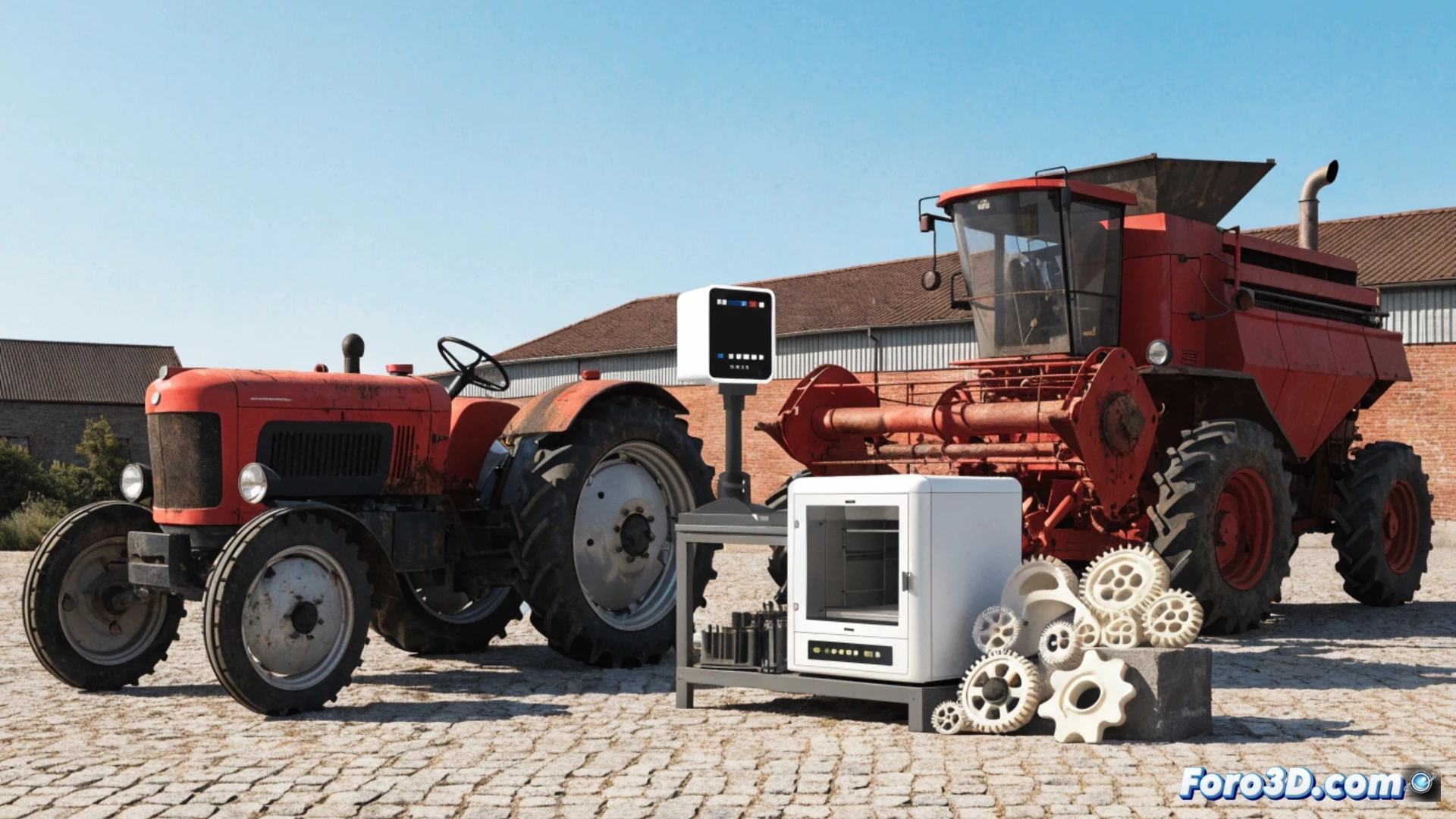
The job of an agricultural machinery operator has a constant enemy: a broken part that is no longer manufactured. This is where 3D technology comes in to avoid weeks of downtime. With a scanner and a printer, you can replicate gears, brackets, or plastic covers in hours. For example, a gear shift lever from a 90s tractor is digitized, modeled, and printed in nylon. Necessary software: Fusion 360 for design, Cura for slicing, and a scanner like the Einscan SE.
How to digitize parts and save on spare parts 🛠️
The process starts with a 3D scan of the broken part or manual calibration with a digital caliper. Then, in Fusion 360 or SolidWorks, the solid model is reconstructed. Tolerances are adjusted for assembly and exported to STL. Slicing is done in PrusaSlicer or Simplify3D, configuring 80% infill and a 0.2 mm layer height for strength. Materials like PETG or ASA withstand vibrations, sun, and oil. Thus, a rubber gasket or a fuse cover is manufactured in the workshop itself, without relying on dealerships.
The day I printed a part and the tractor wouldn't start 🚜
All very nice until you forget to calibrate the printer bed. A buddy printed an air filter bracket, installed it with enthusiasm, and the tractor started sounding like a blender. The part deformed from the engine heat and the filter shot off into the cornfield. In the end, the solution was to glue the original piece with duct tape. The moral: 3D printing helps, but it doesn't save you from measuring twice before hitting the print button.