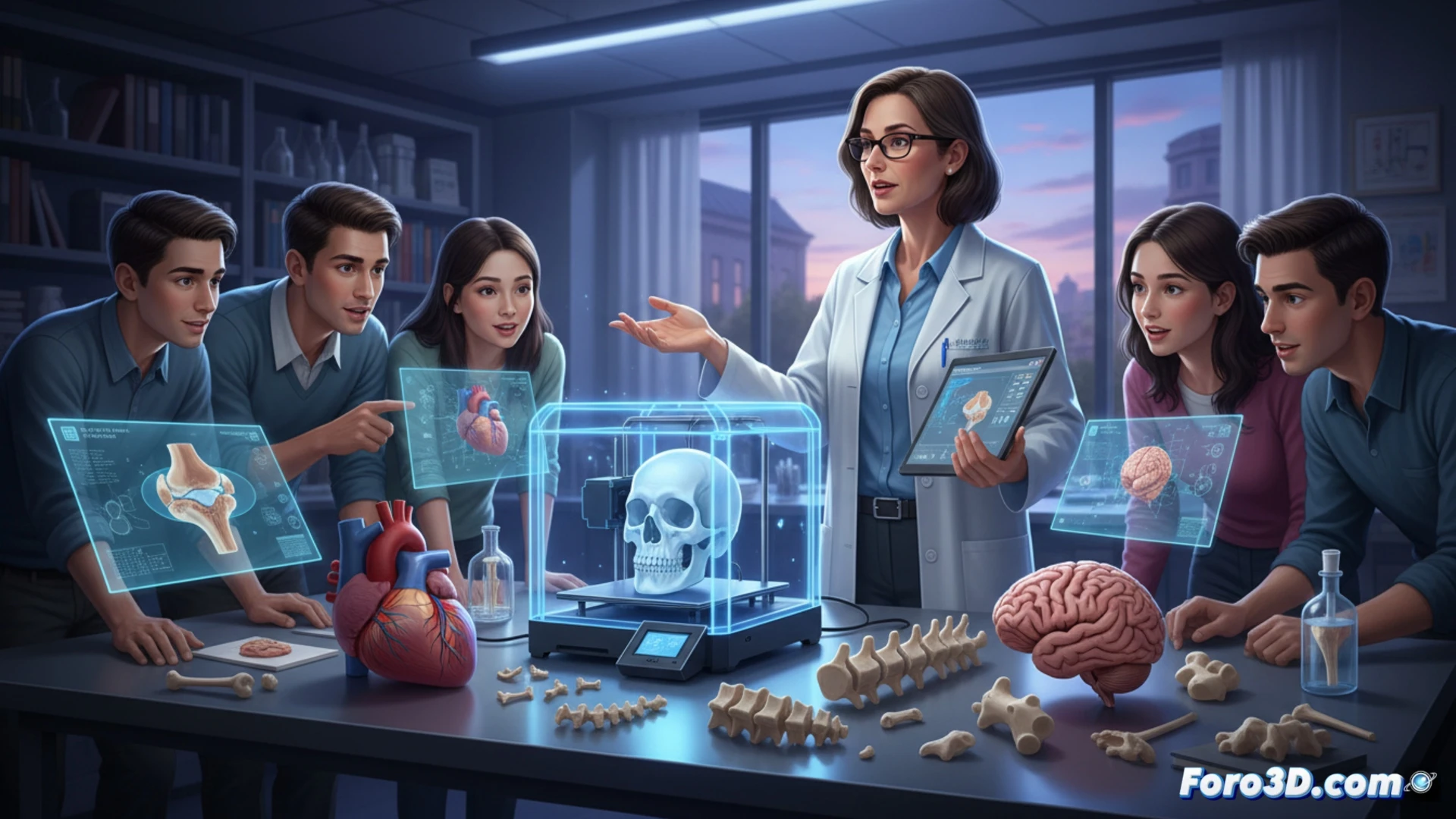
3D technology allows university professors to transform abstract concepts into tangible objects. A clear example is teaching anatomy: instead of relying on atlases or expensive commercial models, the professor can print exact replicas of bones or organs for students to handle in class. This improves spatial understanding and reduces dependence on cadavers or fragile materials.
Programs and workflow for creating educational models 🛠️
To start, the professor needs 3D modeling software like Blender or Fusion 360 to design the parts. Then, a slicing program like Cura or PrusaSlicer prepares the file for the printer. If scanning real objects is required, tools like Meshroom (photogrammetry) or a basic 3D scanner like the Revopoint POP 2 are useful. The initial investment is around 300 euros for an entry-level FDM printer, plus a few weeks of learning time.
When the professor prints their own patience in 3D 😅
Of course, nothing bonds a professor with their students more than watching the model of a neuron peel off the build plate mid-class. Or the classic moment when the filament gets tangled and the professor curses in Latin while trying to unclog the extruder. But in the end, when the student touches the piece and says now I understand, even the most skeptical professor admits that 3D technology is worth every minute lost calibrating the bed.