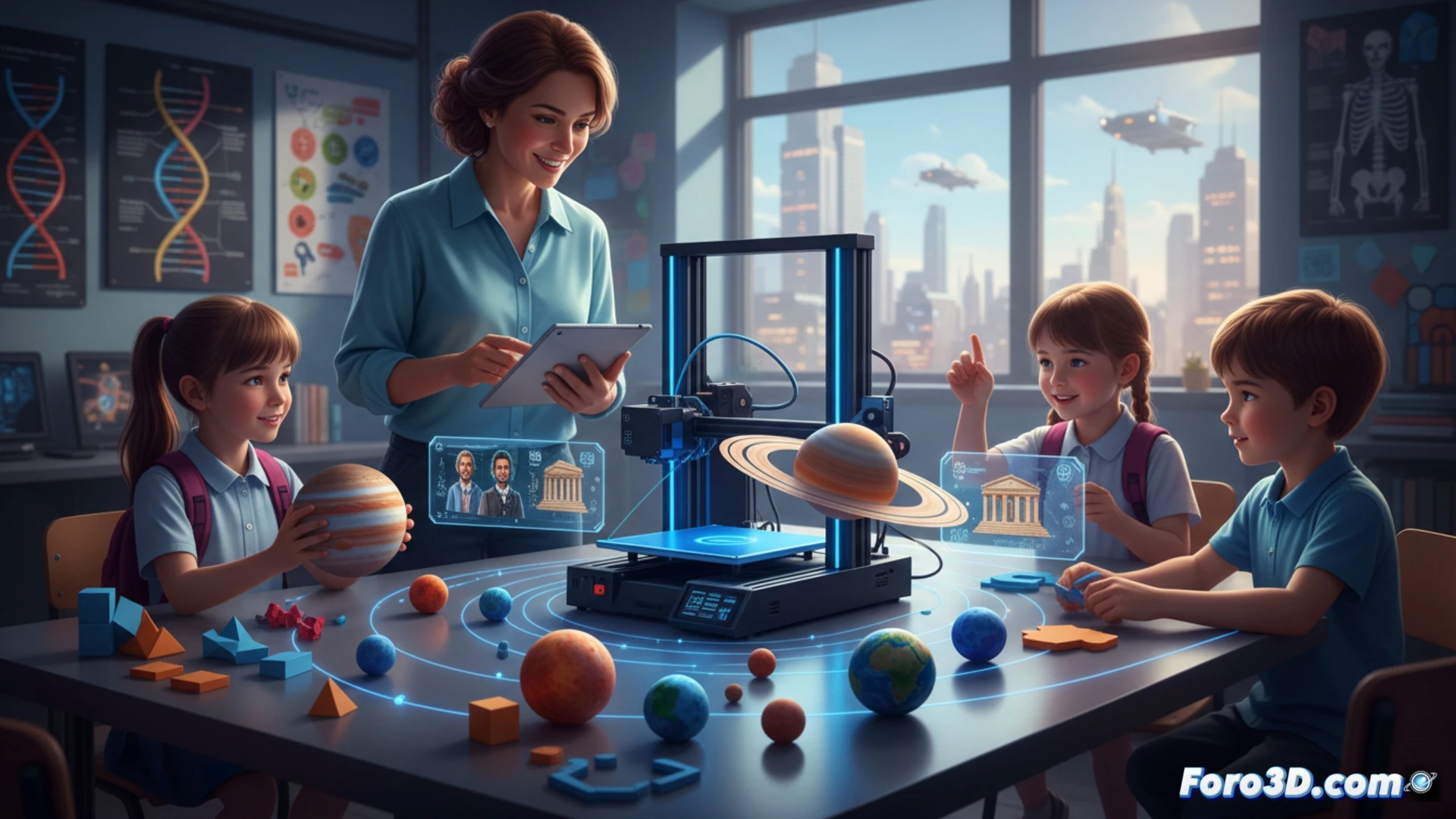
3D technology offers educators tools to make abstract concepts tangible. An elementary school student can understand the solar system by holding a planetary replica in their hands. Three-dimensional visualization allows explaining geometry, history, or biology with physical objects that can be touched and manipulated, facilitating knowledge retention.
Modeling and printing: the basic kit for the digital educator 🛠️
To start, the educator needs 3D modeling software like Tinkercad, which is free and runs in a browser. For more complex parts, Fusion 360 offers more control. The slicing software Ultimaker Cura prepares the files for the printer. A practical example: creating a DNA model for science class. It is designed in Tinkercad, exported to Cura, and printed in PLA filament. The entire process takes less than two hours.
When the educator discovers they don't even know how to turn on the printer 😅
The educator prints their first model: a human skull for anatomy class. Everything goes well until the printer starts spewing plastic as if it were vomiting spaghetti. The fault lies with an unleveled bed, but they swear it's a technological poltergeist. After three failed attempts and a YouTube tutorial, they manage a decent piece. The skull comes out with a crooked jaw, but the students applaud. 3D technology is not magic: it's patience and trial and error.