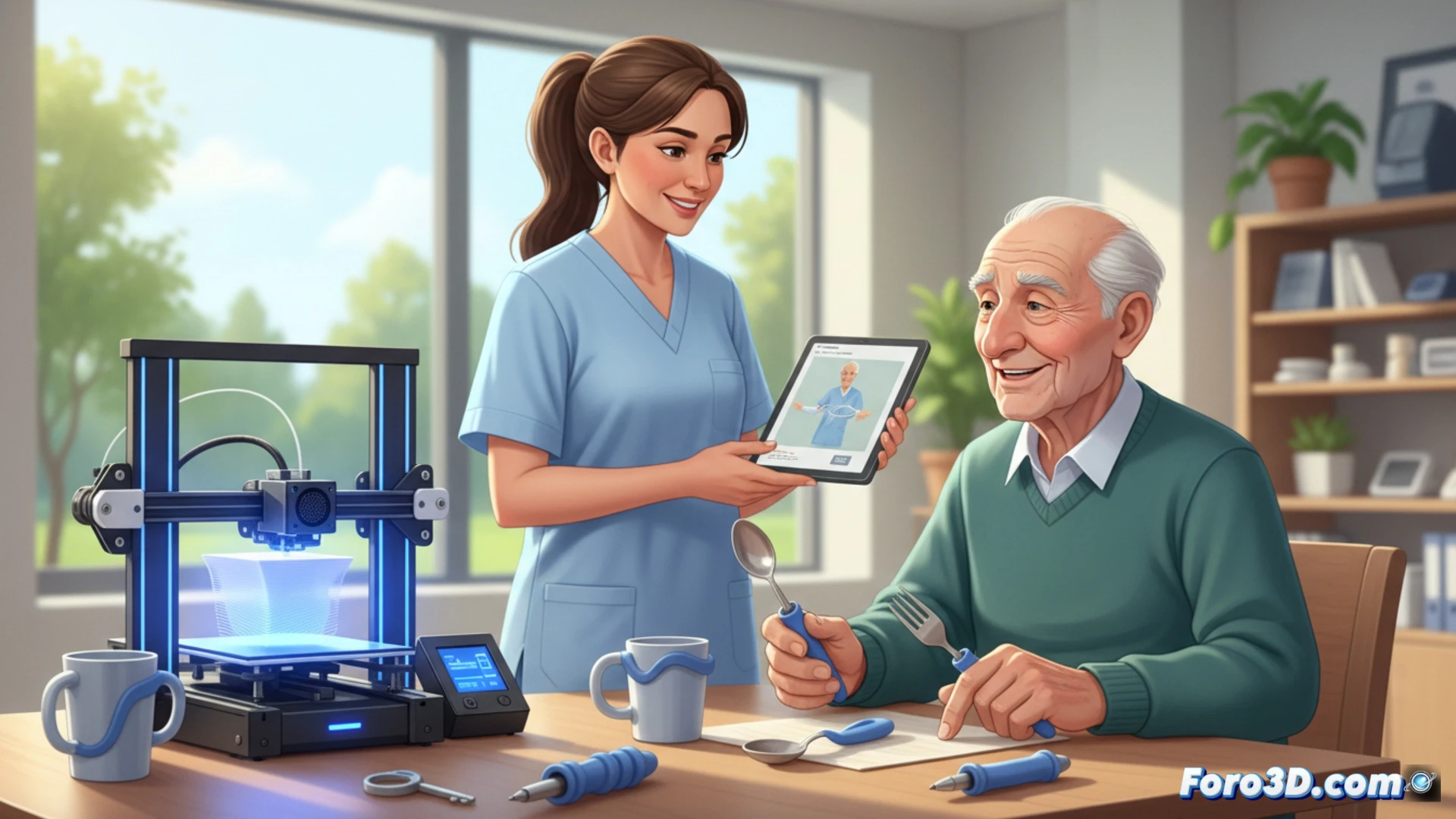
The profession of a geriatric caregiver requires adapting spaces and objects to the needs of elderly people. 3D technology allows for the manufacturing of personalized assistive devices, such as cutlery adapters or door handles, tailored to each user's hand. This reduces injuries and improves their daily autonomy.
Practical example and programs to get started 🛠️
A concrete case: designing a jar opener with an ergonomic handle. The user's hand is scanned with a 3D scanner (e.g., Revopoint POP 3) or manual measurements are taken. The model is designed in Tinkercad or Fusion 360, exported to STL, and printed in PLA or TPU. Necessary programs: Tinkercad (free), Cura (slicer), and a printer like the Ender 3 V2. The process takes about 4 hours.
When technology replaces the hammer and duct tape 😅
Before, if Don Manuel had trouble turning the door knob, you would put non-slip tape on it and that was that. Now you print an ergonomic knob shaped like a crank and it seems like you've earned a master's degree in geriatrics. The problem is that Don Manuel no longer complains about the knob, but about the 3D printer taking up his nightstand space. Modernity's little quirks.