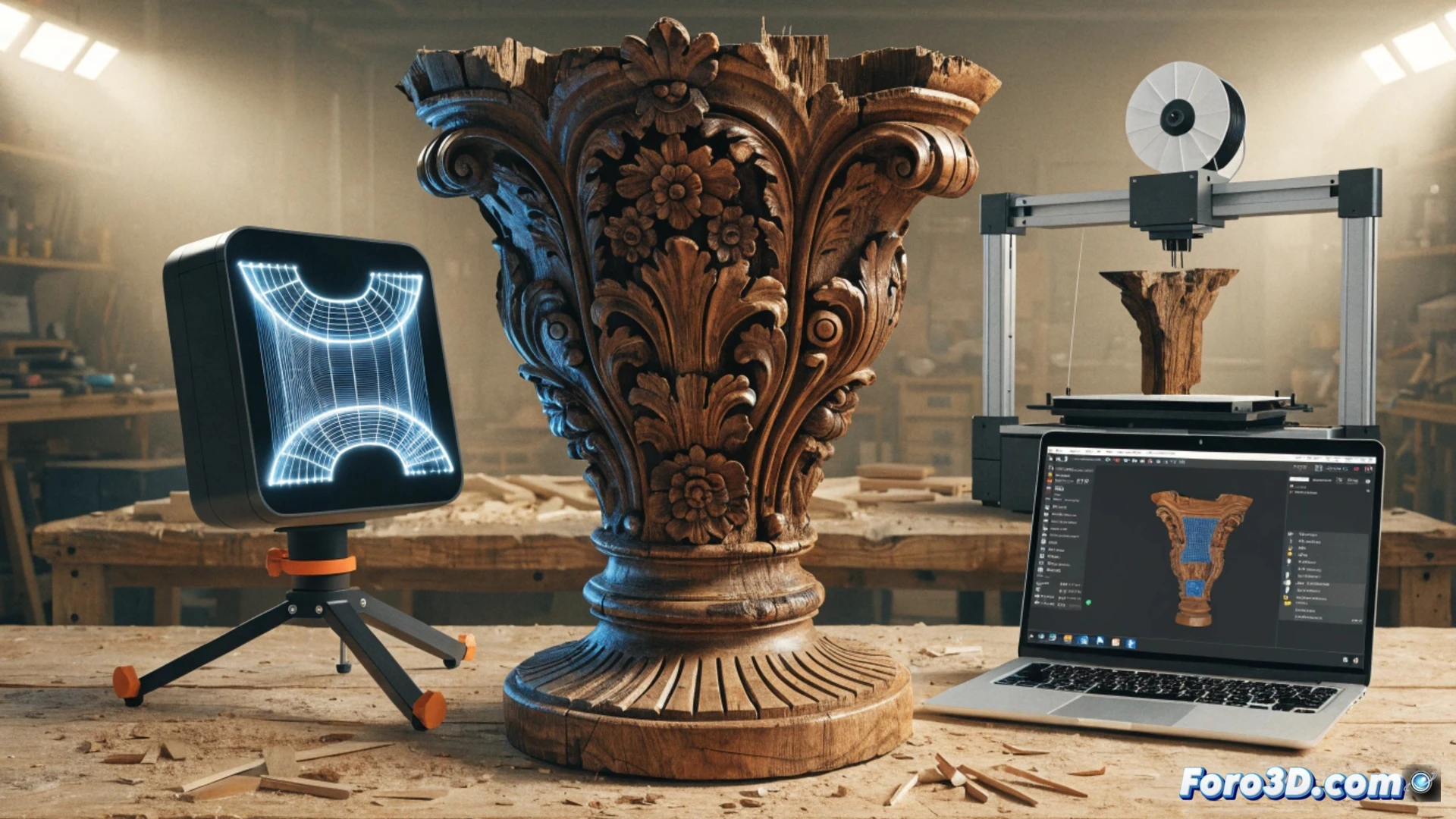
Cabinetmaking is a centuries-old craft that combines precision and patience. 3D technology does not aim to replace the artisan's skill but to simplify complex tasks. For example, when restoring a lost rococo chair leg, a 3D scanner captures the geometry of the matching piece, and modeling allows its replication. The necessary programs are Blender for design, Fusion 360 for parameters, and Cura for slicing the file.
Digitization and prototyping for complex parts 🛠️
The typical workflow begins with a scan using a sensor like the Revopoint POP 3, which generates a point cloud. That cloud is converted into a mesh with MeshLab, and then refined in Rhino 3D to adjust curves and joints. Once modeled, the part is printed in PLA or resin to verify the fit before carving the final wood. This saves hours of trial and error, especially in assemblies like dovetails or curved moldings. The cabinetmaker only touches wood when the virtual prototype fits.
When the 3D printer saves you from the sander 😅
Because yes, sometimes you just don't want to sand anymore. With 3D technology, you can print a plastic jig to mark the holes for a hinge at three in the morning, when the coffee no longer works. The artisan can sleep peacefully knowing that the 0.2 mm error was made by the machine, not their hand. And if the part doesn't fit, you can always blame the cheap filament and not your lack of patience. The irony: wood still wins in smell and warmth.