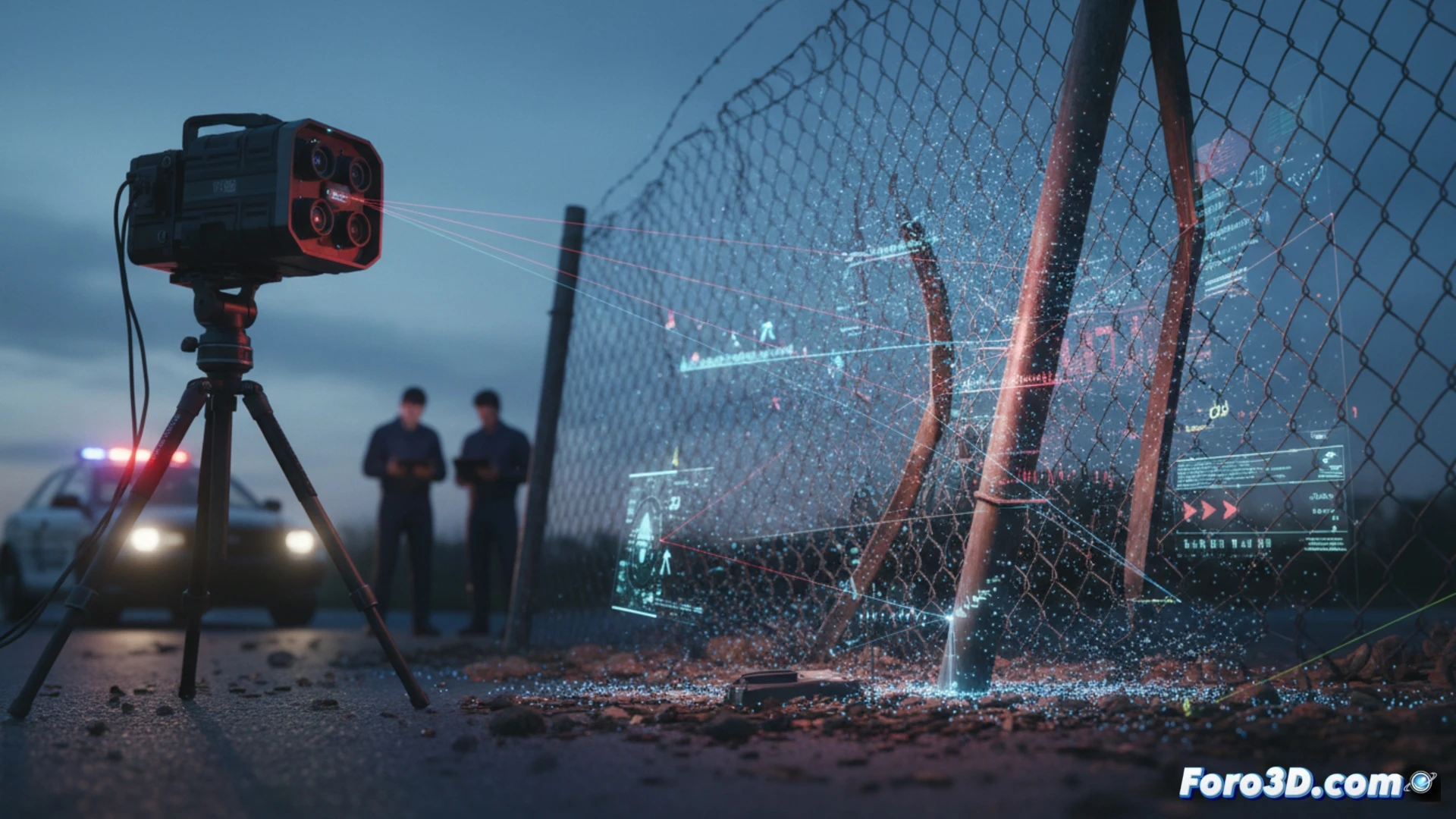
The deformation of a metal or wooden fence after a hit-and-run is not just collateral damage, but a goldmine of kinematic data. In 3D forensic reconstruction, accurately documenting the impact footprint allows for calculating the vehicle's speed, entry angle, and dissipated energy. Photogrammetry and laser scanning capture every millimeter of the deformation, transforming a bent post into a key vector piece of evidence for the investigation.
Technical Methodology for Capture and Analysis 🔬
The process begins with taking convergent photographs of the damaged fence, using scale targets to calibrate the model. With photogrammetry software such as Agisoft Metashape or RealityCapture, a dense point cloud is generated that reflects the material's undulation. Subsequently, this mesh is aligned with the 3D model of the involved vehicle. Using collision detection algorithms, the depth of the deformation is calculated and compared against material stiffness databases (such as those from the NCAC). This allows estimating the minimum impact speed with an error margin of less than 5%, far surpassing traditional tape measures and 2D photographs, which often miss the lateral twisting of the post.
Overcoming the Limitations of Physical Evidence 🛠️
Classic methods, such as measuring the dent's height with a tape measure, fail to document the material's elastic recovery or microfractures. 3D reconstruction allows virtually simulating the moment of impact, varying the vehicle's trajectory until the fence mesh perfectly matches the bumper damage. In a real case of a pedestrian hit-and-run on a rural road, scanning an oak fence made it possible to demonstrate that the vehicle was traveling at 72 km/h, disproving the driver's statement claiming to be going 50 km/h. The deformation footprint, once digitized, speaks more accurately than any witness.
How can the depth and angulation metrics of deformation in a wooden fence, obtained through 3D scanning, differentiate between the impact of a light vehicle and a heavy one at the same impact speed?
(PS: In scene analysis, every scale target is a small unsung hero.)