The Great Frost of 1709 was not just a simple winter. In a single night, extreme cold buried the Baltic Sea under a layer of solid ice, froze rivers to their beds, and devastated crops from France to Russia. This event, the most severe in modern European history, killed hundreds of thousands of people and animals. In this article, we will teach you how to recreate this catastrophe using Houdini, ZBrush, and Blender to visualize the advance of ice and its impact on the human landscape. ❄️
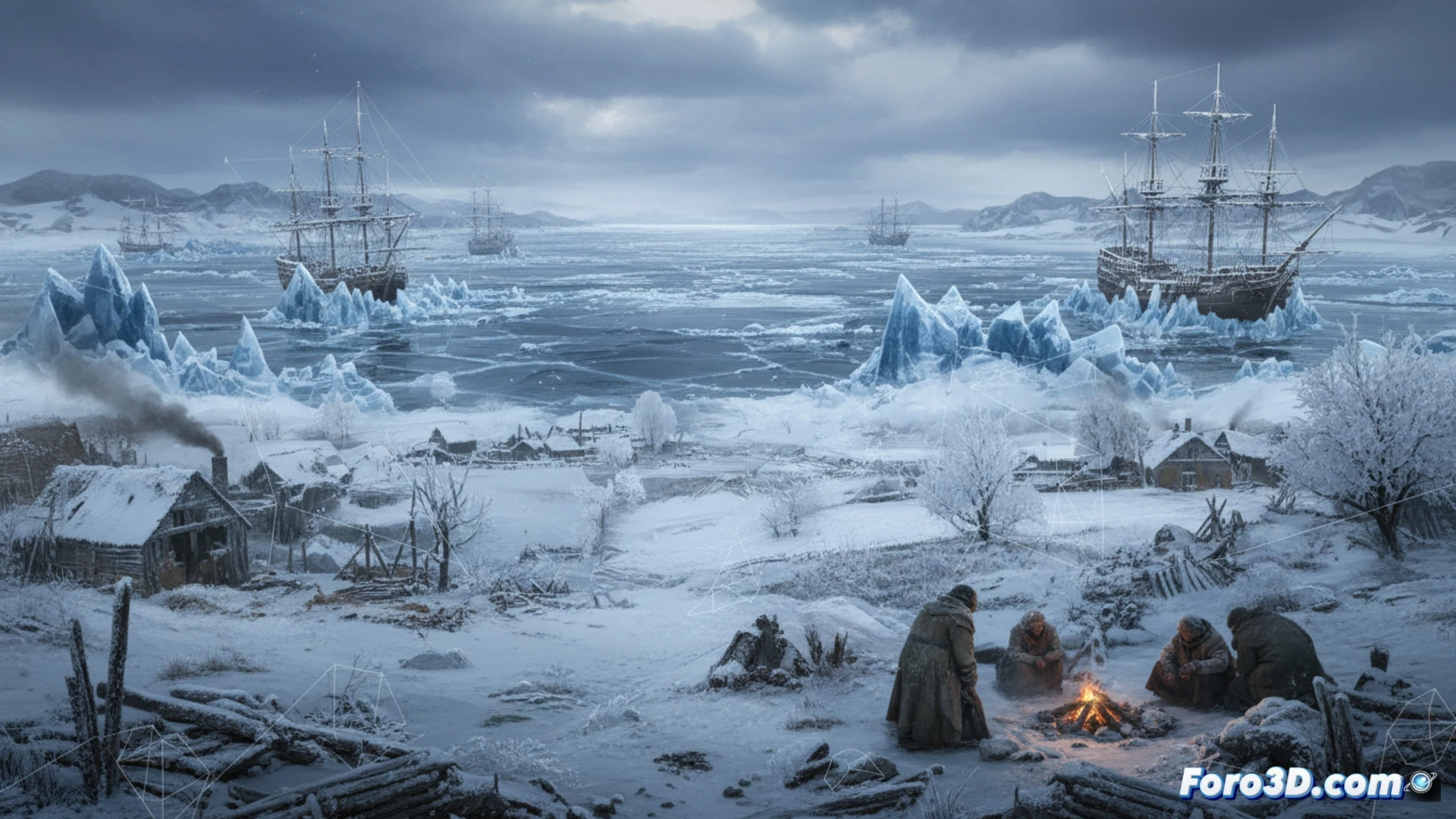
Procedural simulation of ice growth in Houdini 🧊
To represent the expansion of ice, we will start in Houdini with a procedural system based on historical temperature data. We will load an elevation map of Europe and use attribute nodes to define freezing zones based on latitude and altitude. We will apply a VDB (Dynamic Volume) solver to simulate ice growth from the Baltic coasts inland. The key is to use fractal noise (Perlin) modulated by time, so that the ice advances organically, respecting coastlines and geographical obstacles. Then, we will export the resulting geometry as an .abc file to integrate it into Blender.
Sculpting details and setting the disaster scene 🌨️
In Blender, we will recreate the frozen landscape: cities covered in snow, trees fractured by the weight of ice, and the Baltic Sea transformed into a white plain. We will use ZBrush to sculpt fine details on the icy surfaces, such as cracks, trapped air bubbles, and frost textures. The goal is not only aesthetic but educational: each crack can represent the thermal stress that destroyed crops and homes. When rendering with Cycles, we will use cold lighting and dense fog to convey the feeling of a world frozen in time. This visual exercise reminds us of human fragility in the face of extreme climatic phenomena.
What digital modeling techniques allow for the most realistic recreation of the instantaneous ice formation on the Baltic Sea during the Great Frost of 1709?
(PS: Simulating catastrophes is fun until your computer melts down and you become the catastrophe.)