Created by Stan Lee and Jack Kirby, Enchantress (Amora) debuted as an Asgardian sorceress capable of manipulating minds. Her original design, with winged helmets and green tunics, reflected the classic comic book aesthetic of the 60s. Today, her figure has transcended the page to become an icon of 3D modeling, where digital artists explore her duality between goddess and villainess through sculpting and texturing techniques.
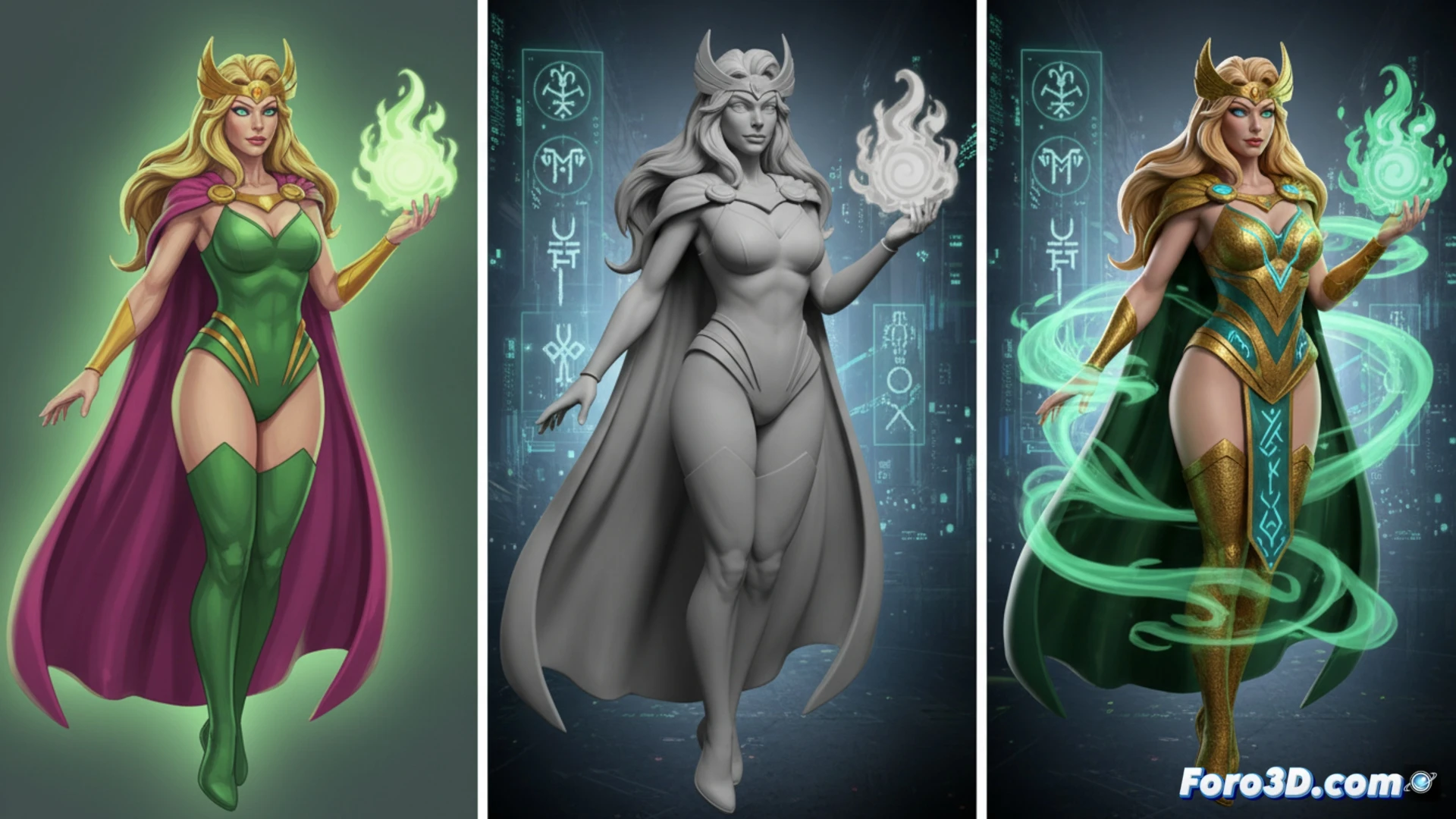
From Kirby's pencil to digital rigging: technical analysis of the modeling 🎨
Amora's transition to 3D involves unique challenges. Her magic requires particle effects and translucent shaders that mimic her enchanting aura. In video games like Marvel Rivals, modelers use clean topology to preserve Kirby's curved and dynamic lines, while facial rigging must capture her subtle manipulative expressions. These digital assets are also reused by the community for fan activism, creating renders that reclaim her autonomy as a complex female character.
Cultural preservation and digital cosplay: Amora's legacy 🖥️
The digitization of Amora not only modernizes her aesthetic but also acts as an archive of pop heritage. Activist artists download these models to recontextualize her in empowerment scenes, freeing her from the evil seductress archetype. On forums like Foro3D, tutorials on retopology and UV mapping are shared, democratizing access to a character who, since her birth in sequential art, continues to inspire new visual narratives.
How does the 3D modeling of Amora transform the classic iconography of the Asgardian sorceress into a vehicle for social critique within digital art and activism?
(PS: if your virtual reality installation doesn't change the world, at least let it not lag)