In the Abbey of San Galgano, in the Italian Tuscany, a real sword rests embedded in a rock since the 12th century. Far from being an Arthurian legend, recent scientific analyses have confirmed the authenticity of the metal and its age. For digital archaeology, this discovery represents a perfect case study: the application of 3D documentation techniques to preserve and analyze a unique object without subjecting it to physical risks.
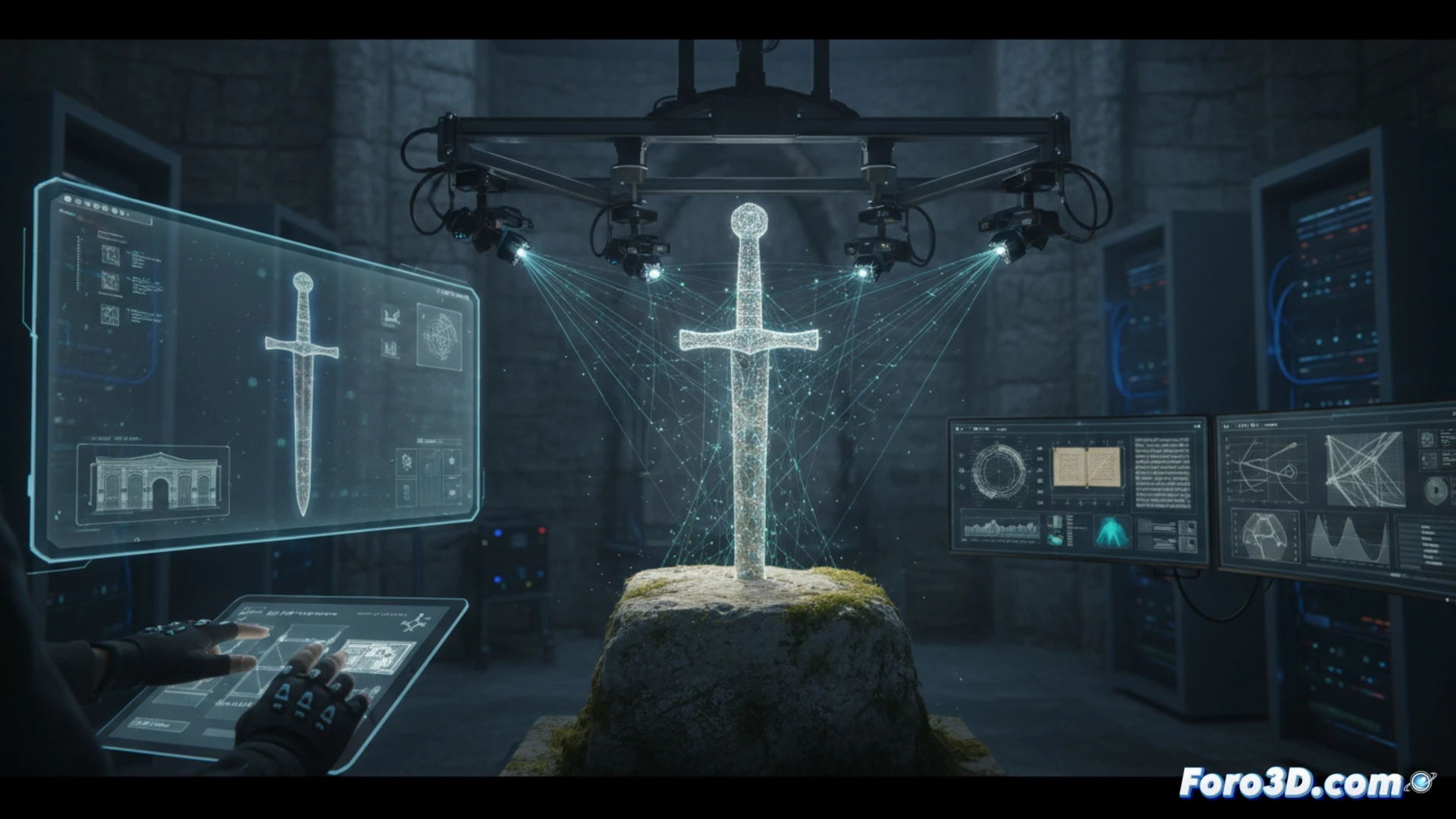
Photogrammetry and Spectrometry: The Scientific Process 🔬
The research team applied a multidisciplinary workflow. First, a high-resolution laser scan of the sword and its stone surroundings was performed to capture the exact geometry of the junction between the metal and the rock. Subsequently, short-range photogrammetry was used, generating a polygonal mesh model with realistic textures. For dating, X-ray fluorescence spectrometry (XRF) was employed, a non-destructive method that analyzed the composition of the iron and carbon inclusions. The results confirmed that the alloy corresponds to 12th-century forging techniques, ruling out modern replicas. This digital twin now allows researchers to study wear marks and patina without touching the original artifact.
Virtual Preservation Against Tourism and Time 🏛️
The creation of a digital twin of the Sword of San Galgano not only validates the legend but also solves a conservation dilemma. Constant exposure to visitors' touch and the abbey's humidity threatens the blade's integrity. With the 3D model, archaeologists can simulate corrosion processes and plan virtual restorations. Furthermore, the digital file allows anyone, from a computer or a virtual reality viewer, to explore the details of the hilt and the inscription on the rock, democratizing access to this medieval heritage.
How can photogrammetry and 3D scanning of the Sword of San Galgano resolve the dilemma between its historical authenticity and the Arthurian legend in digital archaeology?
(PS: If you dig at a site and find a USB, don't plug it in: it could be Roman malware.)