In 1892, on the occasion of the 400th anniversary of the Discovery of America, Madrid dreamed of an iron and steel colossus that would rise 200 meters above the Retiro Park. The Great Sphere of the Columbus Monument would have been the tallest structure in the world, surpassing the Eiffel Tower. However, exorbitant costs and the crisis of 1898 condemned it to oblivion. Today, digital archaeology allows us to bring it back to life.
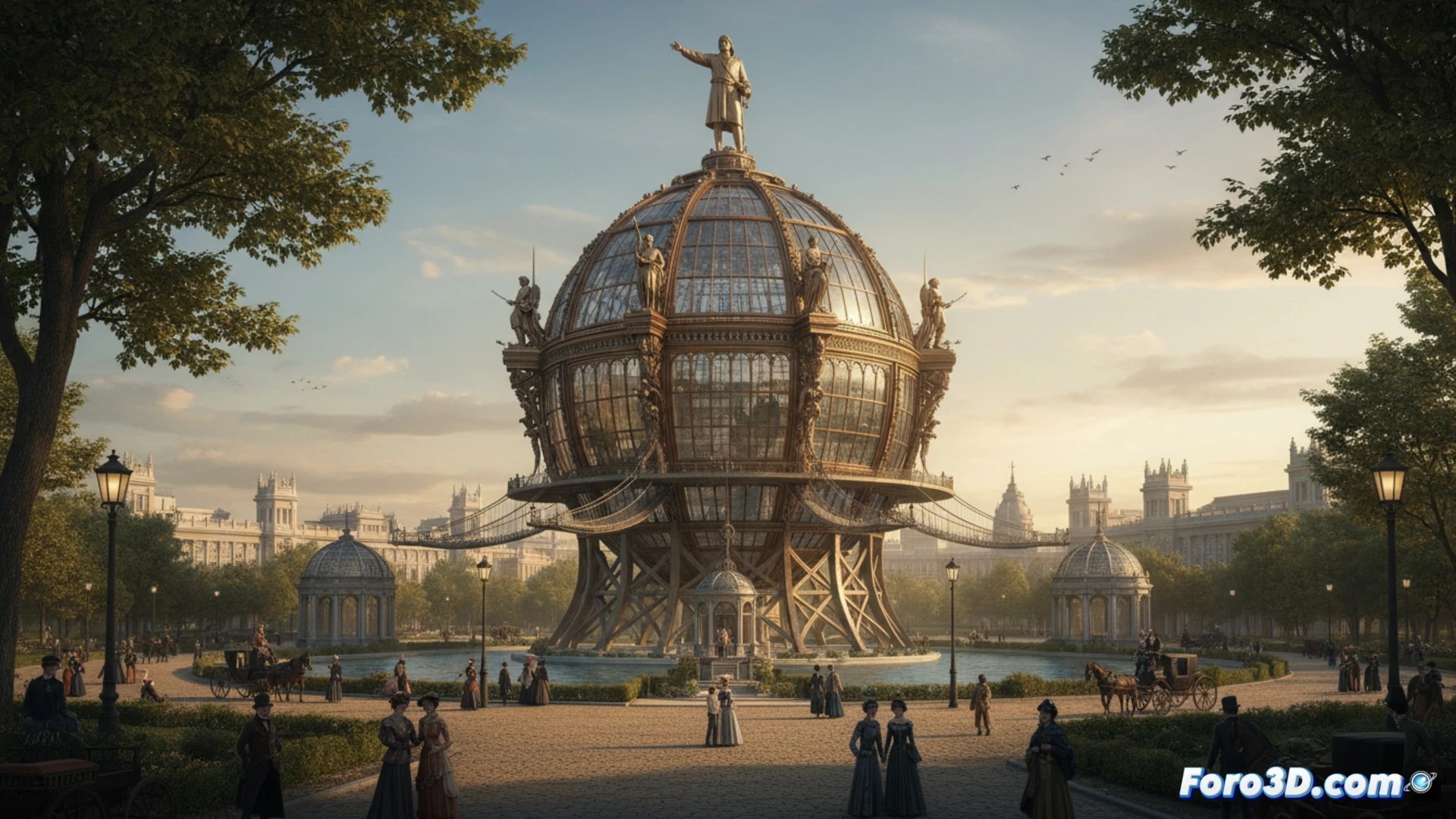
Virtual reconstruction: from blueprint to 3D model 🏗️
Digital archaeology uses historical blueprints, engravings, and period descriptions to reconstruct the project using 3D modeling software such as Blender or 3ds Max. In this case, it starts from the sketches of engineer Alberto de Palacio and architect Arturo Mélida. The sphere, 100 meters in diameter, rested on four 100-meter-high columns. The scale is brutal: the complete building would have doubled the height of the Puerta de Alcalá and tripled that of the Palacio de Cristal. Modeling allows texturing with metallic rust and solar reflections, simulating its real appearance under the light of 1892.
What did we lose by canceling the project? 🏛️
Beyond nostalgia, digital recreation forces us to reflect on lost heritage. The sphere was not just a monument, but a symbol of technological ambition and national pride in a broken Spain. By rendering it alongside the current silhouette of the Retiro, we discover an urban void that history did not fill. Digital archaeology not only preserves what existed, but also materializes what could have been, offering a visual lesson on the decisions that shape our cities.
Is it possible to digitally reconstruct the 200-meter iron and steel sphere that Madrid planned in 1892 to assess its structural viability and its impact on the urban landscape of the time, and which 3D modeling tools would be most suitable for this purpose?
(PS: and remember: if you can't find a bone, you can always model it yourself)