The Earth does not travel alone. It shares its solar orbit with a group of objects known as co-orbitals, bodies that complete one lap around the Sun in exactly 365.25 days. The most famous of them, (469219) Kamoʻoalewa, has puzzled astronomers due to its silicate-rich composition. Does it come from the asteroid belt or is it a fragment of the Moon? A new study in the journal Icarus tips the scales toward the first option, based on high-precision orbital simulations.
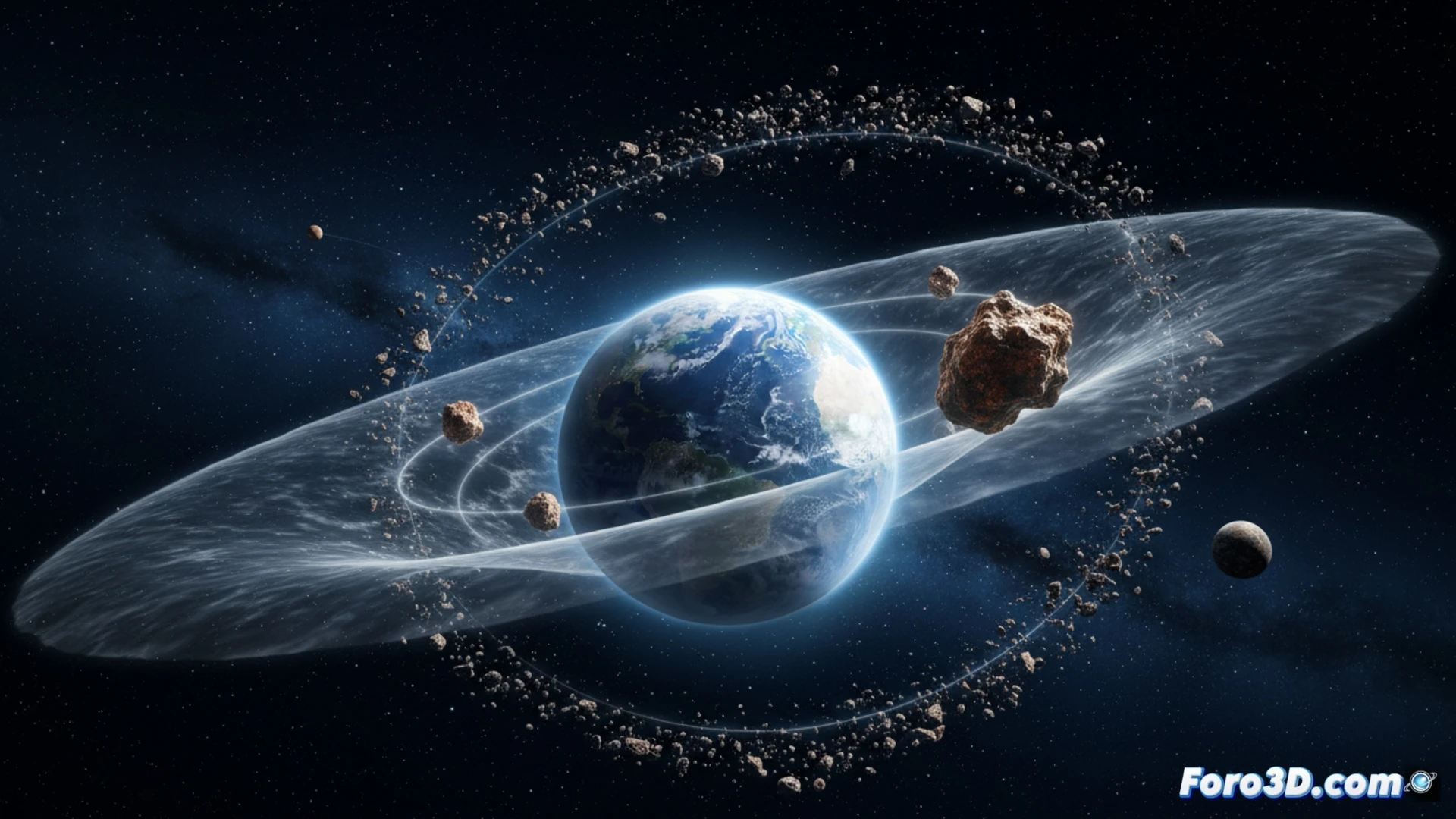
Particle simulation and 3D orbital analysis 🌌
For the Scientific Visualization niche, the challenge is to represent two contrasting hypotheses through dynamic data. The first option places the origin of Kamoʻoalewa in the lunar crater Giordano Bruno, an impact that would have ejected rocks into space. The second points to the main asteroid belt, between Mars and Jupiter. The researchers ran simulations with 12,000 virtual particles from the lunar surface to track their evolution. The result was compelling: the probability of a lunar fragment stabilizing in a quasi-satellite orbit around Earth is extremely low. Visually, this translates into a cloud of points that disperses rapidly, without managing to anchor itself to the Earth-Sun system.
Animated infographic to clear up the mystery 🚀
A 3D animated infographic could solve this puzzle intuitively. The model would show Earth's orbit with its co-orbitals, highlighting Kamoʻoalewa with a bright marker. Activating the lunar simulation, we would see how the 12,000 particles drift away in chaotic trajectories, contrasting with the stable orbit of a typical main-belt asteroid. Including a zoom into the Giordano Bruno crater and a representation of the asteroid belt would allow the viewer to visually compare both sources. Although the asteroid hypothesis gains strength, the animation would make it clear that we still need more data to close the case.
What volumetric visualization and real-time orbital simulation techniques allow for the most effective representation of the complex gravitational dance of Earth's co-orbitals without sacrificing scientific accuracy?
(PS: modeling manta rays is easy; the hard part is making them not look like floating plastic bags)