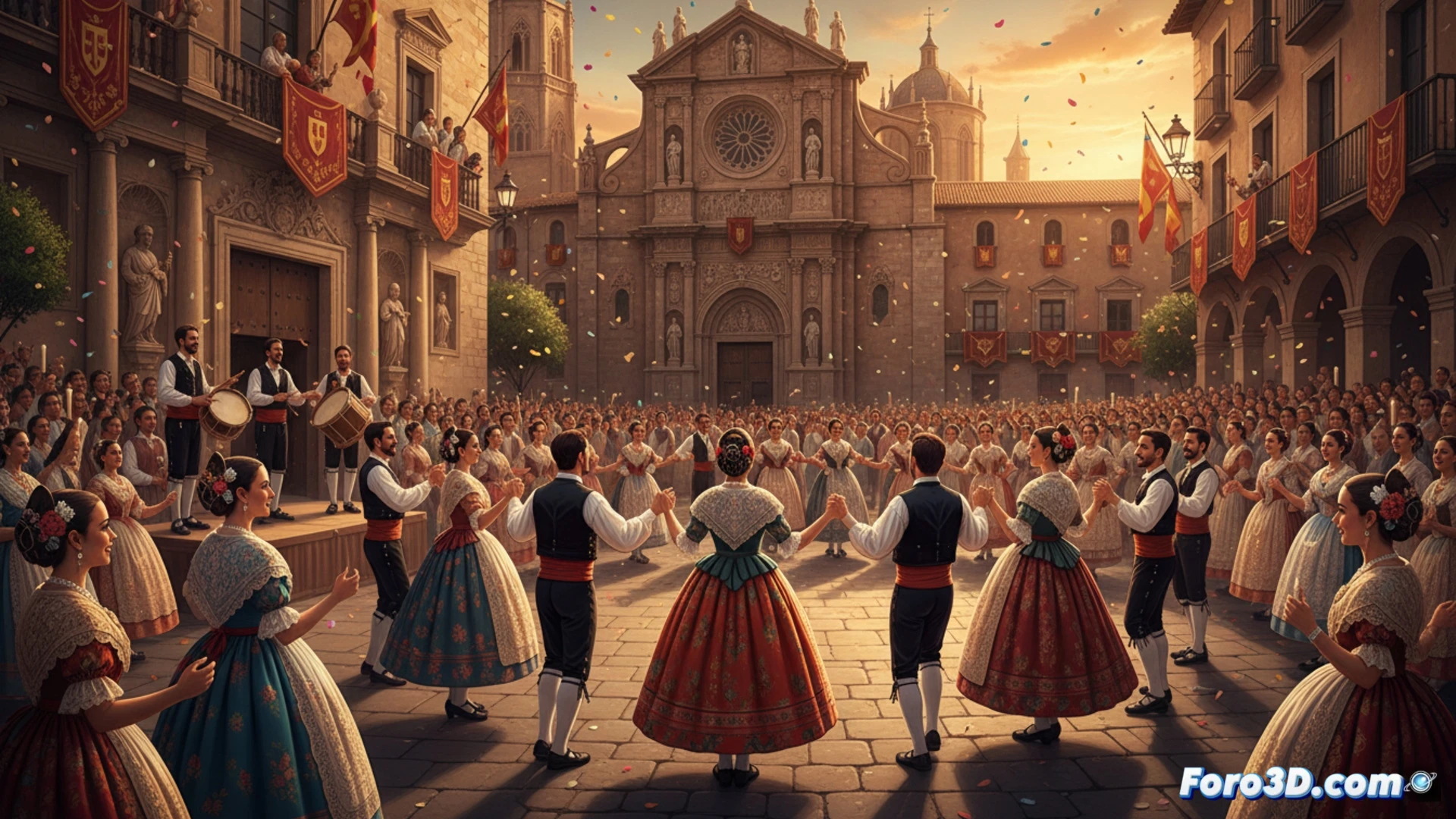
La Dansà is a traditional dance celebrated in honor of the Mare de Déu in various towns of Valencia. Participants form circles and move to the rhythm of the dolçaina and the tabal, creating an atmosphere of devotion and collective joy. This expression of faith and community represents an important pillar of local culture, reminding us of the need to keep traditions alive in the face of the passage of time.
How to program an efficient circular choreography in real time 💃
From a technical point of view, La Dansà implements a cyclic movement algorithm with synchronized displacements. Dancers execute a sequence of basic steps that repeat in loops conditioned by the musical rhythm. To optimize the experience, a polar coordinate system is required to manage the group's rotation and avoid collisions. Synchronization among participants is achieved through auditory signals (music) and visual cues (leader's gestures), similar to a distributed network protocol.
When dancing in a circle is more complex than an algorithm 🤖
Anyone who has tried to keep up with the rhythm of La Dansà knows that synchronization is not as simple as in a computer. While a machine executes instructions without complaint, humans trip, lose the step, or laugh for no reason. And if you add a musician who speeds up the dolçaina out of pure emotion, chaos is guaranteed. In the end, what matters is not precision, but the spirit of the party 🎉.