The discovery in the El Mirón cave (Cantabria) of a woman buried 19,000 years ago, covered in red ochre and accompanied by a stone block with engravings, represents a milestone in Iberian archaeology. This funerary context, known as the Red Lady, offers a unique opportunity to apply digital preservation techniques. The fragility of the pigments and lithic marks requires non-invasive recording.
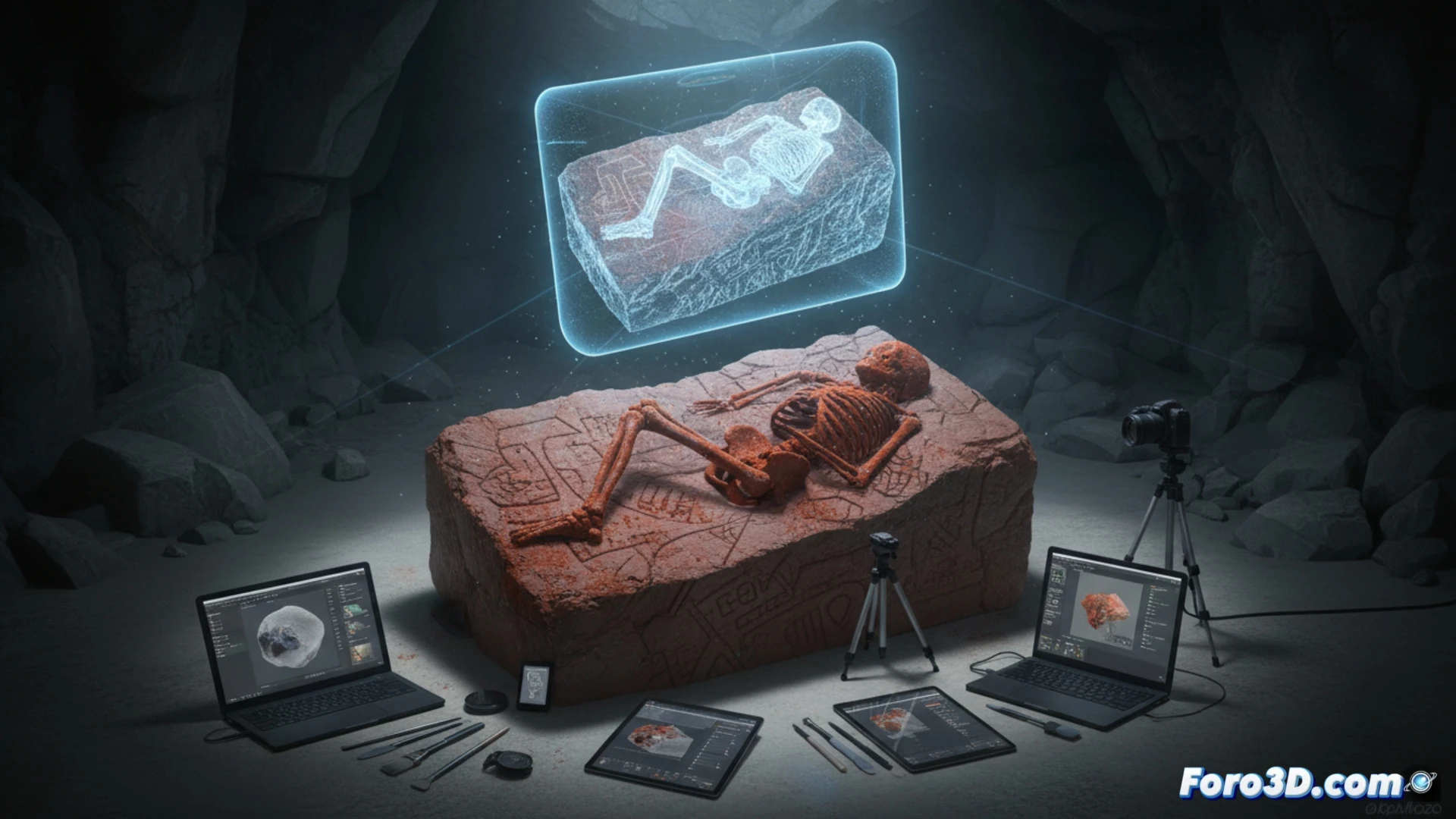
Photogrammetry and 3D scanning of the engraved block 🏺
The application of high-resolution photogrammetry on the stone block would allow capturing each engraved stroke with submillimetric precision. Through a set of convergent images and the use of raking light, the relief of the engravings, which are barely perceptible to the naked eye, could be enhanced. In parallel, 3D scanning of the skeleton, including areas with remains of red pigment, would generate a volumetric model that preserves the exact position of the ochre fragments. This point cloud would serve as the basis for a digital twin of the burial, allowing researchers to rotate, measure, and study the arrangement of the remains without physically handling them.
Virtual reconstruction and safe dissemination 🖥️
With the integrated 3D models, the original funerary scene could be virtually recreated. This reconstruction would allow analyzing hypotheses about the symbolic meaning of the engravings and their spatial relationship with the red-stained body. Furthermore, by publishing this data in open repositories, any researcher could access the discovery without traveling to Cantabria. Digital dissemination avoids degradation of the original due to exposure to light or humidity, ensuring that the Red Lady remains intact for future generations while the world explores her history.
How the digitization and virtual reconstruction of the funerary context of the Red Lady of El Mirón has been addressed, respecting the integrity of the 19,000-year-old archaeological heritage
(PS: and remember: if you can't find a bone, you can always model it yourself)