A female figure of titanic dimensions emerges on a 1,500-meter-high granite wall on the border of Guinea. Known as the Lady of Mali, this silhouette sparks an intense debate between geologists and archaeologists. Is it a prehistoric work of art or a whim of differential erosion? The answer could lie in the digital analysis of its surface.
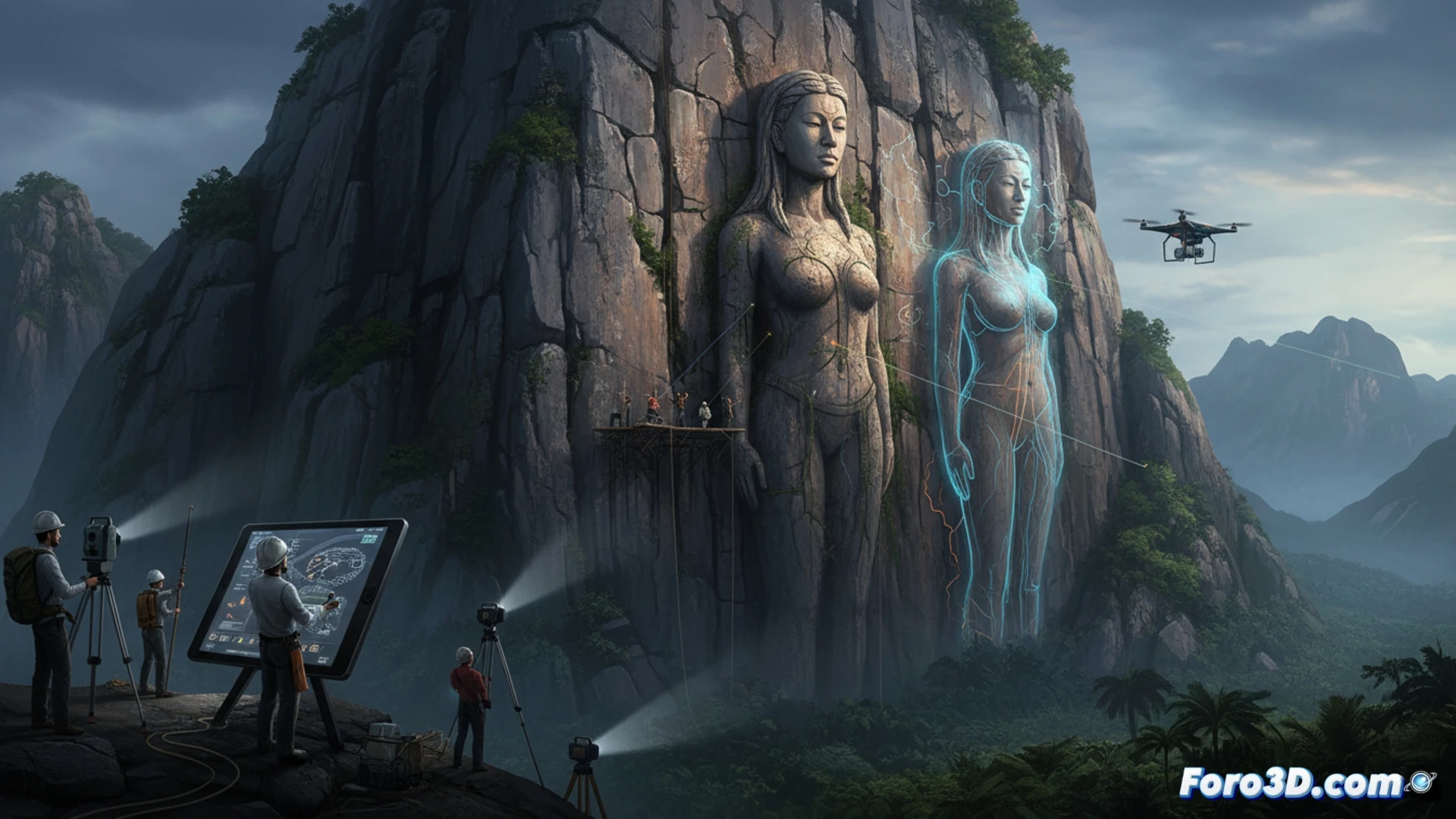
Virtual reconstruction and carving patterns 🏔️
To shed light on the mystery, a workflow based on aerial photogrammetry is proposed. Using drones and high-resolution satellite orthophotos, a textured 3D model of the cliff would be generated. The next step is facet analysis: computer vision algorithms can detect unnatural fracture planes, as well as the repetition of cutting angles that suggest the use of tools. If the Lady is artificial, its profile should show symmetries and contours that natural erosion does not usually produce. Comparison with other geoforms (such as the faces of the Appalachian Mountains) would serve as a statistical control to validate the hypothesis of human intervention.
The challenge of documenting the remote 🛸
Beyond the debate about its origin, the Lady of Mali poses a logistical challenge for digital archaeology. Its location in a hard-to-reach area with dense vegetation limits expeditions. However, 3D technology today allows the site to be virtually preserved without the need for invasive excavations. If its human craftsmanship is confirmed, we would be facing one of the largest rock reliefs in the world, a heritage that deserves to be modeled, cataloged, and protected before climate or looting erases it forever.
What specific technical challenges does the photogrammetry of a figure carved into a 1,500-meter-high granite wall, like the Lady of Mali, present, and how can they be overcome to obtain an accurate 3D model without compromising team safety?
(PS: If you dig at a site and find a USB stick, don't plug it in: it could be malware from the Romans.)