In 1974, workers on the banks of the Mures River in Romania discovered a metallic object alongside mastodon bones. The wedge-shaped piece was identified as nearly pure aluminum. Since industrial aluminum production did not begin until 1886, the find sparked theories about lost technology or extraterrestrial visits. However, digital archaeology today offers tools to debunk these myths with scientific evidence.
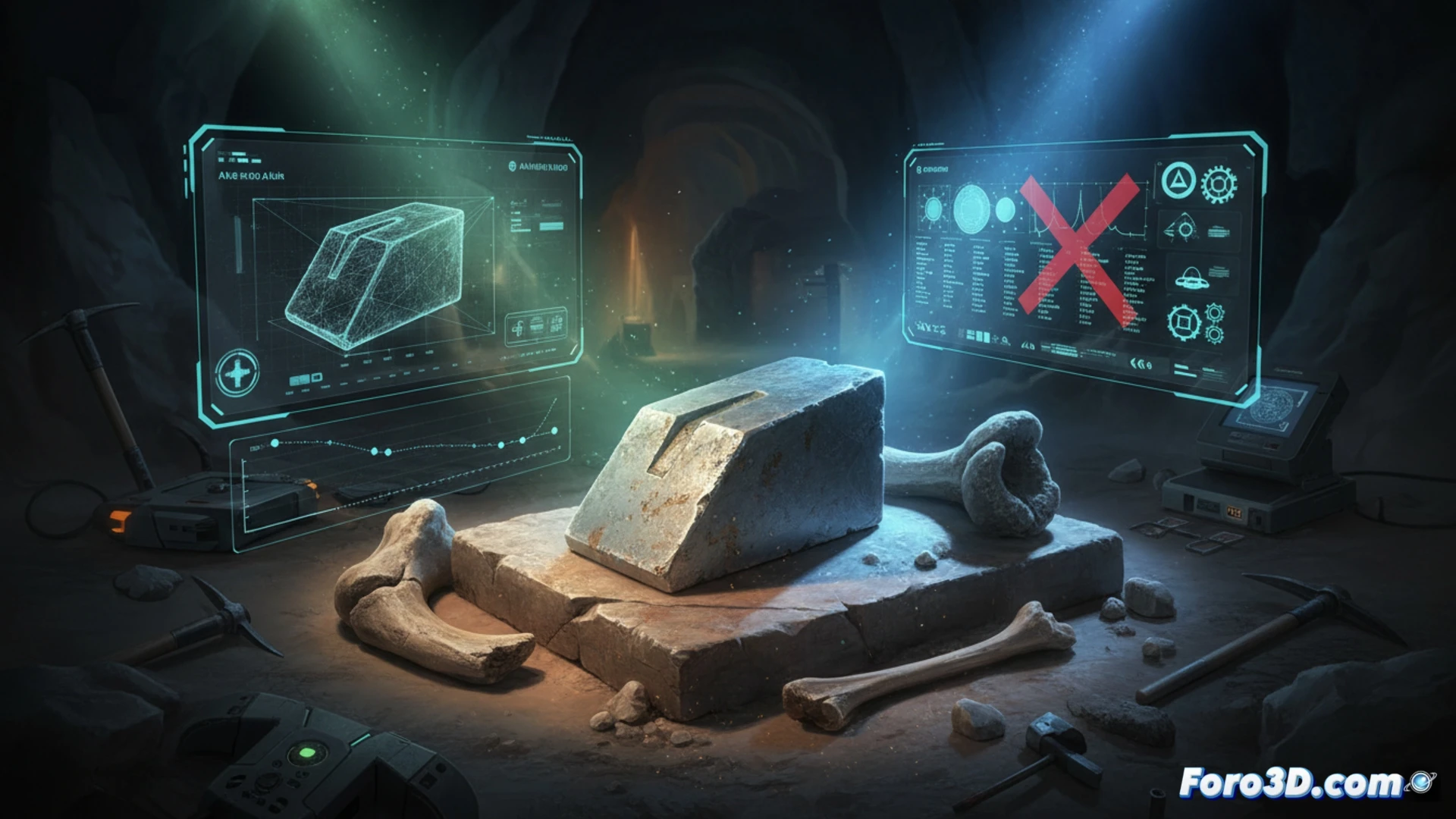
Photogrammetry, 3D Modeling, and Material Analysis 🛠️
To verify the authenticity of the Aiud Wedge, the first step would be to apply high-resolution photogrammetry. This process would capture hundreds of images of the object to generate a precise 3D model, allowing analysis of its manufacturing marks and wear without handling it. Subsequently, 3D modeling could virtually reconstruct the archaeological stratum where it was found, contrasting its position with the mastodon bones. Finally, a digital material analysis, based on spectrometry, would reveal the exact composition of the aluminum. The results would show whether it contains impurities typical of modern processes or, on the contrary, if it is a recent industrial alloy, confirming an accidental deposit at the ancient site.
Scientific Verification vs. Sensationalist Narrative 🔍
Digital archaeology not only debunks the myth but also recontextualizes the object. The Aiud Wedge is not an ancient mystery, but rather a probable fragment of 20th-century machinery that fell into the river and mixed with fossils. This case demonstrates how digital techniques — from virtual dating to oxidation process simulation — allow evidence to be separated from speculation. The real lesson lies not in primitive aluminum, but in the need to apply technological rigor before declaring a find inexplicable.
To what extent can digital surface analysis and scanning electron microscopy dismantle the legend of the Aiud Wedge as evidence of prehistoric aluminum?
(PS: If you dig at a site and find a USB, don't plug it in: it could be Roman malware.)