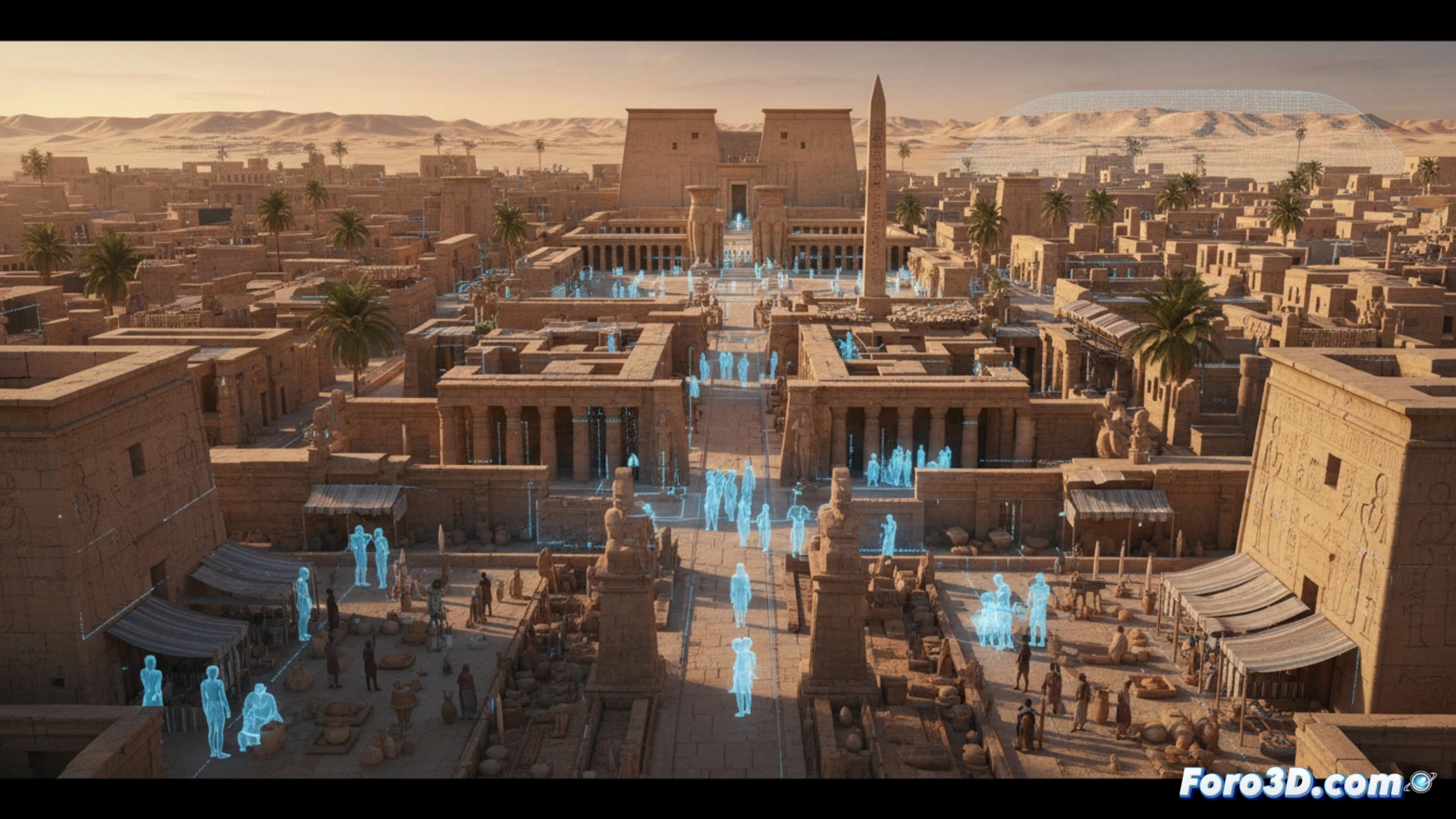
The recent discovery of a 3,000-year-old city beneath the sands of Luxor has been a milestone for archaeology. But the real technological leap has come with the documentation of the site using aerial drone photogrammetry and LiDAR scanning. These techniques have made it possible to create a digital twin of the intact city, offering a unique window into daily life in the New Kingdom without the need to excavate or risk the heritage.
Photogrammetry and LiDAR: the digital eye beneath the sand 🏛️
The field team deployed drones equipped with high-resolution cameras to capture thousands of aerial images at different altitudes. These shots were processed with photogrammetry software to generate a three-dimensional point cloud of each structure, from dwellings to warehouses. In parallel, terrestrial LiDAR scanning penetrated the surface layers of the ground, revealing the layout of buried streets and walls. The result is a precise polygonal mesh that allows measuring distances, volumes, and orientations of buildings with millimeter error, something impossible with traditional manual excavation methods.
The value of exploring without touching 🏺
This digital twin not only preserves the current state of the site for future generations but also democratizes access to knowledge. Archaeologists from around the world can virtually tour the rooms, analyze the arrangement of ovens, silos, and workshops, and even study everyday objects abandoned three millennia ago. Technology allows us to understand how life was organized in the Golden City without altering a single layer of sediment, thus protecting a legacy that the sand had kept in perfect condition.
What technical and ethical challenges does creating a digital twin of a 3,000-year-old city from fragmentary archaeological data pose, and how could this model change our interpretation of daily life in Ancient Egypt?
(PS: If you dig at a site and find a USB stick, don't plug it in: it could be Roman malware.)