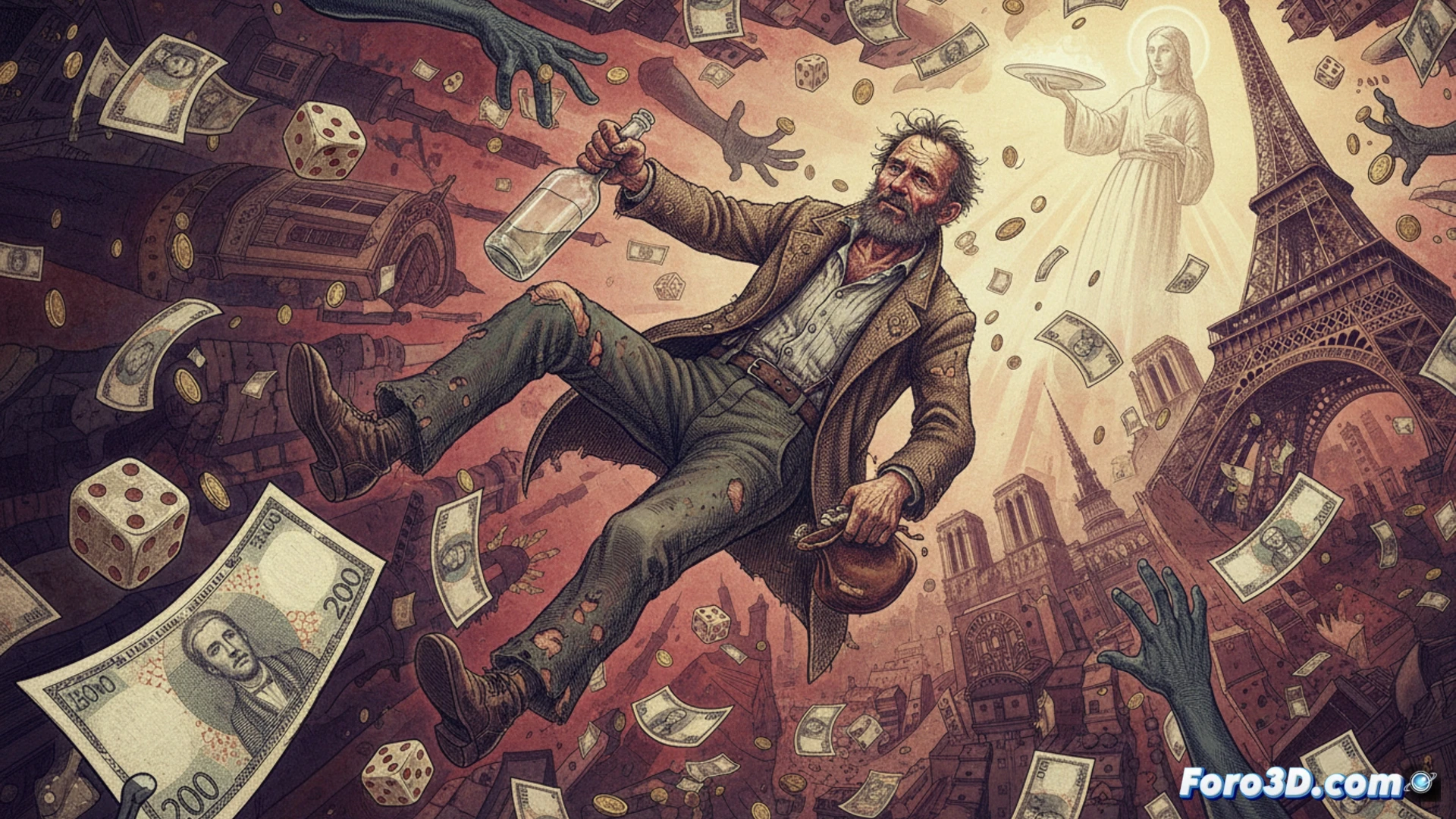
In The Legend of the Holy Drinker, Joseph Roth tells the story of Andreas, an alcoholic vagabond in 1930s Paris. A stranger lends him 200 francs on the condition that he returns them to the local saint. Andreas tries to redeem himself, but his addiction and human frailty drag him back into failure time and again. The novel raises an uncomfortable question: is redemption possible when chance and hopelessness govern our lives? Carmen María Konnikova's work on luck complements this vision.
The paradox of code: when the algorithm decides for you 🤖
If Andreas lived today, his story would intersect with recommendation systems and betting platforms. Current algorithms, trained on behavioral data, detect addiction patterns and deliver addictive content with pinpoint precision. Luck, as Konnikova points out, is not random: it is conditioned by interface design and choice architecture. Thus, Andreas's failure would be replicated in a loop of notifications and microtransactions, where redemption would be buried under layers of code.
The holy drinker and the app of shame 📱
The most ironic thing is that today Andreas would have an app to measure his sobriety, with reminders and progress charts. But like a good antihero, he would use it to ask for a quick loan from the local saint, spend it on cheap wine, and blame the algorithm for suggesting a nearby tavern. In the end, neither technology nor luck can overcome human stubbornness. Roth knew it: redemption is a poorly told joke, and we, poor mortals, are the audience that laughs while crying.