The colonization of Mars faces a critical obstacle: the lack of metals like molybdenum, essential for durable infrastructure. Engineer Serena Suriano proposes extracting these resources from the asteroid belt, but orbital logistics reveal a brutal energy gap. A Starship-class vessel, with 1,100 tons of fuel, only achieves 6.4 km/s of delta-v, insufficient for the required round trip of 12.8 km/s.
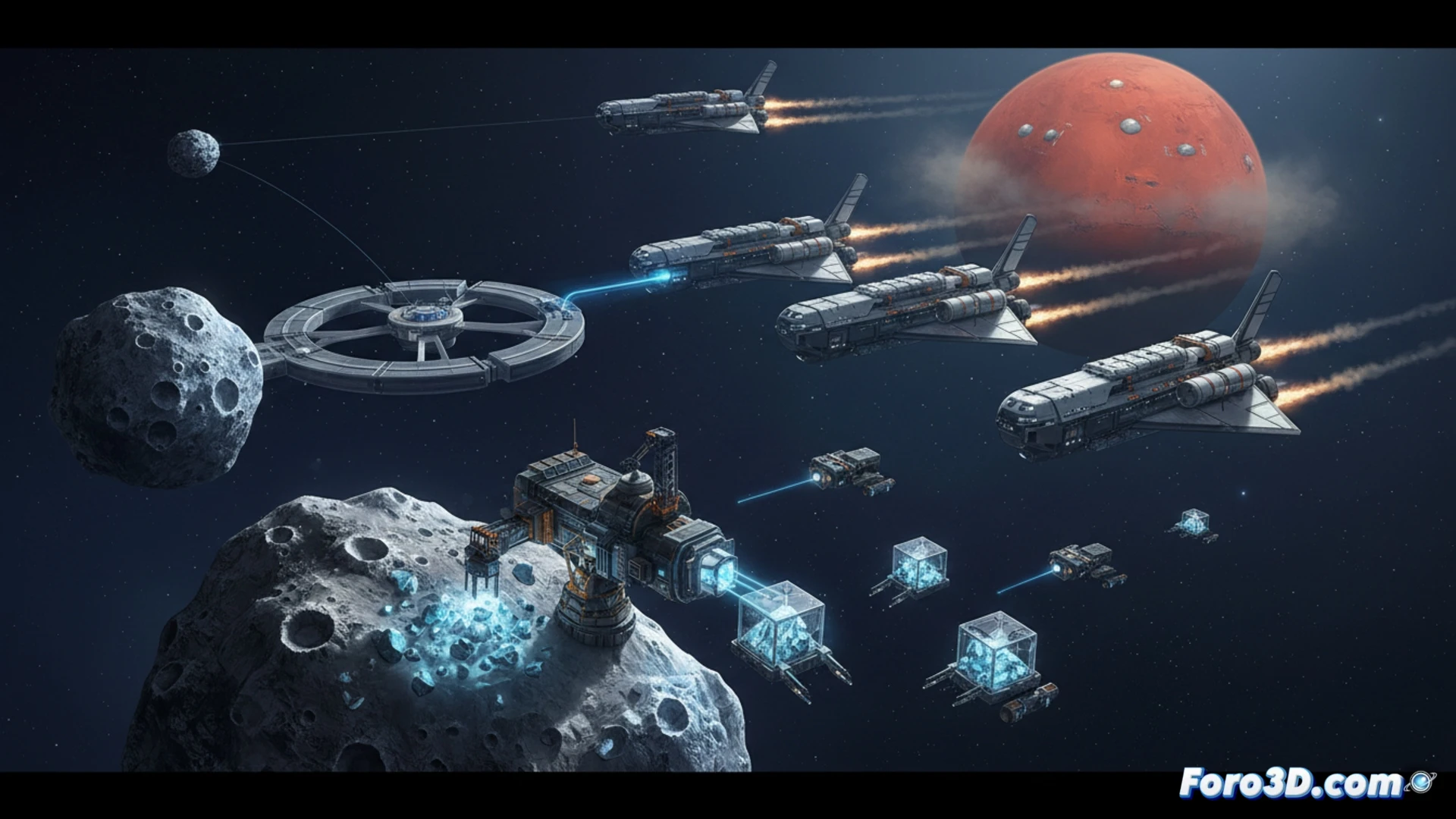
3D Modeling of the Orbital Route and Risk Points 🚀
Let's visualize this supply chain as a 3D model with three nodes. Node A is Mars, where the demand for molybdenum is critical. Node B is a metallic asteroid, the primary source. Node C is a C-type asteroid, rich in water and hydrocarbons, acting as a refueling station. The material flow is unidirectional: from B towards Mars, with a mandatory stop at C to produce propellant. The main risk point is the insufficient delta-v between Mars and B; without the stop at C, the return journey is impossible. In the model, this is represented as an energy bottleneck that is only resolved with on-site fuel production.
Geopolitical Lessons for an Interplanetary Economy 🌍
This route replicates, on a cosmic scale, the dilemmas of terrestrial supply chains: dependence on single extraction points, the need for intermediate infrastructure, and vulnerability to energy costs. On Earth, molybdenum is concentrated in China and Chile; in space, its access depends on a complex orbital choreography. Whoever controls the C-type asteroids, rich in volatiles, will dominate Martian logistics. Colonization is not just a technical challenge, but an exercise in space geopolitics where every stop is a strategic link.
Considering the current challenges of terrestrial logistics, such as the semiconductor shortage or dependence on critical nodes like the Strait of Malacca, what lessons of resilience and geopolitical risk might we be underestimating when designing an interplanetary supply chain that relies on asteroid mining to supply a colony on Mars?
(PS: 3D geopolitics looks so good it makes you want to invade countries just to see it rendered)