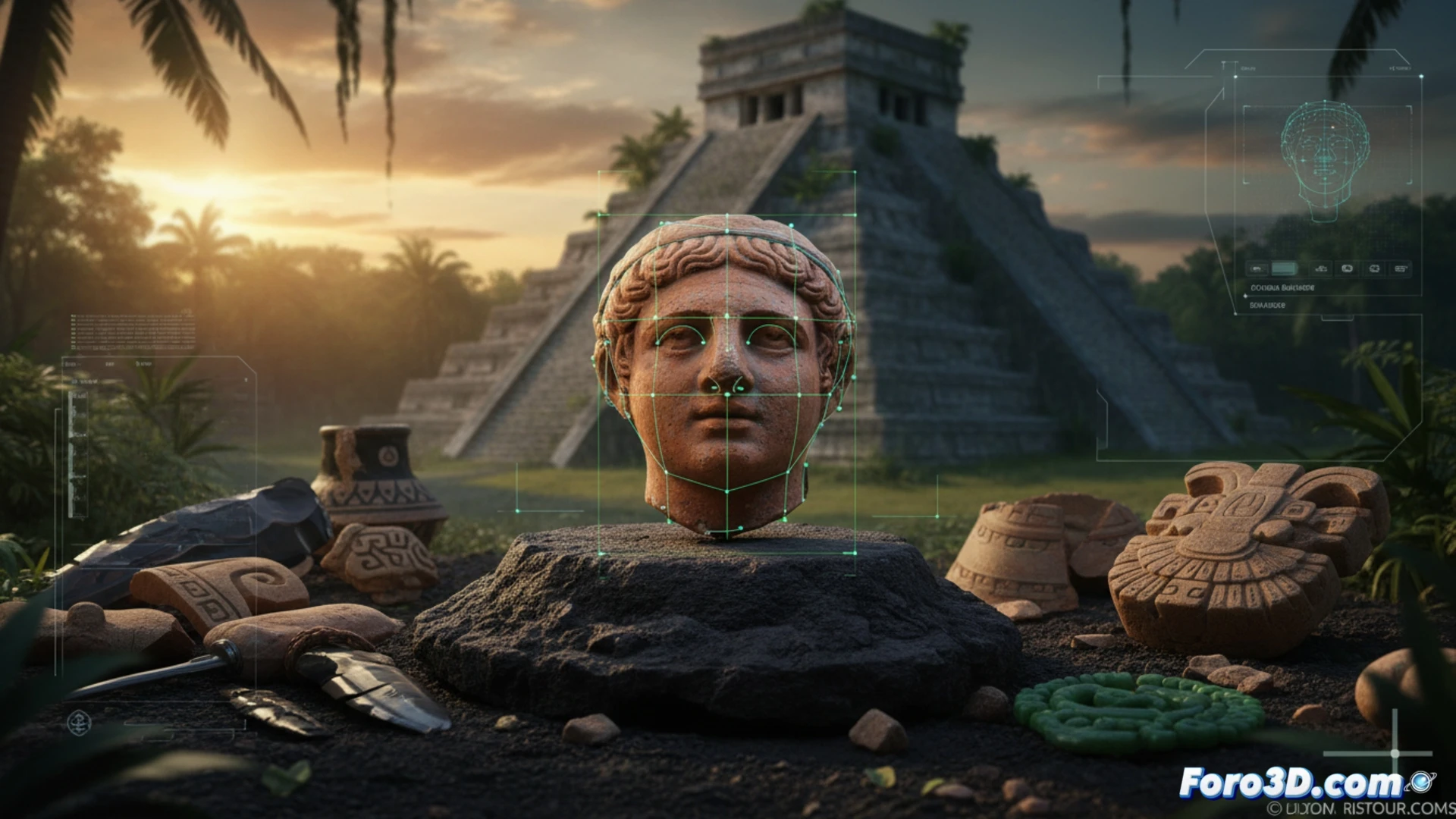
In 1933, a small terracotta head emerged from a pre-Hispanic burial in the Toluca Valley, Mexico. Its appearance, with a beard and features evoking classical Roman art, immediately challenged the established chronology. The dating of the context, prior to the arrival of the Spanish, suggests a transoceanic contact impossible for orthodox archaeology. Today, digital archaeology allows us to re-examine the evidence without prejudice.
3D Scanning and Comparative Feature Analysis 🏛️
To address this controversy, we propose a digital archaeology workflow. First, a high-resolution 3D scan via photogrammetry of the piece, capturing every micro-detail of the terracotta. This model would undergo morphometric analysis to compare its cranial and facial proportions with databases of Roman sculptures from the Hellenistic period and pre-Hispanic figures from the Mesoamerican Postclassic. The goal is not only to seek aesthetic similarities but to identify technical manufacturing processes, such as the use of molds or specific tools, which could indicate its origin. Interactive visualization of the 3D model would allow researchers to rotate and zoom in on the piece in real time, revealing details of the beard, hairstyle, and headdress that are difficult to appreciate in photographs.
Virtual Reconstruction and the Weight of Doubt 🔍
Creating a virtual reconstruction of the burial where the head was found is key. We could simulate the stratigraphic context and the relative position of the piece concerning other objects, such as pots and skeletons, to assess whether there was a later intrusion or a primary deposit. This digital exercise does not solve the mystery but allows us to visualize hypotheses: from a modern fraud to a relic from a Roman shipwreck. Technology does not provide the final answer, but it forces us to ask more precise questions about the past, demonstrating that digital archaeology is the perfect tool for debating the great enigmas of history.
What 3D scanning techniques and material analyses could be applied to the Tecaxic-Calixtlahuaca head to determine whether its style and composition correspond to a Roman or pre-Hispanic context?
(PS: If you dig at a site and find a USB, don't plug it in: it could be malware from the Romans.)