In 1954, archaeologists discovered a sealed pit at the foot of the Great Pyramid of Giza. Inside, disassembled into 1,224 pieces of cedar and sycamore wood, lay the Solar Boat of Khufu, a 43-meter-long ceremonial vessel 4,500 years old. Its state of preservation was exceptional, but any physical manipulation posed a risk of irreversible deterioration. This discovery posed an immediate challenge: how to document and study such a fragile structure without touching it. The answer came decades later with three-dimensional scanning technologies.
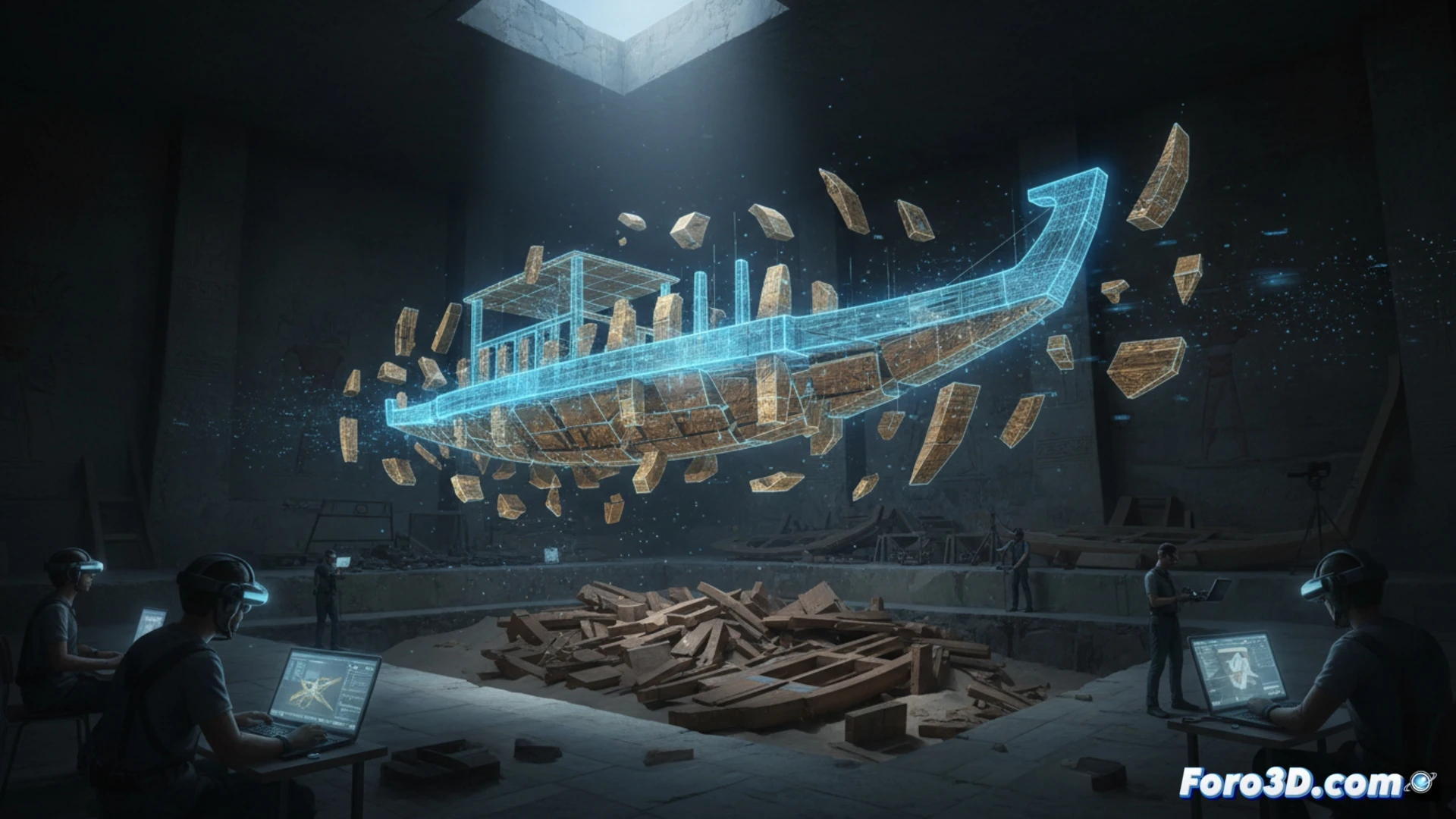
Photogrammetry and laser scanning: the pharaoh's digital twin 🏛️
The Solar Boat 3D project team used high-resolution photogrammetry and laser scanning to capture every joint, every wood fiber, and every remnant of esparto grass rope. Over 10,000 images were taken from all angles, processed using correlation algorithms to generate a point cloud with submillimeter precision. The result is a navigable three-dimensional model that allows Egyptologists to inspect the interior of the hull without opening the acrylic display cases protecting the original. This digital twin has revealed copper tool marks and assembly details that went unnoticed in the physical reconstructions of the 1970s, such as the absence of caulking, suggesting the boat was never used on the Nile.
Solar boat or funerary vessel? The digital debate ⚖️
The virtual reconstruction not only documents but also allows for hypothesis formulation. By simulating the placement of oars and the square sail in the 3D model, researchers have verified that the boat lacks a keel and an effective steering system, reinforcing the theory that it was a purely ritual object. Some scholars argue it served for the pharaoh to travel alongside the god Ra on his celestial journey; others, that it transported Khufu's body during his funeral. Digital archaeology does not resolve the debate, but it allows any user to download the model and draw their own conclusions, democratizing a four-thousand-year-old mystery.
What specific technical and methodological challenges does the team of digital archaeologists face when reconstructing the Solar Boat of Khufu in 3D from its 1,224 original wooden pieces?
(PS: If you dig at a site and find a USB drive, don't plug it in: it could be Roman malware.)