Kunihiko Ikuhara, trained at Toei Animation, is the architect of Sailor Moon's most memorable era. His artistic vision, laden with surrealism and abstract symbolism, has made him a benchmark in auteur anime. With works like Utena, Mawaru Penguindrum, and Sarazanmai, he transforms shoujo aesthetics into a tool for critiquing social structures and conventional narratives.
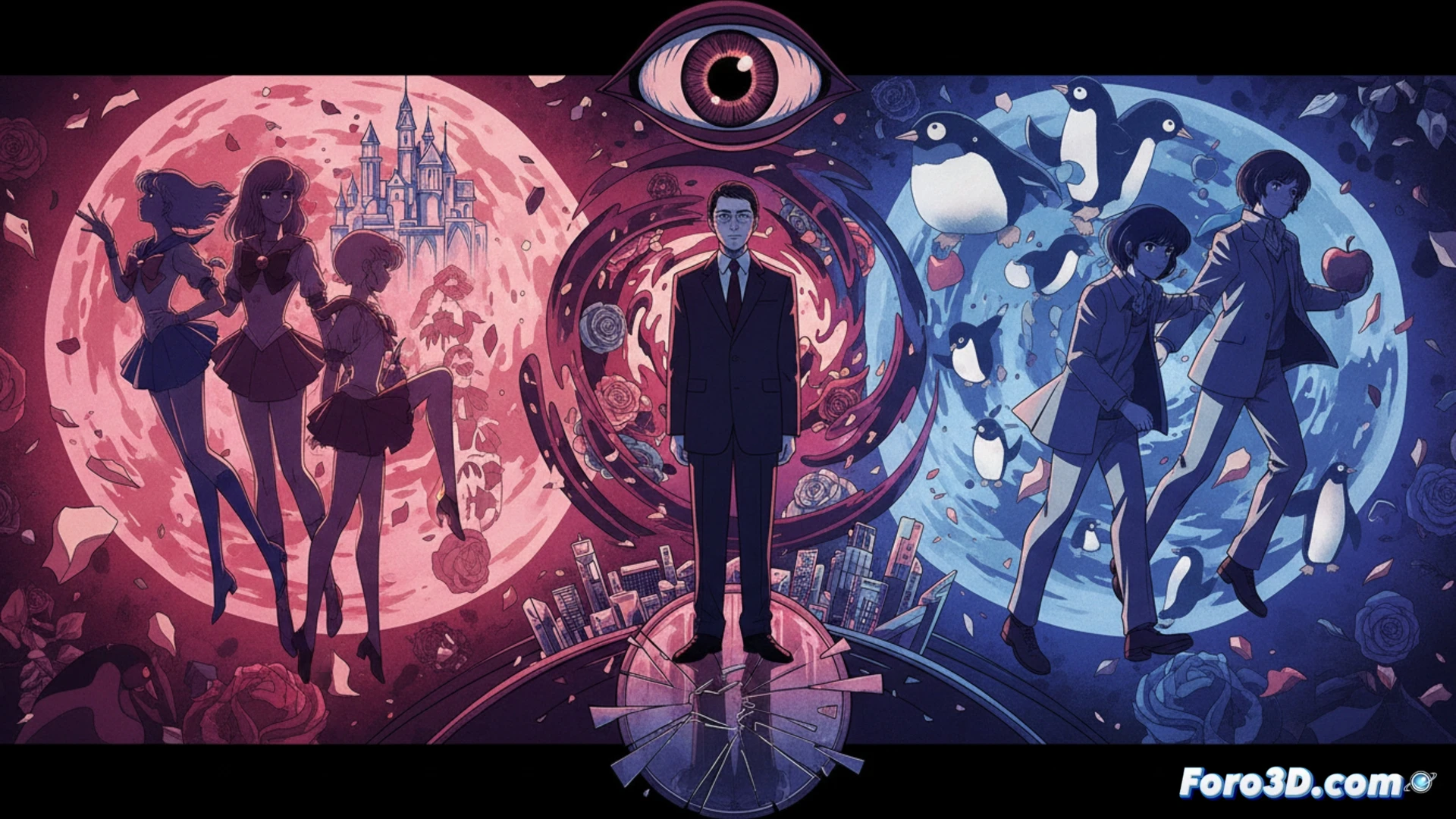
The technical engine behind Ikuhara's visual revolution 🎬
The production of his series demands animation teams with a high tolerance for detail and abstraction. His storyboards include repetitive shots and abrupt transitions that require precise control of timing. The use of distorted backgrounds and saturated color palettes demands meticulous digital composition work. In Mawaru Penguindrum, camera effects and non-linear editing break narrative continuity, forcing the viewer to interpret dense visual symbols. Ikuhara demands almost surgical coordination from his directors of photography and art so that each visual metaphor works without relying on textual explanations.
How to explain to your grandma that you're watching a penguin dance on loop 🐧
Watching an Ikuhara work is like trying to assemble IKEA furniture without instructions: you know there's a structure, but you don't understand why there's a floating apple or a prince turning into a car. If your grandma walks in while you're watching Sarazanmai and sees three boys transforming into kappa singing about desire, don't try to explain it. Just say it's contemporary Japanese art and change the channel quickly before the rabbit hat appears.