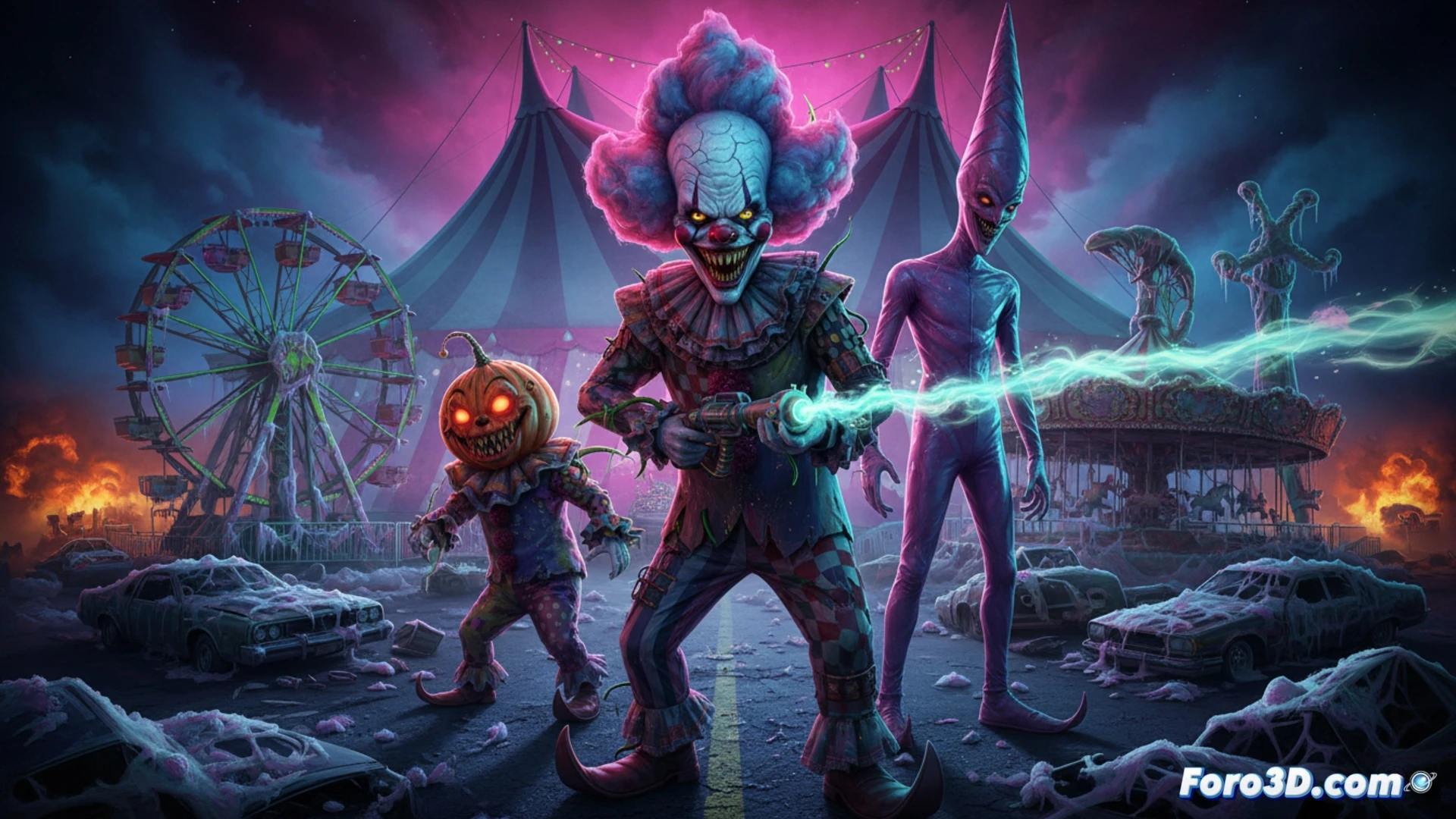
IllFonic has once again demonstrated its mastery of the asymmetric genre with Killer Klowns from Outer Space: The Game. But beyond the gameplay, the title is a technical marvel that pays homage to the 1988 cult film. Using Unreal Engine 4 as a foundation, the team managed to capture the essence of the original practical effects, transforming them into a hyper-realistic and stylized 3D model that breathes the chromatic saturation of the eighties. 🎪
Technical Pipeline: Modeling in Maya, Sculpting in ZBrush, and Effects with Niagara 🛠️
The process of creating the Klowns began with a rigorous study of the film material. The artists used Maya for retopology and the base structure of the characters, ensuring that the exaggerated proportions of the space clowns maintained their visual weight. Subsequently, ZBrush was the key tool for sculpting the organic details of the rubber masks and the folds of the costumes, mimicking the texture of real latex suits. The biggest technical challenge was the implementation of the cotton candy weapons. To achieve this, IllFonic leveraged UE4's Niagara system, creating volumetric particles that simulate the density and satiny sheen of the candy, optimizing performance through dynamic LODs to maintain 60 fps on consoles without losing the sticky, fluorescent aesthetic.
Lessons for Developers: Retro Fidelity Without Sacrificing Real-Time 💡
Killer Klowns is a case study in how technical limitation can be a virtue. Instead of seeking generic photorealism, IllFonic embraced the neon lighting and hard shadows characteristic of B-movie cinema. The key was the use of low-resolution textures with high chromatic contrast, a ZBrush trick to preserve wrinkle detail without consuming memory. For any developer, the message is clear: visual fidelity does not always lie in the polygon count, but in artistic coherence and mastery of tools like Niagara to bring to life weapons that seem pulled from a sugar dream.
In the development of Killer Klowns, how did IllFonic manage the technical challenge of translating the organic and cartoonish character design from ZBrush to an engine like Unreal Engine 4 without losing the essence of eighties horror in the animations and real-time lighting?
(PS: a game developer is someone who spends 1000 hours making a game that people complete in 2)