The independent project Killer Bean has captured the attention of the development community for its bold combination of procedural open-world generation and a B-movie action aesthetic. Developed in Unreal Engine 5, the title not only seeks a vast procedural setting but wraps it in controlled chaos of ragdoll physics and exaggerated particle effects. This technical analysis breaks down how the team leverages the engine's tools to achieve this unique style, exploring the asset pipeline and optimizations needed to maintain real-time fluidity.
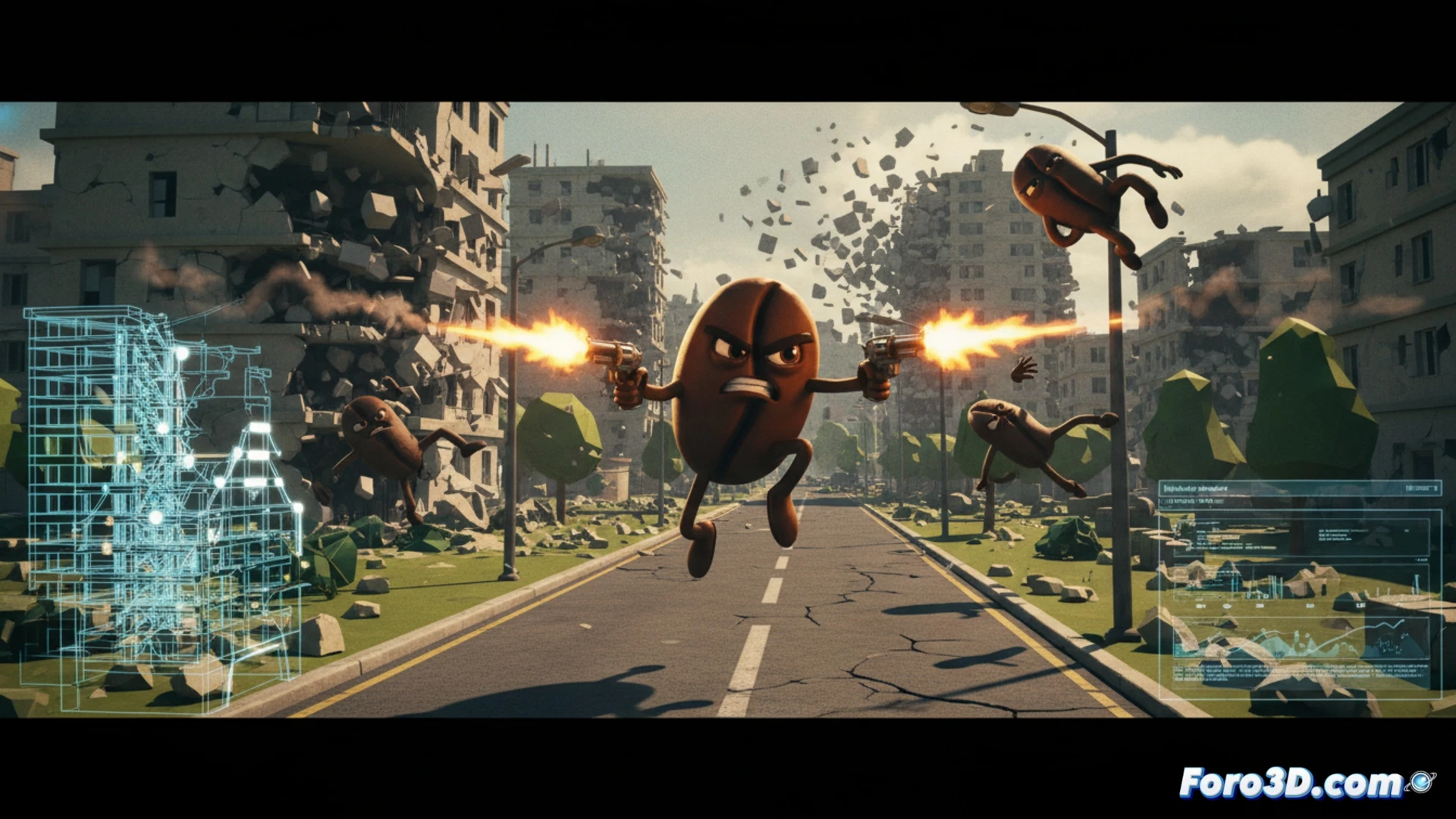
Procedural pipeline: from Maya to UE5 with real-time optimization 🎮
Killer Bean's workflow relies on a hybrid pipeline that combines traditional modeling in Maya with custom procedural generation tools. The team builds base assets, such as characters and vehicles, in Maya, applying clean, low-polygon topology to facilitate procedural scaling. These models are imported into Unreal Engine 5, where the procedural generation system deploys the open world, distributing elements like buildings and cover randomly yet coherently. The key lies in optimizing assets for real-time: dynamic LODs and low-resolution textures are used, scaled via UE5's Virtual Texture system, allowing the engine to render large expanses without sacrificing performance. Additionally, the developer has implemented an object pooling system for ragdoll physics, limiting the number of simultaneously active bodies to avoid overloading collision calculations, a common challenge in massive chaos scenes.
Controlled chaos: the art of physics and exaggerated VFX 💥
Killer Bean's B-movie style materializes in its ragdoll physics and particle effects system. Instead of seeking realism, the team embraces exaggeration: enemies fly through the air upon impact, with animations prioritizing spectacle over physical accuracy. This is achieved by adjusting mass and gravity parameters in UE5's physics engine, along with a particle system that generates highly saturated explosions and flashes. The developer notes that the key is balance: although effects are exaggerated, they must feel reactive and not break immersion. The interview reveals that Niagara is used for VFX, with emitters triggering in sequence to simulate chaos, while the ragdoll system is combined with procedural animations so bodies react comically yet predictably—an approach that optimizes performance without losing the characteristic low-budget action film style.
What specific technical challenges does integrating B-movie style physics with procedural environment generation in Unreal Engine 5 present, and how has the conflict between the need for kinematic control of collisions and the randomness of the open world been resolved?
(PS: game jams are like weddings: everyone is happy, no one sleeps, and you end up crying)