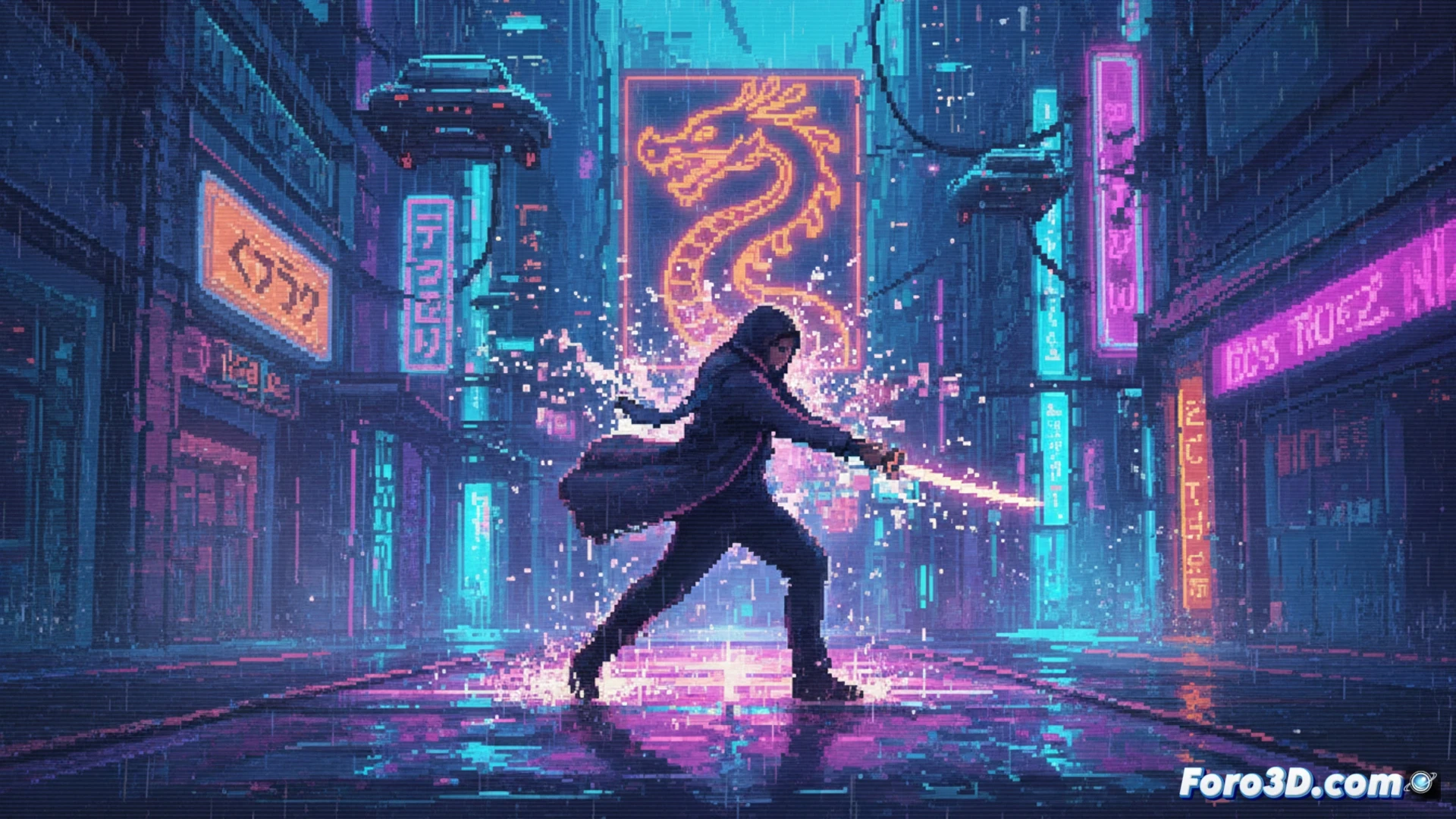
The development of Katana ZERO represents a case study in resource optimization within the GameMaker Studio 2 engine. Far from pursuing photorealism, the Askiisoft team opted for a pixel art aesthetic with neon palettes, complemented by a particle system and VHS tape distortion effects. The goal was not merely decoration, but to build a visual interface that communicates to the player the sensation of manipulating time, using technology as a narrative vehicle.
Workflow between Aseprite and the particle system 🎨
The creation of sprites and combat animations was carried out entirely in Aseprite, a tool that allows precise control over the limited color palette and frame-by-frame animation. Once exported, these sprites were integrated into GameMaker Studio 2, where the real technical challenge lay in the particle system. To simulate temporal distortion, the developers implemented custom shaders that generated a line-sweep effect and chromatic shift, mimicking the failure of a VHS tape. The key was synchronizing these particles with the game's pause state, making the environment react dynamically without causing performance drops on modest hardware.
Technical decisions that enhance visual narrative ⚙️
The choice of GameMaker Studio 2 was no coincidence. Its efficient handling of surfaces and buffers allowed real-time post-processing effects, such as motion blur and chromatic aberration, without needing heavier engines. By combining this with low-resolution sprites, the game maintains consistent fluidity even during the most chaotic sequences. The lesson here is clear: limiting tools can be an advantage if the visual design is planned from the first frame, using every pixel and every particle to reinforce the gameplay experience, not just to embellish it.
How did the Katana ZERO team implement the real-time VHS distortion effect with GameMaker Studio 2 without compromising the pixel art performance and precise combat gameplay?
(PS: optimizing for mobile is like trying to fit an elephant into a Mini Cooper)