The launch of Atelier Yumia: The Alchemist of Memories and the Imagined Land marks a technical milestone for Koei Tecmo as it brings its proprietary Katana Engine to a full open world. The novelty lies not only in the size of the setting, but in the integration of a day/night cycle that directly impacts gameplay, modifying the availability of alchemical materials depending on the time. This article breaks down the production pipeline and the dynamic lighting challenges faced by the technical art team. 🌍
Asset pipeline: From Maya to Substance Painter in open world 🛠️
The workflow documented by Koei Tecmo reveals a production chain focused on resource optimization for open world streaming. Base models are sculpted in ZBrush and retopologized in Maya, where high and low polygon geometries are prepared. The key to visual realism lies in Substance Painter, where PBR textures are generated, allowing Katana Engine to render materials such as alchemical metals and crystals with dynamic light response. To manage performance, the team implements an aggressive LOD (levels of detail) system and occlusion culling that prioritizes objects near the player, avoiding frame drops in dense vegetation areas or cities.
Dynamic lighting as a game driver 💡
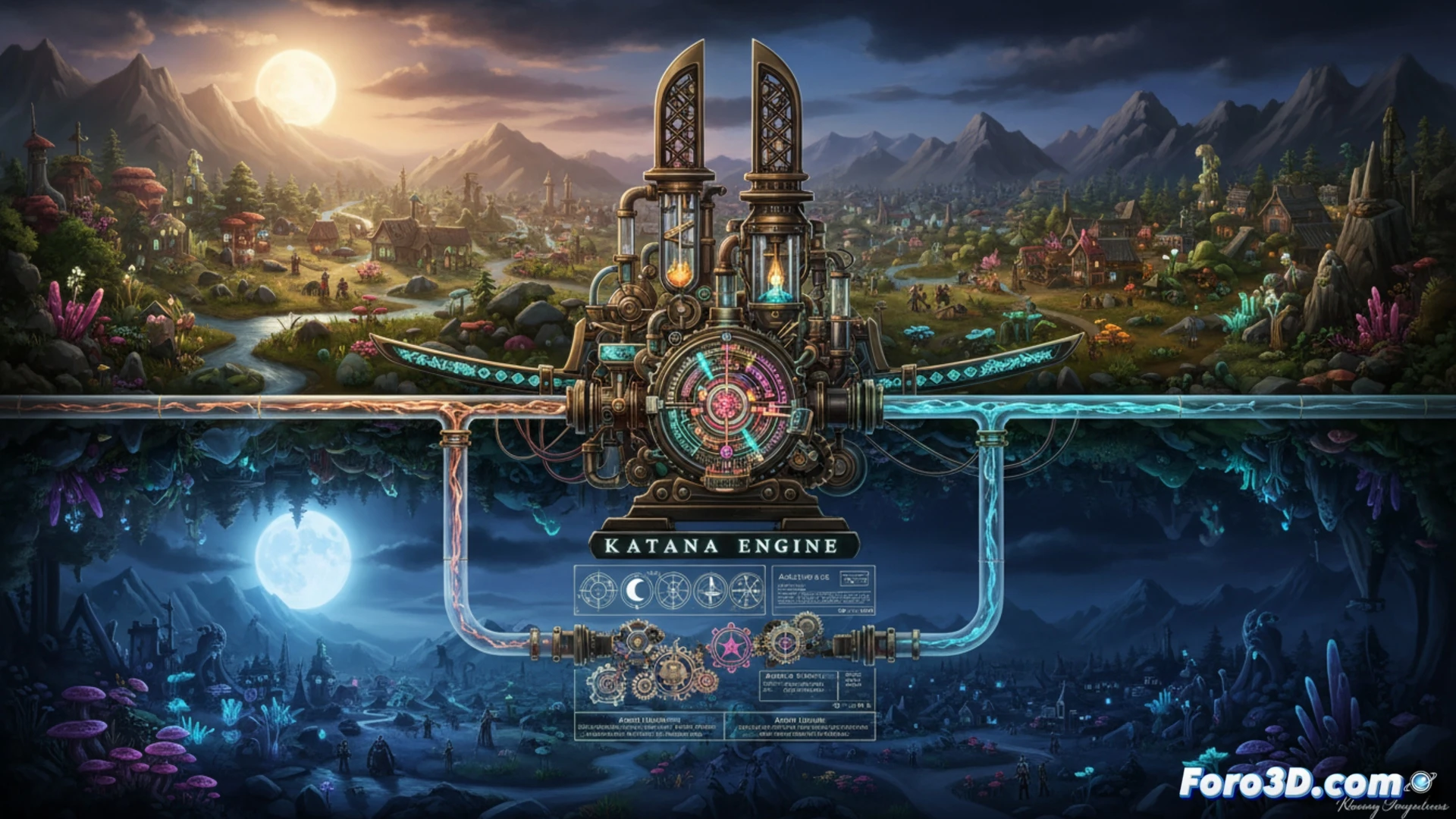
Koei Tecmo's riskiest decision was linking ingredient gathering to the time of day, forcing Katana Engine to recalculate shadows and light bounces in real time without sacrificing frames per second. According to interviews with the technical team, the static global time system was discarded in favor of a hybrid system: the main lighting is pre-calculated at key times (dawn, noon, dusk, and night) and smoothly interpolated between these states. This allows the engine to consume fewer resources than a fully dynamic light system, maintaining visual coherence so the player can visually identify which plants or minerals are available at that precise moment in the cycle.
How Katana Engine optimizes the real-time representation of the alchemical cycle to achieve material and particle fusion without sacrificing performance in open environments like those in Atelier Yumia
(PS: optimizing for mobile is like trying to fit an elephant into a Mini Cooper)