A structural failure in an extrusion-printed concrete column revealed a dangerous weakness: the cold joint. 3D analysis through scanning with Creaform and simulation in Abaqus quantified a 40% loss in mechanical adhesion between layers. This defect, caused by a delay of only 5 minutes in printing, demonstrates how material fatigue at critical interfaces can compromise the integrity of large-scale additive structures.
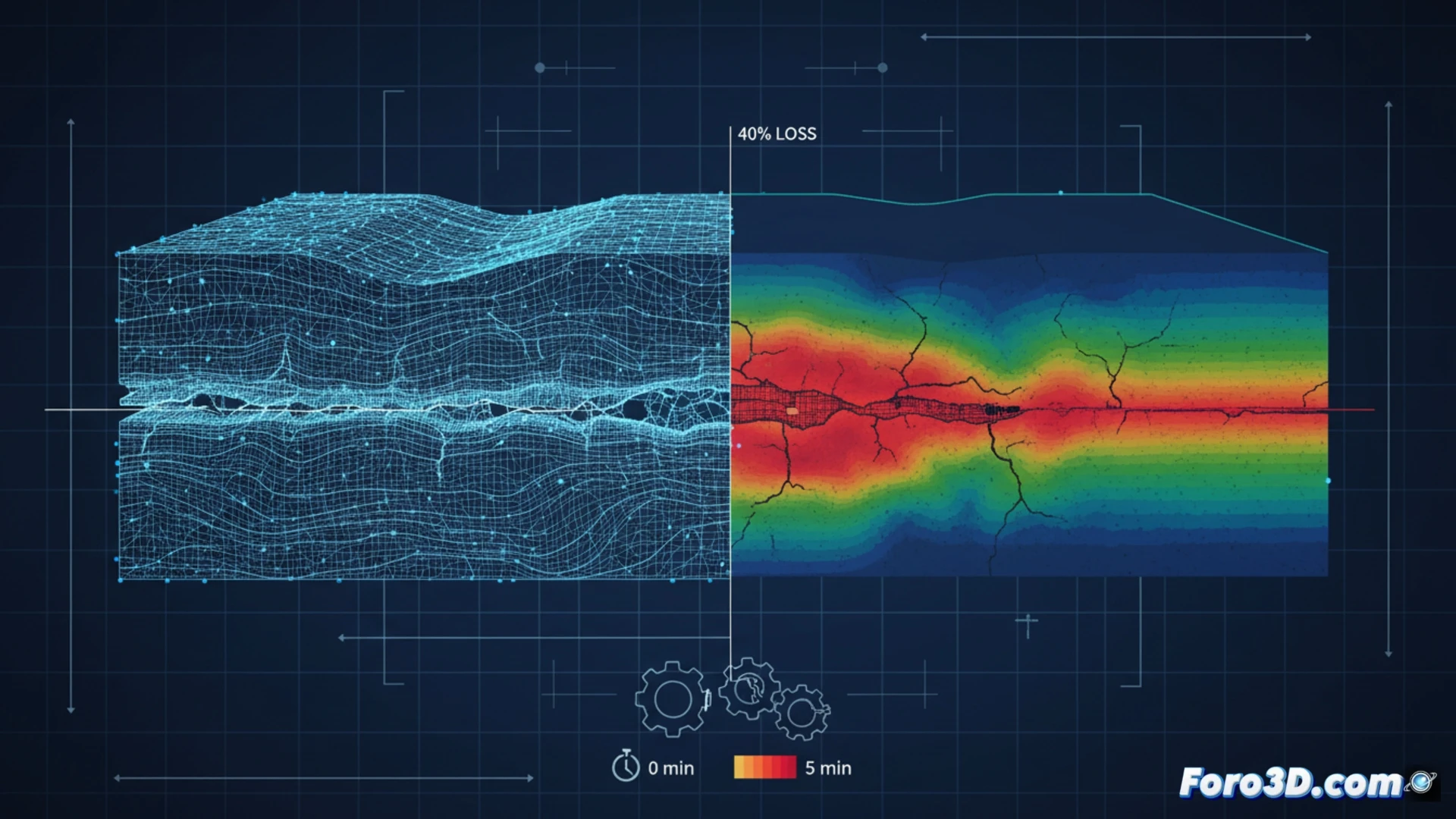
Workflow: From Scanning to Contact Simulation 🔬
The process began with scanning the failed column using Creaform VXelements to generate a high-resolution point cloud. With CloudCompare, the geometries of the affected layers were aligned, and the morphology of the cold joint was extracted. This realistic model was imported into Abaqus, where a nonlinear contact analysis was defined. The finite element simulation modeled the interface as a cohesive surface, revealing that the maximum shear stress was concentrated at the edge of the delayed layer, initiating premature cracking. The effective friction coefficient was reduced by 40% compared to a properly hydrated joint.
Implications for Material Fatigue in Additive Manufacturing ⚙️
The cold joint acts as a fatigue notch in the concrete, creating a preferential path for crack propagation under cyclic loads. This study demonstrates that printing parameters, such as interlayer time, are critical for durability. The integration of 3D scanning and numerical simulation allows predicting these weak points and adjusting extrusion speed or ambient humidity, avoiding catastrophic failures in tall columns.
How can the transition zone of a cold joint in a 3D printed concrete column be accurately modeled to predict its behavior under cyclic loads through finite element analysis?
(PS: Material fatigue is like yours after 10 hours of simulation.)