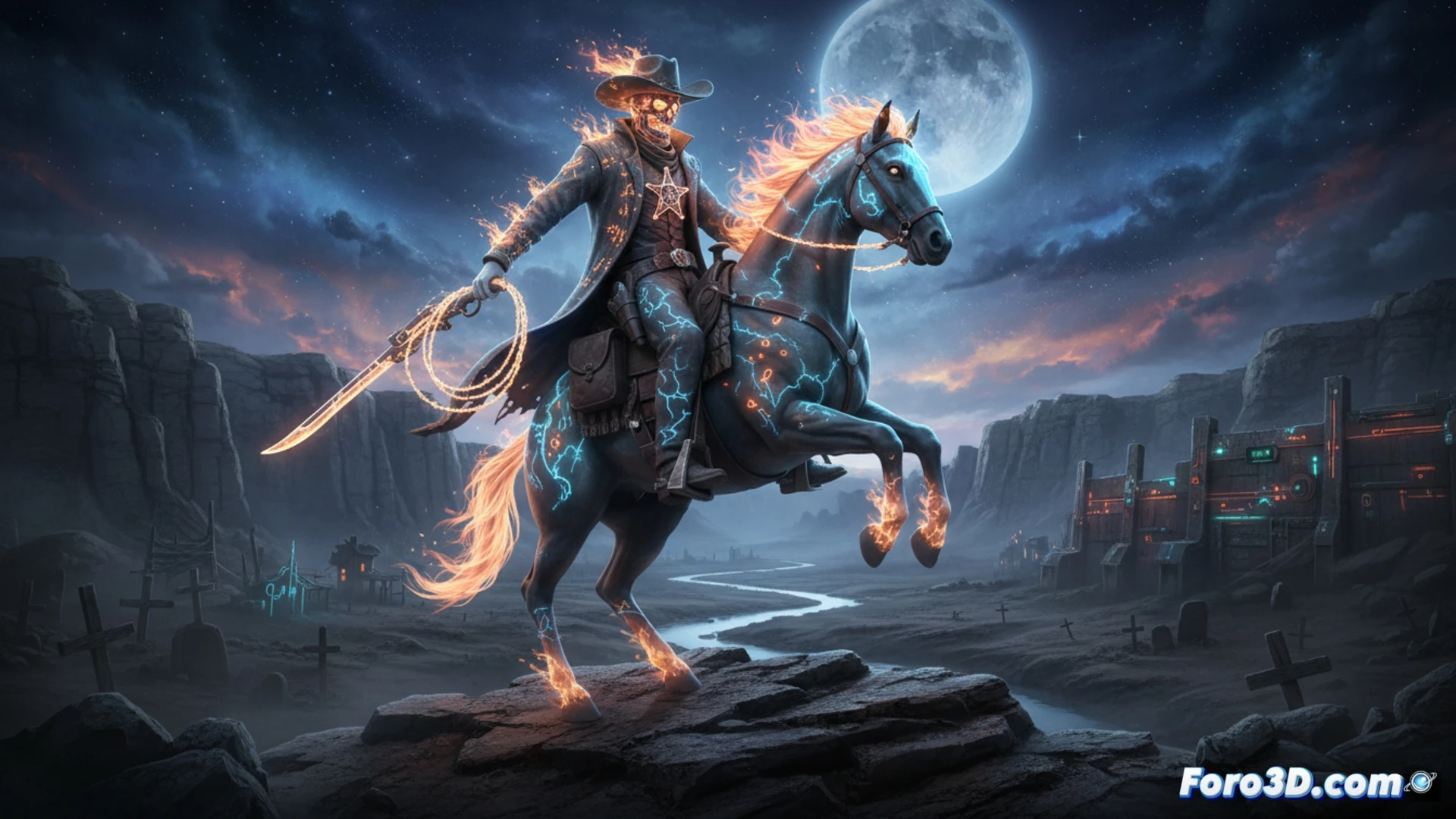
The Phantom Rider, known in Spanish as Jinete Fantasma, is a Marvel character created by Gary Friedrich and Herb Trimpe who embodies the spectral vigilance of the American Southwest. His figure, mounted on a ghostly horse, represents a form of popular justice that transcends death. In the context of digital art and activism, this archetype offers a rich field of study for analyzing how 3D modeling tools can update narratives of identity, territory, and historical memory, transforming a Western myth into a symbol of contemporary resistance.
Technical reinterpretation: spectral modeling and equine symbolism 🐎
To approach the Phantom Rider from 3D design, it is key to focus on two elements: the spectral aesthetic and the silhouette of the horse. The rider's modeling must prioritize a translucent and ethereal appearance, achieved through opacity maps and light dispersion shaders in engines like Unreal Engine or Blender. The ghostly horse, for its part, is not a simple steed, but a vehicle of symbolism: its mane and tail can be animated with smoke or will-o'-the-wisp particles, and its bone structure can be exaggerated to evoke a connection with the underworld. Techniques such as retopology for smooth animation and the use of procedural textures to generate a supernatural glow are essential to endow the character with a visual presence that dialogues with the historical injustices of the border.
Visual activism: the specter as a denunciation of erased territories 🌵
The true potential of the Phantom Rider in digital art lies in its ability to embody discourses on historical memory. By rendering his figure in desert landscapes generated through photogrammetry of areas in the American Southwest, a visual tension between the real and the spectral can be created. This technique allows for the denunciation of land appropriation and systemic violence against Indigenous and mestizo communities. The ghost horse, then, ceases to be a simple accessory and becomes a vehicle of visual justice: its gallop over digital territories reminds us that the wounds of the past remain present, demanding to be seen and repaired.
As a digital artist, how could the 3D figure of the Phantom Rider be used to resignify the historical memory of the border and denounce current social injustices without falling into cultural appropriation or visual sensationalism?
(PS: if your virtual reality installation doesn't change the world, at least let it not lag)