The launch of Sins of a Solar Empire II brings with it a silent technical revolution: the Iron Engine 3. Unlike its predecessors, this proprietary engine from Ironclad Games introduces two rendering and simulation challenges that no commercial engine has managed to integrate natively: the dynamic orbital calculation of celestial bodies and the management of thousands of independent turrets on a single capital ship. We analyze how they maintain smoothness on a map that is never static. 🚀
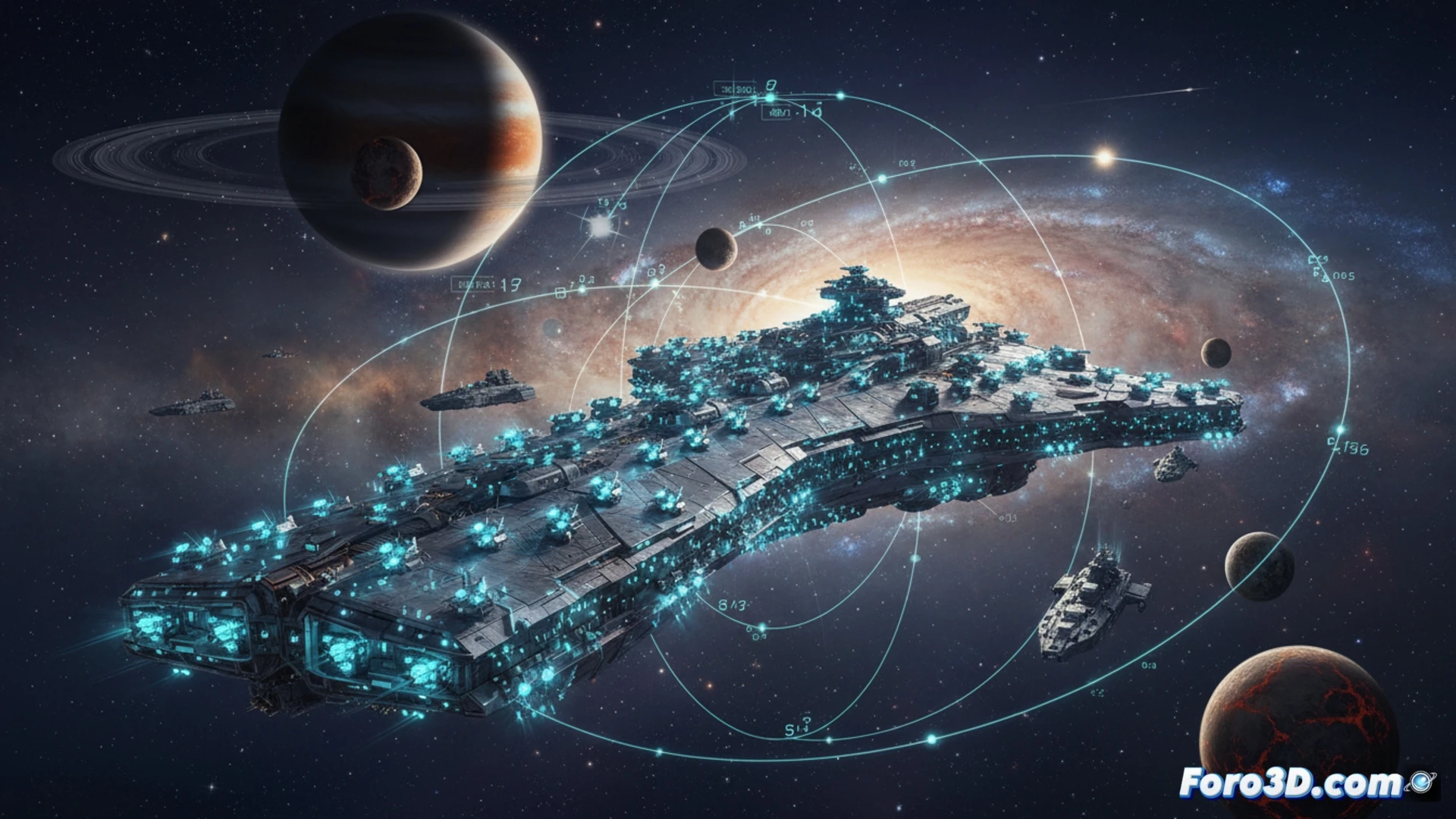
Orbital simulation and dynamic LOD by sector 🌌
The biggest technical challenge of Iron Engine 3 is the constant relocation of planets in the game space. While in Unity or Unreal Engine a strategy map is based on fixed coordinates, here each body follows an elliptical trajectory calculated per frame. To avoid a performance collapse, the engine implements a level of detail (LOD) system by gravitational sector: distant planets are simplified to spheres with low-resolution textures, while nearby ones receive full shading and line-of-sight occlusion calculation. Capital ships, for their part, are not a single mesh; each turret is treated as an independent entity with its own targeting and animation system, using GPU instancing to avoid saturating the CPU with draw calls. This allows a ship like the Kol Battleship to display its 48 functional turrets without sacrificing 60 FPS in fleets of a hundred ships.
Implications for level design and AI ⚙️
The impact on gameplay is profound. With no fixed positions, attack routes and control zones change during the game, forcing developers to rethink pathfinding AI. Iron Engine 3 solves this with a navigation graph that recalculates in the background each time a planet crosses a critical distance threshold. For modding, this flexibility is a double-edged sword: it allows for living maps, but requires designers to understand basic orbital mechanics. Ironclad has opted for proprietary tools that abstract these calculations, moving away from the standardization of engines like Unity, but gaining precise control over spatial simulation.
How does Iron Engine 3 achieve the balance between simulating real orbits and real-time strategic gameplay without compromising performance in massive turret engagements?
(PS: game jams are like weddings: everyone is happy, no one sleeps, and you end up crying)