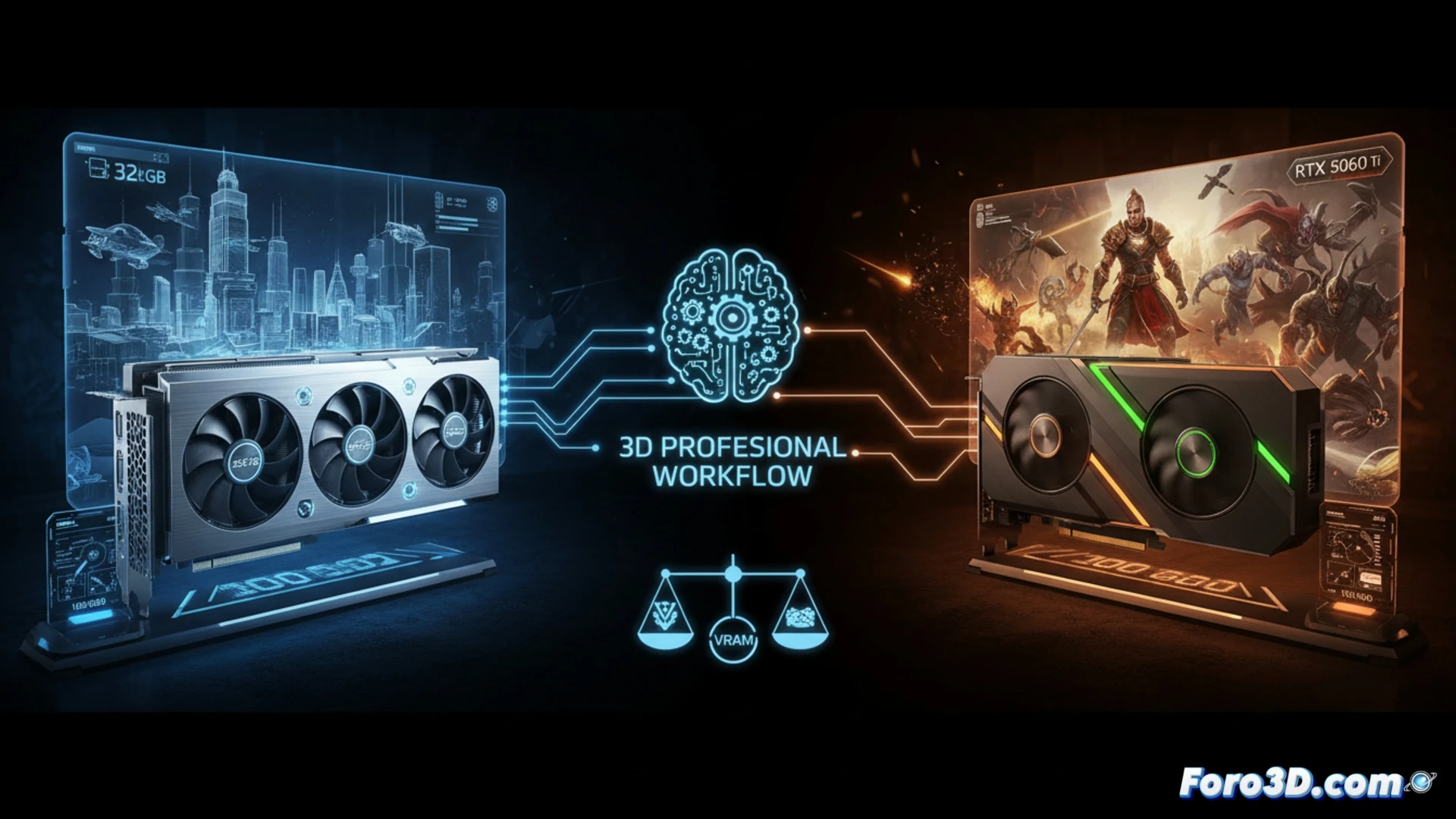
The arrival of the Intel Arc Pro B70, priced at 1000 euros and featuring 32 GB of VRAM, has sparked controversy in the gaming sector, but for the professional 3D hardware user, the equation changes radically. While its gaming performance is comparable to a cheaper NVIDIA RTX 5060 Ti, the true value of this GPU lies in its massive memory capacity for intensive workflows in modeling, rendering, and simulation. We analyze whether the 32 GB justify the investment compared to mass-market consumer options.
Professional benchmarks: Blender, Unreal Engine, and local AI workloads 🎯
In applications like Blender, the Arc Pro B70 shows a notable improvement over previous Intel generations, but in pure rendering cycles (Cycles), the RTX 5060 Ti, with its more mature CUDA architecture, typically maintains a 10% to 15% advantage. However, Intel's true strength emerges in scenes with high polygon density and 8K textures that saturate the 8-12 GB of the competition. In Unreal Engine 5, when loading levels with Lumen and Nanite, the 32 GB allow maintaining smoothness in the viewport without swapping data to system RAM, a critical factor in complex projects. For local AI workloads, such as Stable Diffusion with large models or fine-tuning, the extra VRAM enables processing higher resolution image batches without memory errors, a clear limitation on the RTX 5060 Ti. In physics and particle simulation tasks, where geometry buffers quickly consume VRAM, the Intel offers a working margin that its rival cannot match.
Smart investment or technical whim? 🤔
For the 3D professional working with heavy assets, complex simulations, or local AI model training, the Arc Pro B70 makes sense as a productivity tool. The 32 GB of VRAM allow keeping complete projects open without bottlenecks, something an RTX 5060 Ti cannot guarantee. However, for the user who prioritizes fast batch rendering or compatibility with NVIDIA proprietary plugins, the consumer option remains more cost-effective. Ultimately, the Intel is not a card for gamers, but a specialized workstation that justifies its price in environments where memory is the most valuable resource.
How does Intel justify the 1000 euros of the Arc Pro B70 against the RTX 5060 Ti when the 32 GB of VRAM are essential for professional 3D workloads, yet irrelevant for the gaming that dominates the market?
(PS: If your computer is smoking when opening Blender, maybe you need more than a fan and faith)