Infernax is a clear example of how indie development can merge retro aesthetics with modern technology to create a unique visual impact. Using Unity as the main engine and Aseprite for sprite creation, the game achieves a faithful homage to the NES era, but with a layer of violence and destruction that the original console could never process. This article breaks down the technical techniques behind this visual paradox.
Limited palettes and modern particles in Unity 🎮
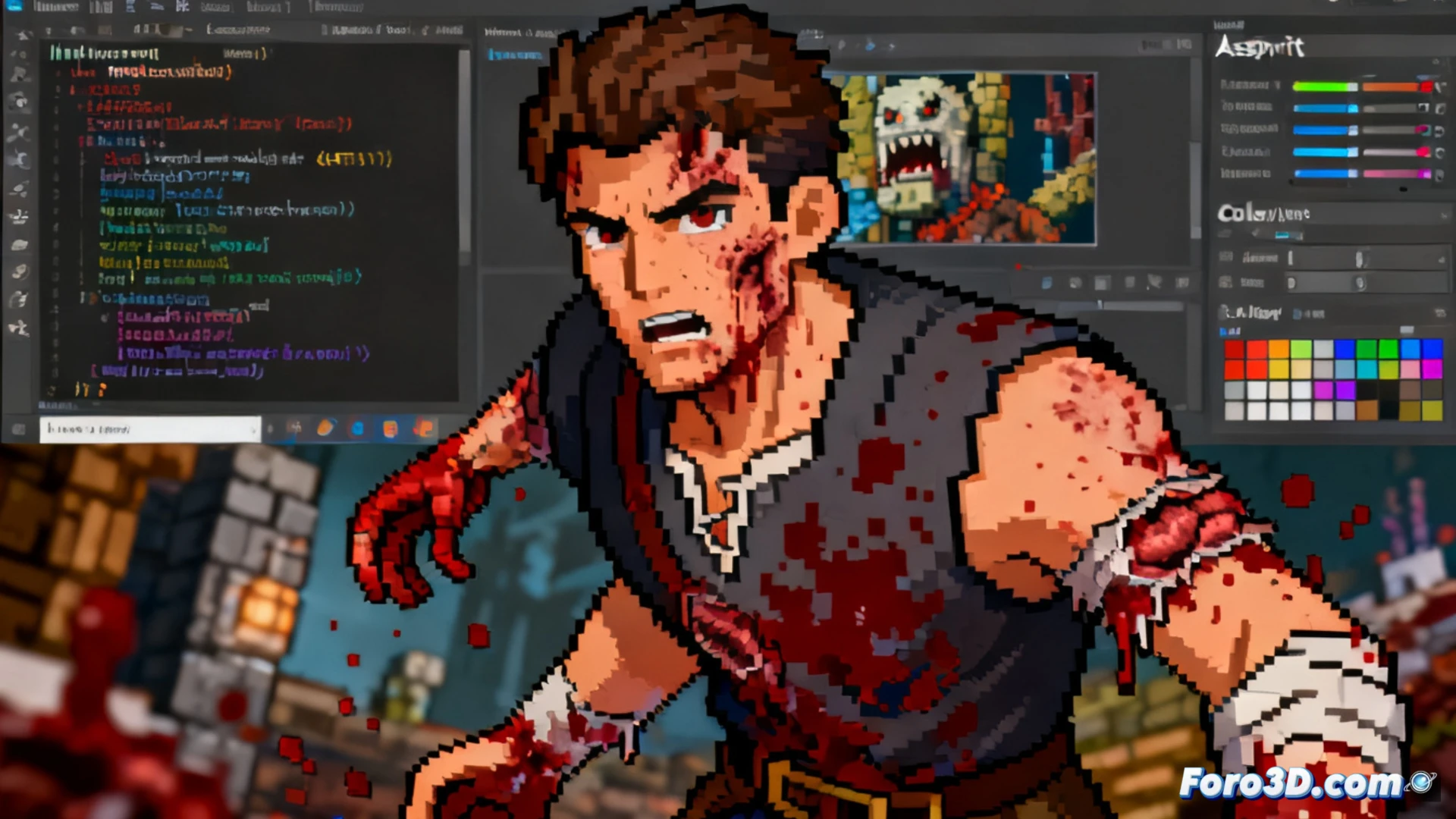
The technical secret of Infernax lies in the discipline of the limited palette. The sprites, drawn in Aseprite, strictly respect the NES 64-color palette, forcing developers to optimize each hue to convey blood and metal. However, the magic happens in Unity. The engine handles a particle system (Particle System) that, instead of using detailed sprites, employs small, low-resolution red squares that simulate splatters. By combining them with Unity's 2D physics (Rigidbody2D), these particles react to the environment, colliding with walls and floors, generating a sense of weight and chaos that breaks the illusion of being in a simple 8-bit game. The key is scaling the resolution of the particle textures to match the background pixel art, avoiding the blurry image effect that would ruin the retro immersion.
Tips for indies seeking visual impact 💡
For developers wanting to emulate this style, the main advice is not to underestimate the power of a reduced palette. In Aseprite, work with indexed color modes and limit saturation to maintain consistency. In Unity, avoid using realistic dynamic lights; instead, use simple shaders that modify the color of sprites when taking damage, simulating the NES flicker. Finally, for gore, remember that less is more: eight well-animated red pixels have more impact than an HD blood texture. Optimizing particle rendering using Object Pooling is vital to maintain stable 60 fps without sacrificing the carnage.
How does Infernax balance the creative freedom of pixel art in Aseprite with the technical limitations of Unity to represent gore expressively without losing the 8-bit aesthetic?
(PS: 90% of development time is polishing, the other 90% is fixing bugs)