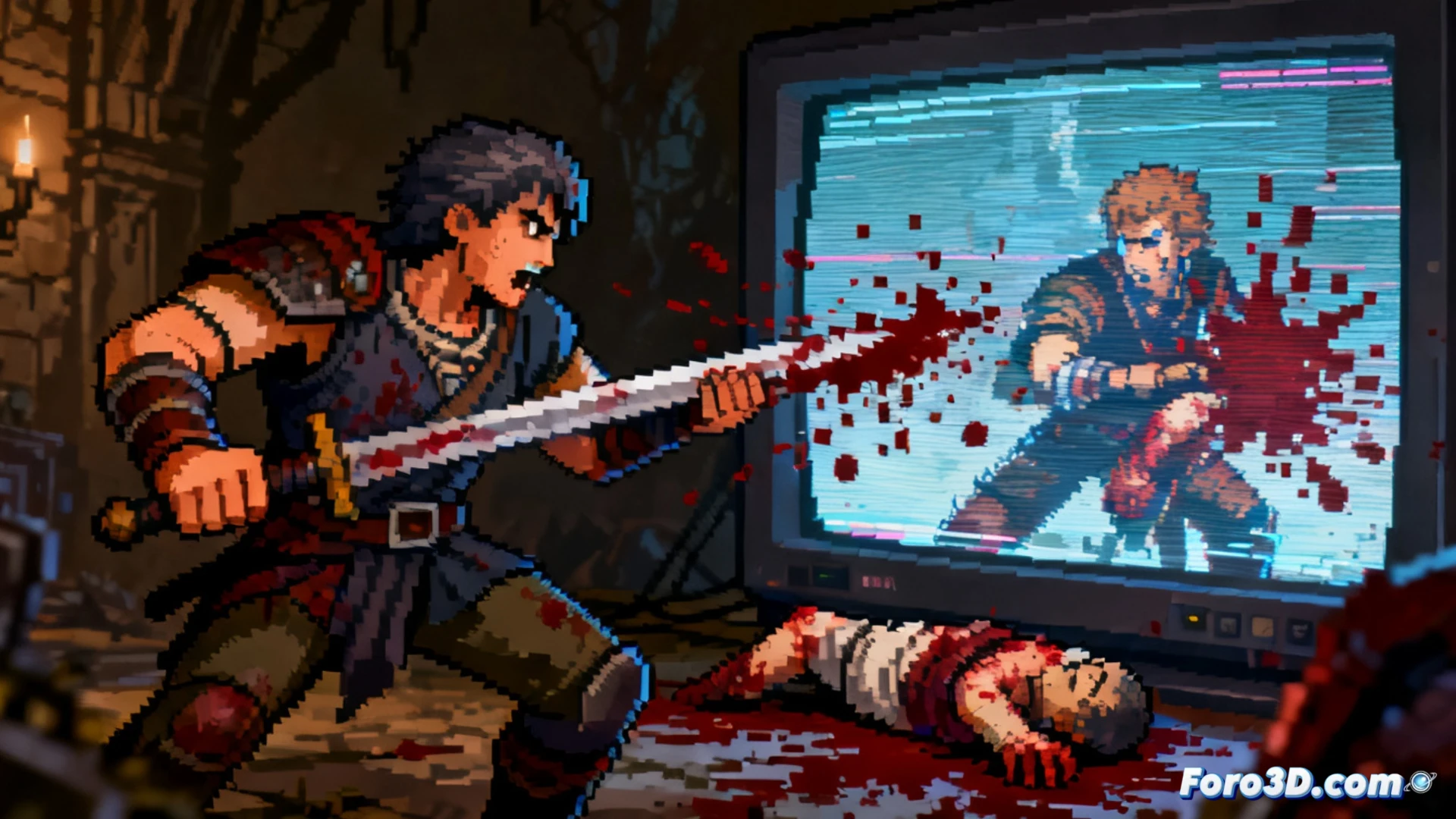
Infernax is not just a homage to NES classics; it's a masterclass in tricking the human eye into believing it's seeing a 1990 cartridge with modern hardware capabilities. The trick lies in an art pipeline that respects the technical limitations of the 8-bit era (16x16 sprites, 56-color palettes) but applies real-time particle effects and sprite deformation (vertex displacement) from Unity. This article breaks down the studio's custom emulation framework and how Aseprite becomes the Swiss Army knife for achieving that signature pixelated gore.
Technical Pipeline: Forced Palettes and Destruction Shaders 🎮
The Infernax development team built a custom framework on top of Unity that emulates the limitations of the NES PPU (Picture Processing Unit). This means that, although the engine can handle 16 million colors, the game forces the palette to a maximum of 56 global colors, with a strict limit of 4 colors per sprite. This is where Aseprite comes in: each dismemberment or explosion animation is drawn respecting this master palette, but exported with separate layers so Unity can apply a deformation shader. The result is that the blood is not a pre-rendered animated sprite, but a particle system that uses Aseprite textures (8x8 pixels) with a shader that scales and tints them in real-time, simulating the violence of a modern game without breaking the retro illusion. For indie developers, the key is to avoid using bilinear filtering and to program a rendering system that prioritizes the sharpness of the square pixel (point filtering).
The Indie Lesson: Fewer Colors, More Impact 💀
Infernax demonstrates that limitation is not an enemy, but a design tool. By restricting the palette to 56 colors, the team forces the player to focus on silhouette and animation, not superficial details. The gore works precisely because it is unexpected within such a restrictive visual framework. The advice for developers is clear: don't try to imitate the 8-bit style using compressed HD textures; instead, build your own color rule system in Aseprite and program a renderer in Unity that respects those rules as if they were hardware physics. The magic of Infernax lies not in what it adds, but in what it chooses to omit.
As an indie developer, what pixel art and Unity programming techniques do you recommend for achieving impactful 8-bit gore without sacrificing performance and the retro aesthetic of classic NES games?
(PS: a game developer is someone who spends 1000 hours making a game that people complete in 2)