A recent study has uncovered an alarming reality: wildfires in the Arctic and boreal forests are burning soils that have stored carbon for thousands of years. This carbon, trapped in deep layers formed by organic matter under cold and humid conditions, is now being massively released into the atmosphere. The resulting CO2 emissions are far higher than previous estimates, forcing a rethink of current climate models. The phenomenon triggers a dangerous cycle: global warming intensifies wildfires, and these, in turn, accelerate climate change by releasing greenhouse gases.
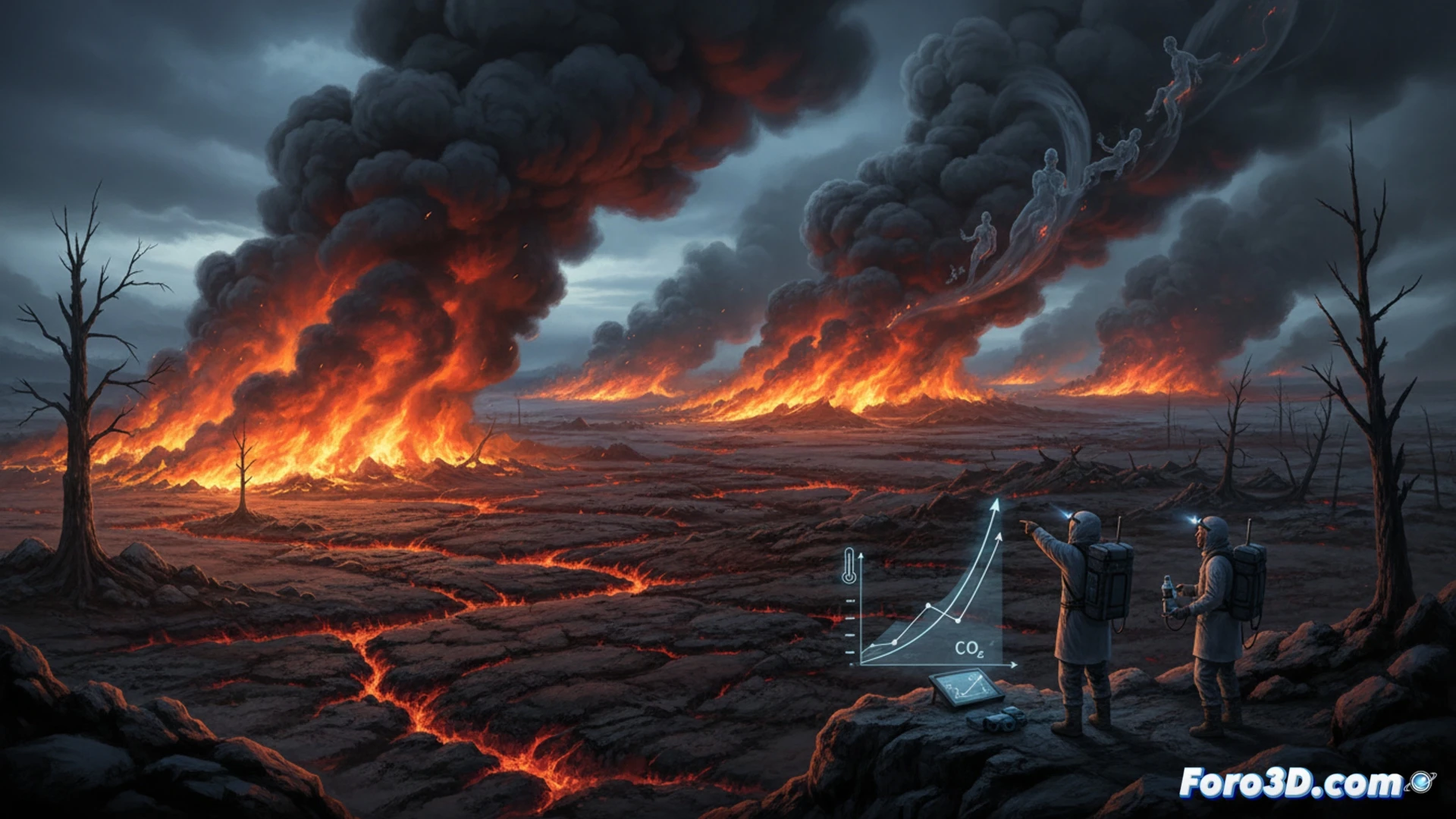
3D visualization of the disaster: fire penetration into deep soils 🔥
To understand the magnitude of the problem, the progression of an Arctic wildfire can be modeled in 3D. The simulation shows how the fire, fueled by record temperatures, is not limited to surface vegetation. Using a three-dimensional soil profile, the penetration of flames into layers of peat and permafrost, which act as reservoirs of organic carbon, is visualized. Overlaid heat maps reveal the internal temperature of the ground, while animated graphs compare emissions estimated by old models (low) with actual ones (exponential). This tool allows researchers to predict climate feedback: the more burning, the more CO2, and the more CO2, the greater the likelihood of new wildfires.
A frozen legacy vanishing into smoke 💨
The loss of these millennial soils represents not only an ecological catastrophe but also a death sentence for global climate goals. Each wildfire in the Arctic is not an isolated event; it is a fuse that detonates a carbon stock that nature took millennia to accumulate. Scientists warn that if this trend continues, the coming decades will see a massive release of CO2 impossible to contain with current strategies. The question is no longer whether the ice is melting, but how much ancient carbon we are willing to let escape before the feedback cycle becomes unstoppable.
It is possible to stop the climate feedback cycle of Arctic wildfires without drastically reducing global carbon emissions
(PS: Simulating catastrophes is fun until your computer crashes and you are the catastrophe.)